AI.Prompt.Architecture.Analyzers
1.18.0
dotnet add package AI.Prompt.Architecture.Analyzers --version 1.18.0
NuGet\Install-Package AI.Prompt.Architecture.Analyzers -Version 1.18.0
<PackageReference Include="AI.Prompt.Architecture.Analyzers" Version="1.18.0" />
<PackageVersion Include="AI.Prompt.Architecture.Analyzers" Version="1.18.0" />
<PackageReference Include="AI.Prompt.Architecture.Analyzers" />
paket add AI.Prompt.Architecture.Analyzers --version 1.18.0
#r "nuget: AI.Prompt.Architecture.Analyzers, 1.18.0"
#:package AI.Prompt.Architecture.Analyzers@1.18.0
#addin nuget:?package=AI.Prompt.Architecture.Analyzers&version=1.18.0
#tool nuget:?package=AI.Prompt.Architecture.Analyzers&version=1.18.0
AI.Prompt.Architecture.Analyzers
Roslyn analyzers for enforcing architecture, naming conventions as well as limiting LOCs generated by AI coding agents in .NET solutions.
Installation
dotnet add package AI.Prompt.Architecture.Analyzers
Adding the package drops a default .editorconfig at the consumer project root (via contentFiles). It ships sensible defaults; the sections below explain how to override each rule from your own .editorconfig.
Rules at a glance
| ID | Rule | Configured by |
|---|---|---|
ARCH001 |
Model type is placed in the folder expected by its suffix | architecture_analyzer.model_suffix / architecture_analyzer.model_folder / architecture_analyzer.model_conventions |
ARCH002 |
The file name matches the type name | (no configuration) |
ARCH003 |
Only whitelisted suffixes are allowed inside a given folder / a module carries provider contracts | architecture_analyzer.model_folder_allowed_suffixes |
ARCH004 |
A module project does not implement its own provider interfaces | (auto a project counts as a module when its assembly name ends with .Module) |
ARCH005 |
DTO properties are alphabetically ordered (identifier-like properties excluded) | (no configuration) |
ARCH006 |
Class body stays within its LOC ceiling | architecture_analyzer.loc_max_lines_per_class |
ARCH007 |
Method body stays within its LOC ceiling | architecture_analyzer.loc_max_lines_per_method |
ARCH008 |
Solution respects the global "% of code added per prompt" budget | architecture_analyzer.loc_budget_percent_global + shipped MSBuild target |
ARCH009 |
Project respects the per-project "% of code added per prompt" budget | architecture_analyzer.loc_budget_percent_project + shipped MSBuild target |
ARCH010 |
Project contains the folder(s) required by its own convention (e.g. HR.Infrastructure must have Models/Entities) |
architecture_analyzer.required_project_folders |
ARCH011 |
Class methods are alphabetically ordered | (no configuration) |
ARCH012 |
Forbidden cross-module reference | architecture_analyzer.module_reference_barrier |
ARCH013 |
Variable name is at least N characters long | architecture_analyzer.min_variable_name_length |
ARCH014 |
Class name is at least N characters long | architecture_analyzer.min_class_name_length |
ARCH015 |
Method name is at least N characters long | architecture_analyzer.min_method_name_length |
ARCH016 |
A class whose name matches pattern X must not accept a method parameter whose type matches pattern Y | architecture_analyzer.method_argument_type_barrier |
ARCH017 |
Forbids + / += string concatenation use a StringBuilder |
(no configuration) |
ARCH018 |
Forbids string interpolation ($"...") use a StringBuilder |
(no configuration) |
ARCH019 |
Detects a method whose body duplicates another one (copy/paste, renamed) | architecture_analyzer.duplicate_code_similarity_percent / ..._min_tokens |
ARCH020 |
A type must not reuse the name of a type already available from a referenced project | architecture_analyzer.duplicate_type_name_scope / ..._exceptions |
ARCH021 |
A prompt that adds production code must add tests too (solution-wide ratio) | architecture_analyzer.min_test_lines_percent + shipped MSBuild target |
ARCH022 |
Ratchet a method's cyclomatic complexity may never increase | architecture_analyzer.complexity_ratchet_allowed_increase + shipped MSBuild target |
ARCH023 |
Ratchet, strict mode complexity rising in a churn hotspot (error) | architecture_analyzer.hotspot_churn_percentile / ..._churn_window_days |
ARCH024 |
Inferred conventions a new type deviates from a regularity the project already follows (learned, not configured) | architecture_analyzer.convention_min_support / ..._min_ratio / ..._ignore |
ARCH025 |
Related-test gate a member this change adds or grows must be exercised by a test the same change adds (not just any test) | architecture_analyzer.test_link_min_added_lines + shipped MSBuild target |
ARCH027 |
Oscillation this change re-adds a block of code a recent commit removed (warning, temporal) | architecture_analyzer.oscillation_window_commits + shipped MSBuild target |
Configuring the rules
Overriding severity (works for every rule)
Every diagnostic is emitted as an error by default, except ARCH022 which is a warning (a complexity increase is sometimes legitimate see its section). Downgrade or silence one from any .editorconfig:
[*.cs]
# error | warning | suggestion | silent | none
dotnet_diagnostic.ARCH006.severity = warning
dotnet_diagnostic.ARCH008.severity = suggestion
dotnet_diagnostic.ARCH009.severity = none
Localization: the analyzer ships a French neutral catalog and an English satellite (en/Architecture.Analyzer.resources.dll). The message rendered follows Roslyn's UI culture no .editorconfig knob is needed.
ARCH001 Model type in the expected folder
Both suffix and folder can be tuned. Folder separators accept /, \, or > (> is handy in .editorconfig where / can be significant).
Single convention (default: BusinessModel → Models/Business)
[*.cs]
architecture_analyzer.model_suffix = ViewModel
architecture_analyzer.model_folder = Presentation/ViewModels
Multiple conventions in one line this key, when present and non-empty, replaces the two above:
[*.cs]
architecture_analyzer.model_conventions = BusinessModel=Models/Business;DataModel=Models/Data;ViewModel=Presentation/ViewModels
The matching convention is the one with the longest suffix that matches the type name (so CustomerBusinessModel matches BusinessModel, not a shorter Model).
ARCH002 File name matches type name
No configuration. public class CustomerBusinessModel must live in CustomerBusinessModel.cs. Fix by renaming either the file or the type.
ARCH003 Whitelist of suffixes per folder
Restrict which suffixes are allowed inside specific folders. Same folder separator flexibility as ARCH001; commas separate multiple suffixes for the same folder; semicolons separate the folder rules.
[*.cs]
architecture_analyzer.model_folder_allowed_suffixes = \
  Models/Business=BusinessModel;\
  Models/Data=DataModel,DataProvider;\
  Presentation/ViewModels=ViewModel
With the config above, a CustomerDataModel under Models/Business/ reports ARCH003 because Models/Business only allows BusinessModel. When several folder rules match, the deepest wins (so Models/Business/Sub overrides Models). Types under a folder that has no rule are ignored.
Note: ARCH003 is reused by the ModuleProviderAnalyzer for "module projects must ship at least one provider interface under Models/Data/Providers/" no .editorconfig needed there (see next section).
Strict per-project file allow-list. ARCH003 is also reused to whitelist which files may live in a project. When a project's assembly name matches a configured pattern, every .cs file matching none of the allowed patterns is reported. A pattern without a separator matches the file name anywhere (*Dto.cs); a pattern with a / matches the path relative to the project root (Models/*BusinessModel.cs allows that name only under Models/). * matches within one folder segment, ** across segments:
[*.cs]
architecture_analyzer.project_allowed_files = \
  *.Contracts=Models/*Dto.cs,*Request.cs;\
  *.Module=Models/*BusinessModel.cs
So in a *.Module project, Models/CustomerBusinessModel.cs is allowed, but the same file under Services/, or a Models/Helper.cs, is reported. Projects with no matching pattern are never restricted, and generated files are ignored. Folder-relative patterns rely on the project directory, exposed to the analyzer as a build property; when it is unavailable the pattern is matched as a path suffix instead.
ARCH004 Providers must not be implemented inside a module project
Fires automatically when:
- the compiled project's assembly name ends with
.Module, and - a class in that project implements an interface declared under
Models/Data/Providers/of the same module.
To fix, either move the implementation to an infrastructure project outside the module, or remove the .Module suffix from the project.
ARCH005 DTO properties ordered alphabetically
Applies to types whose name ends with BusinessModel, DataModel, or ViewModel. Identifier-like properties (containing Id) are ignored in the ordering check. No configuration; just reorder the properties.
ARCH006 / ARCH007 Class / method size ceiling
Both default to 20 lines. Override them per project or per folder:
# Project-wide
[*.cs]
architecture_analyzer.loc_max_lines_per_class = 60
architecture_analyzer.loc_max_lines_per_method = 25

# Loosen a specific folder that hosts generated code
[src/Generated/**.cs]
architecture_analyzer.loc_max_lines_per_class = 200
architecture_analyzer.loc_max_lines_per_method = 200
Set the value to a positive integer; anything else falls back to the default (20).
ARCH008 / ARCH009 LOC budget "% of code added since HEAD"
These two rules cap the cumulative lines of code added since HEAD per project (ARCH009) and per solution (ARCH008) as a percentage of the existing tracked C# code base. The percentages are read from .editorconfig; the actual line counts are computed by the MSBuild target shipped with the package (build/Architecture.Analyzer.targets), which shells out to git at build time and forwards the values through CompilerVisibleProperty.
Enable the budgets in .editorconfig:
[*.cs]
# Per-project budget: any project that grows by more than 3% of its current size errors out.
architecture_analyzer.loc_budget_percent_project = 3

# Solution-wide budget: any single prompt that grows the whole solution by more than 2% errors out.
architecture_analyzer.loc_budget_percent_global = 2
Both are integers. Omitting a key disables the corresponding rule. The budget itself is ceil(baseline * percent / 100), so a 1000-line project with a 3% budget rejects any change that adds more than 30 lines.
Prerequisites for the MSBuild target:
gitmust be onPATHat build time (the target no-ops silently if it isn't, so budgets stay quiet in odd environments).- The build must run from inside a git working tree.
Manual override (useful in tests or CI without git): feed the four inputs directly as MSBuild properties. They're already declared CompilerVisibleProperty, so setting them from the command line or from Directory.Build.props is enough to bypass the git task:
dotnet build /p:ArchitectureLocProjectBaselineLines=1000 \
             /p:ArchitectureLocProjectAddedLines=15 \
             /p:ArchitectureLocSolutionBaselineLines=50000 \
             /p:ArchitectureLocSolutionAddedLines=120
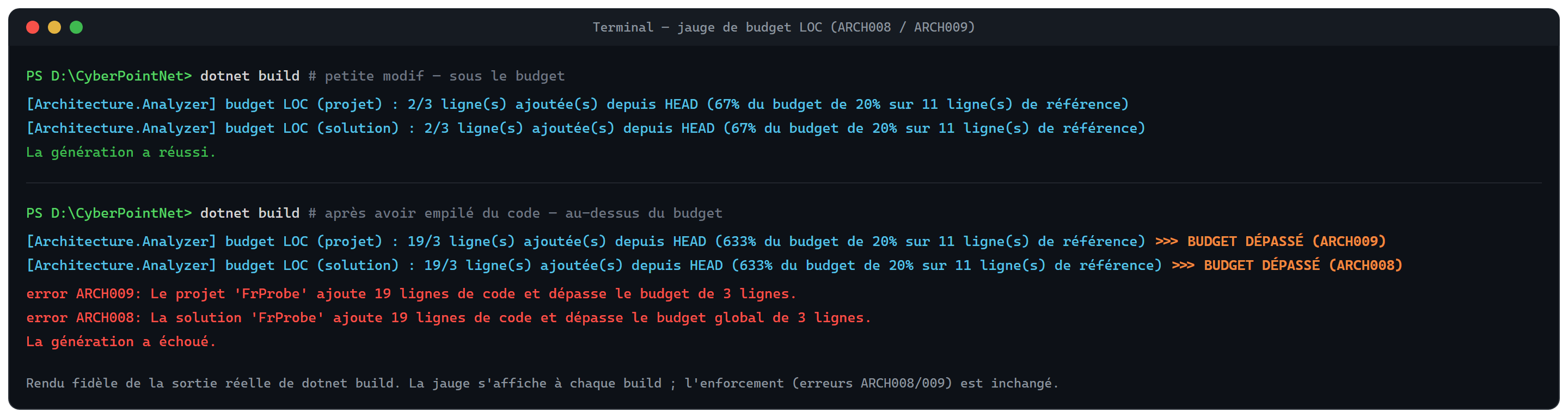
Per-build gauge. Whenever a budget percentage is set, the shipped MSBuild target prints the current usage on every build (project and solution), e.g. [Architecture.Analyzer] LOC budget (project): 12/50 line(s) added since HEAD (24% of the 20% budget on 250 baseline line(s)). This makes the pressure visible continuously not only when the budget is blown so you can course-correct before hitting the wall. Going over adds a >>> OVER BUDGET (ARCHxxx) marker (and ARCH008/ARCH009 still fail the build). The message reads the same loc_budget_percent_* keys from your .editorconfig, and is suppressed during IDE design-time builds. Like the ARCHxxx diagnostics, it follows the build's UI culture (French by default, English when the UI culture is English).
ARCH010 Required folder per project
Enforce that a given project (matched by assembly name) contains at least one file under a specific folder. Same folder separator flexibility as ARCH001; commas separate multiple required folders for the same project; semicolons separate the project rules.
[*.cs]
architecture_analyzer.required_project_folders = \
  HR.Infrastructure=Models/Entities;\
  HR.Module=Models/Data,Presentation/ViewModels
With the config above, the HR.Infrastructure project reports ARCH010 (once, at compilation end) unless at least one .cs file lives under Models/Entities. Projects with no matching rule are ignored.
ARCH011 Methods ordered alphabetically
Applies to every class. Methods must be declared in alphabetical order (ordinal comparison). No configuration; just reorder the methods.
ARCH012 Module reference barrier
Forbid one module from referencing another. The syntax B>A means "B must not reference A". Multiple rules are separated by ; (consistent with the analyzer's other multi-rule keys); , is also accepted.
[*.cs]
architecture_analyzer.module_reference_barrier = Portal>Domain;Portal>SSO
With the config above, any type in a project whose assembly name matches Portal (e.g. MyApp.Portal) will report ARCH012 if it references a type from a Domain or SSO assembly (e.g. MyApp.Domain).
Module matching is flexible: Portal matches assembly names that equal Portal, start with Portal., or end with .Portal (case-insensitive).
Exempting files (e.g. the composition root). The application entry point legitimately wires modules together, so Program.cs / Startup.cs usually must reference otherwise-forbidden modules. List the files to exclude from the barrier with module_reference_barrier_exceptions (;- or ,-separated). An entry matches by file name (Program.cs) or by path suffix (Portal/Program.cs):
[*.cs]
architecture_analyzer.module_reference_barrier = Portal>Infrastructure
architecture_analyzer.module_reference_barrier_exceptions = Program.cs;Startup.cs
With this config, Program.cs may reference Infrastructure freely while every other file in Portal still reports ARCH012.
ARCH013 / ARCH014 / ARCH015 Minimum name length
Reject identifiers whose name is too short to be descriptive. The three rules are independent and each is opt-in: a rule fires only when its own key is set to a positive integer, and leaving a key unset disables that rule (there is no default minimum).
ARCH013covers variables local variables and fields.ARCH014covers classes.ARCH015covers methods the message reminds the author that a method name must be expressive and reflect the method's intent. Only names the app actually chooses are checked: a method that overrides a base member or implements an interface member declared in a referenced assembly (NuGet, Microsoft, etc.) is exempt, because that name is imposed by the external contract. Overrides and interface implementations of the app's own base classes or interfaces are still checked (the name was chosen in your code).
[*.cs]
# A variable name must be at least 3 characters long.
architecture_analyzer.min_variable_name_length = 3

# A class name must be at least 4 characters long.
architecture_analyzer.min_class_name_length = 4

# A method name must be at least 4 characters long.
architecture_analyzer.min_method_name_length = 4
With the config above, int a = ...; reports ARCH013, class Ab { } reports ARCH014 and void Go() { } reports ARCH015, while int total = ...;, class Order { } and void Execute() { } pass. Because the rules read separate keys, you can enable one without the others. As with every rule, the folder-scoped .editorconfig mechanism lets you loosen or disable them for specific paths (e.g. generated code):
[src/Generated/**.cs]
dotnet_diagnostic.ARCH013.severity = none
dotnet_diagnostic.ARCH014.severity = none
dotnet_diagnostic.ARCH015.severity = none
ARCH016 Method argument type barrier
Forbid the methods of a class from accepting a certain kind of object as a parameter, matched by name. The syntax ClassPattern>ForbiddenTypePattern means "a type whose name matches ClassPattern must not declare a method parameter whose type name matches ForbiddenTypePattern". Multiple rules are separated by ; (consistent with the analyzer's other multi-rule keys); , is also accepted. The rule is opt-in: it fires only when the key is set.
Each side is a pattern, and a leading and/or trailing * selects how it matches so you can target a suffix, a prefix, the whole name, or a substring:
| Pattern | Matches | Example |
|---|---|---|
*Module |
name ends with Module (suffix) |
CustomerModule |
Module* |
name starts with Module (prefix) |
ModuleRegistry |
Module |
name is exactly Module (whole name) |
Module |
*Module* |
name contains Module (substring) |
MyModuleHelper |
[*.cs]
# Classes whose name ends with "Module" must not take a parameter whose type ends with "DataModel".
architecture_analyzer.method_argument_type_barrier = *Module>*DataModel
With the config above, any class whose name ends with Module (e.g. CustomerModule) reports ARCH016 when one of its methods declares a parameter whose type ends with DataModel (e.g. void Register(CustomerDataModel model)). The check looks through arrays and generic type arguments, so CustomerDataModel[] and Wrapper<CustomerDataModel> are caught too. Matching is ordinal (case-sensitive), so a CustomerViewModel parameter does not match *DataModel. Only methods declared in a class are checked (records included); interfaces and structs are out of scope, and a generic method's own type parameters (e.g. Register<TDataModel>(TDataModel item)) are never treated as a forbidden type.
ARCH017 No + string concatenation
Forbids concatenating strings with + or += use a StringBuilder instead. Enabled by default; no configuration. A concatenation chain (a + b + c) is reported once, at the top of the chain.
Two cases are deliberately allowed: compile-time-constant concatenations (literal-only expressions such as "a" + "b" and const fields the compiler folds them, they cost nothing at runtime, and a const cannot use a StringBuilder), and user-defined + operators that return a string. Downgrade or silence per path with the usual override:
[*.cs]
dotnet_diagnostic.ARCH017.severity = warning
ARCH018 No string interpolation
Forbids string interpolation ($"...") use a StringBuilder instead. Enabled by default; no configuration. It is a sibling of ARCH017 with its own id, so you can tune the two independently. Each $"..." is one diagnostic (however many holes it has).
Allowed: a hole-free interpolated string ($"plain text") and a compile-time-constant interpolated string (all-constant holes / const fields folded by the compiler, and a const cannot use a StringBuilder).
Interpolation is pervasive (logging, formatting a single value, …), so shipping this as an error is aggressive scope it to the paths you care about, or downgrade it:
[*.cs]
dotnet_diagnostic.ARCH018.severity = warning
ARCH019 Duplicated method bodies
Flags a method whose body has the same shape as another method in the same compilation. The comparison runs on the sequence of token kinds, with identifiers and literal values discarded so renaming the variables does not hide a copy. That is precisely how a coding agent duplicates a helper instead of reusing it.
[*.cs]
# Minimum body size, in tokens, before a method is considered at all. Default: 30.
architecture_analyzer.duplicate_code_min_tokens = 30

# How close two bodies must be to be reported, in percent. 100 = identical shape only. Default: 90.
architecture_analyzer.duplicate_code_similarity_percent = 90
The message names the method to reuse: "C.Second duplicates C.First by 100%: reuse C.First instead of writing a copy." Each pair is reported once, on whichever method comes later in the source.
Never reported: bodies shorter than duplicate_code_min_tokens (a shared shape in a 3-line accessor is not duplication), abstract and interface declarations, and generated code. On very large projects (>4000 candidate methods) the rule automatically narrows to exact structural matches so it stays linear.
Tests repeat structure on purpose (arrange / act / assert), so exclude them unless you explicitly want that signal:
[**/*Tests.cs]
dotnet_diagnostic.ARCH019.severity = none
ARCH021 Tests required for the code a prompt adds
Caps how much production code a prompt may add without tests. The MSBuild target already counts the lines added since HEAD; this rule splits that figure between production and test files and compares the two.
The ratio is deliberately solution-wide, never per project: tests almost always live in a different project, so a per-project check would see "0 test lines" on the module you just grew.
[*.cs]
# For every 100 production lines added, at least 20 test lines must be added. Rule off when absent.
architecture_analyzer.min_test_lines_percent = 20

# Changes smaller than this are exempt  demanding tests for a 3-line fix only breeds filler tests.
architecture_analyzer.test_ratio_min_added_lines = 50

# How a file is recognised as a test file (path substrings / file-name suffixes).
architecture_analyzer.test_file_patterns = /tests/;.tests/;tests.cs;test.cs;spec.cs
A prompt adding 200 production lines and 10 test lines reports: "adds 200 production line(s) for only 10 test line(s) (ratio 5%, minimum 20%): add tests before going further."
Never reported: a prompt that adds no production line (touching only tests), and any change below test_ratio_min_added_lines. Like ARCH008/ARCH009 the counter resets at each commit, so the budget is per increment. The per-build gauge prints the current ratio even when it passes, so the pressure is visible before the wall.
ARCH020 A type name already taken by a referenced project
Do not declare a type whose name already exists in something you reference. If you could already see that type and you write another one with the same name, you copied it instead of using it.
[*.cs]
# Which assemblies count as "ours". Defaults to the first segment of the compiled assembly name,
# so CyberPointNet.Portal compares itself only against CyberPointNet.*  never against the BCL.
architecture_analyzer.duplicate_type_name_scope = CyberPointNet

# Names allowed to repeat.
architecture_analyzer.duplicate_type_name_exceptions = Program;Startup
Why it complements ARCH019. ARCH019 compares method bodies, so it loses sight of a copy as soon as the two drift apart precisely when the problem gets worse (several behaviours under one name). ARCH020 compares the name, which does not drift. It is the net that catches ageing duplication.
It filters itself. Two independent applications that do not reference each other cannot see each other's types, so a Portal.AccountController and an SSO.AccountController are never reported that is normal MVC convention. Only "I had access to the original and redeclared it anyway" surfaces.
Never reported: nested types (their name is already qualified by the enclosing type), internal types of referenced assemblies (they could not have been reused), a different generic arity (Wrapper<T> vs Wrapper), and anything listed in the exceptions. Namespaces are deliberately ignored: the colliding name is the signal.
ARCH022 The complexity ratchet
A method's cyclomatic complexity may stay equal or go down. Never up.
Unlike a ceiling ("no method above 20"), a ratchet needs no arbitrary threshold and no baseline file: it only ever looks at what this change made worse. That is what makes it switchable on, as-is, on a legacy code base of any size the existing mess becomes the reference point, and you simply stop adding to it.
[*.cs]
# How much a method may grow before it is reported. 0 (the default) is a strict ratchet.
architecture_analyzer.complexity_ratchet_allowed_increase = 0
Why a warning and not an error. Unlike a duplicate or a name collision, a complexity increase is sometimes the legitimate evolution of the software: a new business case, a new failure mode to handle. Blocking the build would push people to split methods artificially just to satisfy the tool producing worse code than the one it prevents. Because the ratchet has no backlog, the warning stays rare and therefore visible. Escalate it where you want it to block, typically in CI only:
dotnet build -warnaserror:ARCH022
How the comparison works. The shipped MSBuild target extracts the HEAD version of every changed .cs file (git show HEAD:<file>) into obj/, and hands them to the analyzer as AdditionalFiles. The analyzer parses both versions and compares them method by method. Methods are matched on type + name + parameter count, never on line numbers, so moving a method inside its file does not lose its history.
Complexity is the classic count: 1, plus one per decision point (if, loops, case, catch, &&, ||, ?:, ??, switch arms, when). else adds nothing it belongs to the if already counted.
Never reported: a method absent from HEAD (it is new, so it degraded nothing), a file that did not change, and anything below the allowed increase. As with the LOC budget, the reference is HEAD, so committing moves the ratchet forward.
ARCH023 The ratchet goes strict in a hotspot
A file the team keeps touching and that keeps growing more complex is where your next incident comes from. ARCH023 is the same regression as ARCH022, reported as an error instead of a warning when it happens in such a file.
[*.cs]
# Files above this churn percentile are hotspots. 90 = the top 10% most-touched files.
architecture_analyzer.hotspot_churn_percentile = 90

# How far back the history is counted.
architecture_analyzer.churn_window_days = 90
Churn does not measure anything it selects. This is the key design point: churn can only ever grow (every commit increases it), so it could never be ratcheted itself. Instead it is used as a targeting mechanism: it decides which files get the strict treatment. The rule therefore reads as "you may add complexity, except where it is dangerous" which is precisely the answer to the objection that complexity is sometimes a legitimate evolution.
The count comes from git log --no-merges --since=<window> --name-only, written once per repository into the system temp folder and shared by every project of the solution rather than recomputed for each. A file below the minimum (3 recent changes) is never a hotspot, however small the repository.
ARCH024 Conventions inferred from the code itself
Every analyzer makes you declare your conventions. But a code base already has conventions they are just implicit. ARCH024 learns them and flags the types that break them:
Out of 18
*Providertypes, 17 share folder =Infrastructure/Providers;SmtpProviderhasServices. Align it with the convention, or declare the exception.
Nobody wrote that rule. It was observed.
How it learns. For each type, the analyzer extracts a few traits folder, namespace, kind (class/record/struct), sealed, static, accessibility, base type and groups types by the suffix of their name (CustomerBusinessModel is grouped both as *BusinessModel and, more broadly, as *Model; the more specific suffix wins). Whenever a suffix has enough examples and a trait shares one value in at least 90% of them, that is a convention.
What it enforces. Conventions are learned on every type of the project the legacy majority defines the norm but deviations are reported only in the files the current change touched. Existing outliers are never surfaced; only new code must conform. Without the change list produced by the shipped MSBuild target, the rule stays silent.
[*.cs]
architecture_analyzer.convention_min_support = 5    # examples needed before a regularity counts
architecture_analyzer.convention_min_ratio = 90     # share the majority value must reach
architecture_analyzer.convention_ignore = Provider>folder;Model>sealed   # conventions to leave alone
Additive to ARCH001 / ARCH003. The explicit rule wins: for any suffix you configured in model_suffix, model_conventions or model_folder_allowed_suffixes, no folder convention is inferred, so a deviation is never reported twice. Every other trait of that suffix is still learned.
Why a warning. The majority can be the mistake, and only a human can tell. The message shows its evidence "17 of 18" precisely so that call takes ten seconds. A majority of "not sealed", "not static" or "no base type" is just the default and is never treated as a convention.
ARCH025 The related-test gate
ARCH021 measures the volume of test lines a prompt adds. An AI agent games it by writing tests anywhere an unrelated file, a padded test, a test with no assertion. ARCH025 closes that hole: the test must actually be about the code this change touched.
[*.cs]
architecture_analyzer.test_link_min_added_lines = 3
A production member is accountable when this change makes it new (with at least the floor of body lines) or grows it by at least the floor, and it is not private. An accountable member T.M is satisfied only when some test method:
- was added or modified by this same change (a whitespace edit to an old test does not count the comparison ignores trivia),
- carries a test attribute and is not
[Skip]/[Ignore]/[Explicit], - contains an assertion (
Assert,Should,Verify,Received…), - invokes
Mnot insidenameof/typeof, not inside a swallowingtry/catch, - in a file that references the concrete type
Tin a real type position, so mocking the interface (Substitute.For<IT>()) does not count.
Otherwise:
error ARCH025: 'OrderService.Apply' was added or modified by this change but no added or modified test exercises it (0 changed test(s) reference OrderService…): add a test that constructs OrderService and asserts on the result of Apply, then rebuild.
Measures movement, not state. Only members this change makes new or grows are ever examined, so switching it on in a legacy repository reports nothing until the next change no backlog. It reuses the HEAD copies, changed-files list and test-file classification the shipped MSBuild target already produces; the target also hands the changed test files to the production compilation, which never compiles them.
Honest limits. Being static, it cannot judge that an assertion is meaningful (a Assert.True(true) next to the call passes) or that the call is actually executed. It flags integration/DI/fixture tests that exercise the code without naming the type; scope those out with test_link_exclude_paths or a folder-scoped dotnet_diagnostic.ARCH025.severity = none. Property accessors are not yet accountable. Off by default; enable per repository.
ARCH027 Oscillation
When an AI agent goes in circles, it re-adds code that a recent commit removed. No stateless tool can see this: it needs the last few commits, not the current snapshot. ARCH027 reports it, as a plain fact.
[*.cs]
architecture_analyzer.oscillation_window_commits = 5
The shipped MSBuild task collects the blocks of code removed in the last N commits (via git log -p), and the blocks this change adds (working tree plus untracked files). A block is three or more consecutive non-trivial lines, normalized so a re-add with different indentation still matches. When an added block hashes to a removed one:
warning ARCH027: This change re-adds a block of code that commit a1b2c3d (simplify the retry loop) removed 2 commit(s) ago.
It only states the fact. It makes no attempt to tell a deliberate revert from thrashing both look the same, and only you know which. That is why it is a warning, not an error. Keep the window small (a few commits) so it targets churn within a working session rather than old history. Off by default; enable per repository.
Impact history attribute each change to its prompt
Every change an AI agent makes starts with a prompt. This feature keeps a local CSV that records, for each change, what the change did and the prompt that caused it so git blame gains a "why", and you can see which prompt pushed a change over budget or dropped the test ratio.
Turn it on (it is off by default, because it writes files into your repository):
[*.cs]
architecture_analyzer.impact_history_enabled = true
On every real build with changes since HEAD, the shipped MSBuild target appends a row to .architecture/impact-history.csv at the repository root:
timestamp_utc,prompt,files_changed,added_production_lines,added_test_lines,test_ratio_percent,project_budget_percent,solution_budget_percent
2026-09-14T13:20:05Z,"add session rotation to the module",7,312,40,12,20,10
One row per prompt, not per build. A single prompt triggers many builds; a row is written only when the prompt or the diff changed since the last row, so the file stays a timeline of prompts, not build noise. It is skipped during IDE design-time builds.
Where the prompt comes from. The build reads .architecture/current-prompt.txt at the repo root, or the ARCHITECTURE_ANALYZER_PROMPT environment variable as a fallback. For Claude Code, a one-line UserPromptSubmit hook writes that file automatically. With neither present, the row is still written, with an empty prompt.
Setting up the Claude Code hook. Merge this into .claude/settings.json (shared) or .claude/settings.local.json (local, git-ignored):
{
  "hooks": {
    "UserPromptSubmit": [
      { "hooks": [ { "type": "command",
        "command": "pwsh -NoProfile -File \"${CLAUDE_PROJECT_DIR}/.claude/hooks/capture-prompt.ps1\"" } ] }
    ]
  }
}
Then add .claude/hooks/capture-prompt.ps1, which writes the prompt from the hook's stdin JSON to the file the build reads:
$data = [Console]::In.ReadToEnd() | ConvertFrom-Json
$root = if ($env:CLAUDE_PROJECT_DIR) { $env:CLAUDE_PROJECT_DIR } else { $data.cwd }
$dir  = Join-Path $root '.architecture'
New-Item -ItemType Directory -Path $dir -Force | Out-Null
Set-Content -Path (Join-Path $dir 'current-prompt.txt') -Value $data.user_prompt -NoNewline -Encoding UTF8
exit 0
Use powershell instead of pwsh if you do not have PowerShell 7+; on a shell without PowerShell, capture-prompt.sh (Bash + jq) is the equivalent. The hook exits 0, so it never blocks a prompt; the analyzer's only requirement is that the file ends up containing the prompt. Ready-made copies of both scripts and this snippet are in docs/hooks.
Local by design. Add .architecture/ to your .gitignore; the trail is per-developer and never committed. The prompt is stored verbatim keep the history local if your prompts can contain anything sensitive.
Full worked example
A typical monolith .editorconfig layered on top of the shipped defaults:
root = true

[*.cs]
# ARCH001: model conventions used by this codebase.
architecture_analyzer.model_conventions = \
  BusinessModel=Models/Business;\
  DataModel=Models/Data;\
  ViewModel=Presentation/ViewModels

# ARCH003: guard each folder against foreign suffixes.
architecture_analyzer.model_folder_allowed_suffixes = \
  Models/Business=BusinessModel;\
  Models/Data=DataModel;\
  Presentation/ViewModels=ViewModel

# ARCH006/ARCH007: keep files small so prompt-diffs stay reviewable.
architecture_analyzer.loc_max_lines_per_class = 60
architecture_analyzer.loc_max_lines_per_method = 25

# ARCH008/ARCH009: hard cap on code volume added per prompt.
architecture_analyzer.loc_budget_percent_project = 3
architecture_analyzer.loc_budget_percent_global = 2

# ARCH012: Portal cannot reference Domain or SSO directly.
architecture_analyzer.module_reference_barrier = Portal>Domain;Portal>SSO

# Downgrade a rule for legacy folders.
[legacy/**.cs]
dotnet_diagnostic.ARCH005.severity = suggestion
dotnet_diagnostic.ARCH006.severity = none
License
See LICENSE.txt.
Learn more about Target Frameworks and .NET Standard.
-
.NETStandard 2.0
- No dependencies.
NuGet packages
This package is not used by any NuGet packages.
GitHub repositories
This package is not used by any popular GitHub repositories.
| Version | Downloads | Last Updated |
|---|---|---|
| 1.18.0 | 86 | 9/15/2026 |
| 1.17.0 | 83 | 9/15/2026 |
| 1.16.0 | 84 | 9/15/2026 |
| 1.11.0 | 90 | 9/13/2026 |
| 1.10.1 | 82 | 9/13/2026 |
| 1.8.0 | 90 | 9/13/2026 |
| 1.7.0 | 93 | 9/12/2026 |
| 1.6.4 | 102 | 9/9/2026 |
| 1.6.2 | 93 | 9/5/2026 |
| 1.6.0 | 100 | 9/5/2026 |
| 1.5.3 | 104 | 9/2/2026 |
| 1.5.2 | 102 | 9/2/2026 |
| 1.5.1 | 100 | 9/1/2026 |
| 1.5.0 | 94 | 8/31/2026 |
| 1.4.0 | 106 | 8/30/2026 |
| 1.3.0 | 95 | 8/30/2026 |
| 1.2.0 | 99 | 8/29/2026 |