MartenStudio 0.3.0
dotnet add package MartenStudio --version 0.3.0
NuGet\Install-Package MartenStudio -Version 0.3.0
<PackageReference Include="MartenStudio" Version="0.3.0" />
<PackageVersion Include="MartenStudio" Version="0.3.0" />
<PackageReference Include="MartenStudio" />
paket add MartenStudio --version 0.3.0
#r "nuget: MartenStudio, 0.3.0"
#:package MartenStudio@0.3.0
#addin nuget:?package=MartenStudio&version=0.3.0
#tool nuget:?package=MartenStudio&version=0.3.0
Marten Studio
An embeddable Blazor Server admin UI for MartenDB, shipped as one MIT-licensed
Razor Class Library. You add AddMartenStudio() to your container and MapMartenStudio() to your
endpoint pipeline, and the studio runs inside your own ASP.NET Core application against that
application's own configured IDocumentStore — browsing document collections and their JSON,
inspecting and steering event streams, projections and the async daemon, running guarded queries and
managing schema. Everything it knows, it knows because you configured Marten that way: aliases,
duplicated fields, soft delete, tenancy, projections and metadata columns all come from your
StoreOptions. That is the whole reason a Marten UI beats pgAdmin, and it is why the studio is keyed on
IDocumentStore and never on a connection string.
It is not a standalone application, not a fleet monitor and not a connection-string tool. There is no "point it at a database" mode, and there never will be — a studio that could be aimed anywhere would have to re-implement everything Marten already knows, and would get it subtly wrong. If you want production telemetry for a fleet of Marten services, that is CritterWatch's job; if you want a general SQL client, that is pgAdmin's. The niche in between — this process, this store, with Marten's own metadata in front of you and every mutating action off until you turn it on — is what Marten Studio is for.
Registering the studio must never change how your application behaves. No global styles, no component-library version pinned onto your host, no middleware ordering requirement, no altered authentication, no second projection daemon. A host that adds the package and never maps it is byte-for-byte the application it was.
Screenshots
 |
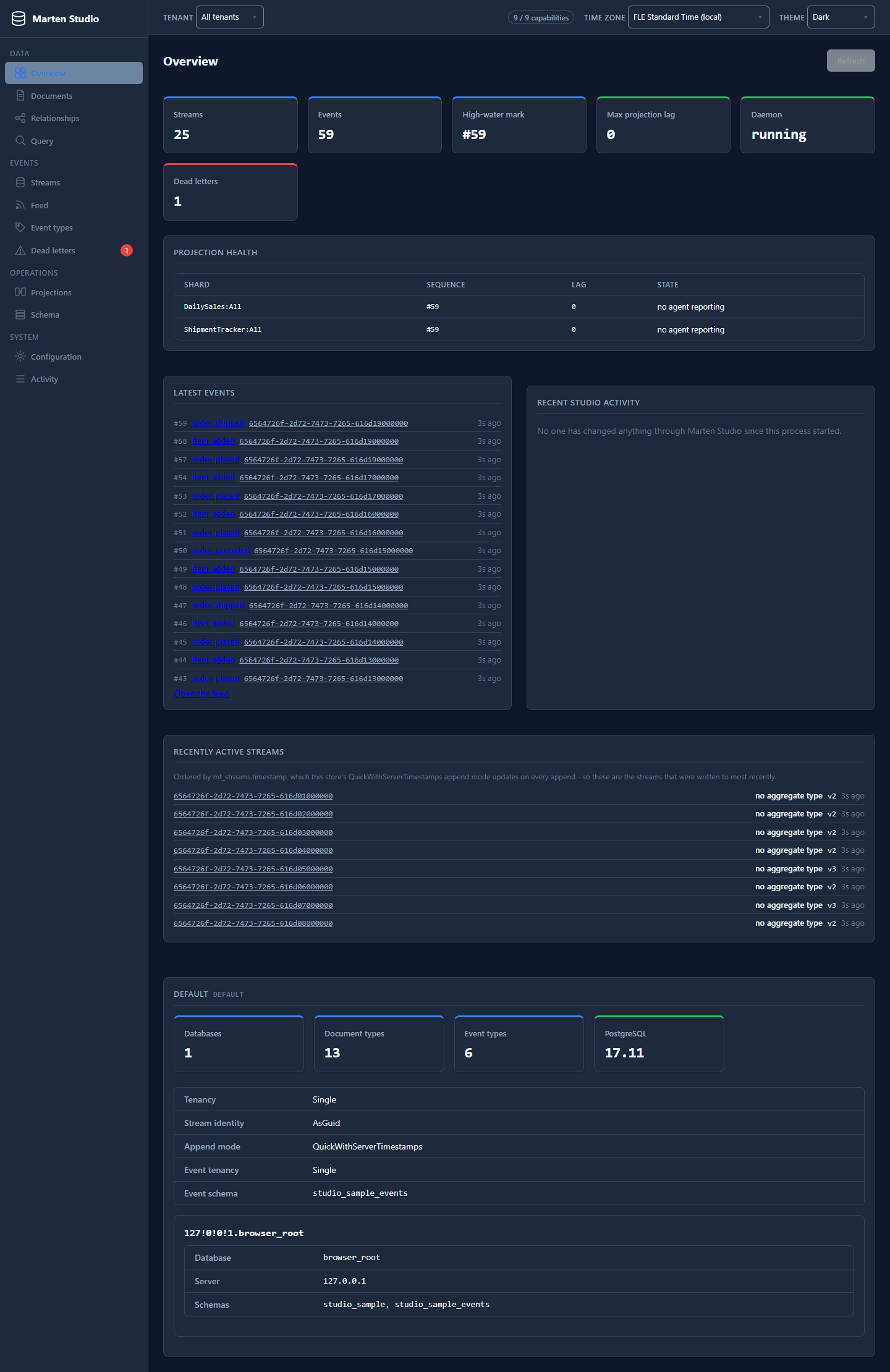 |
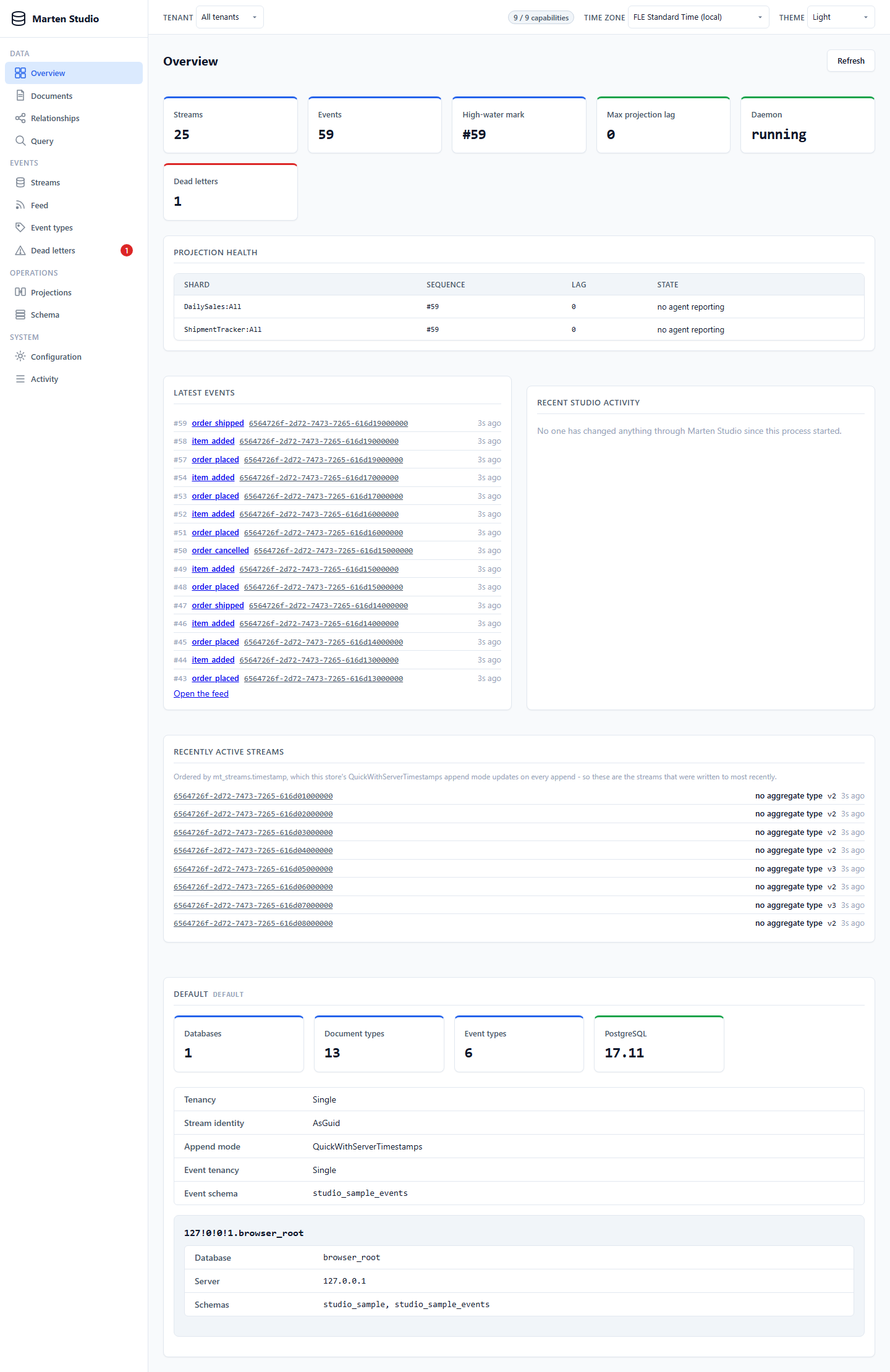
| Overview — one card per store, with tenancy, stream identity and the databases behind it | The same page in the dark theme, which follows the theme picker behind the header's gear button |
 |
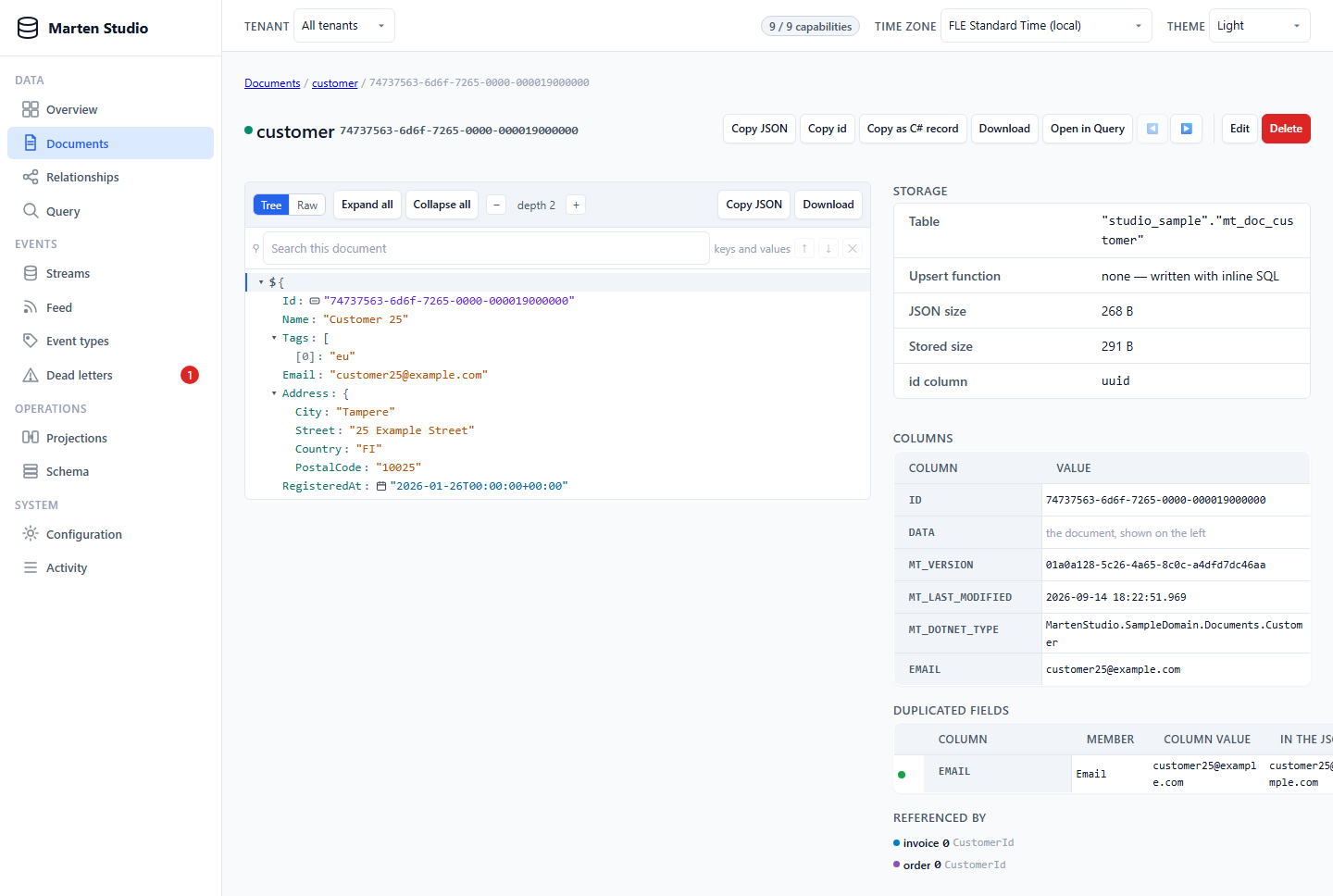 |
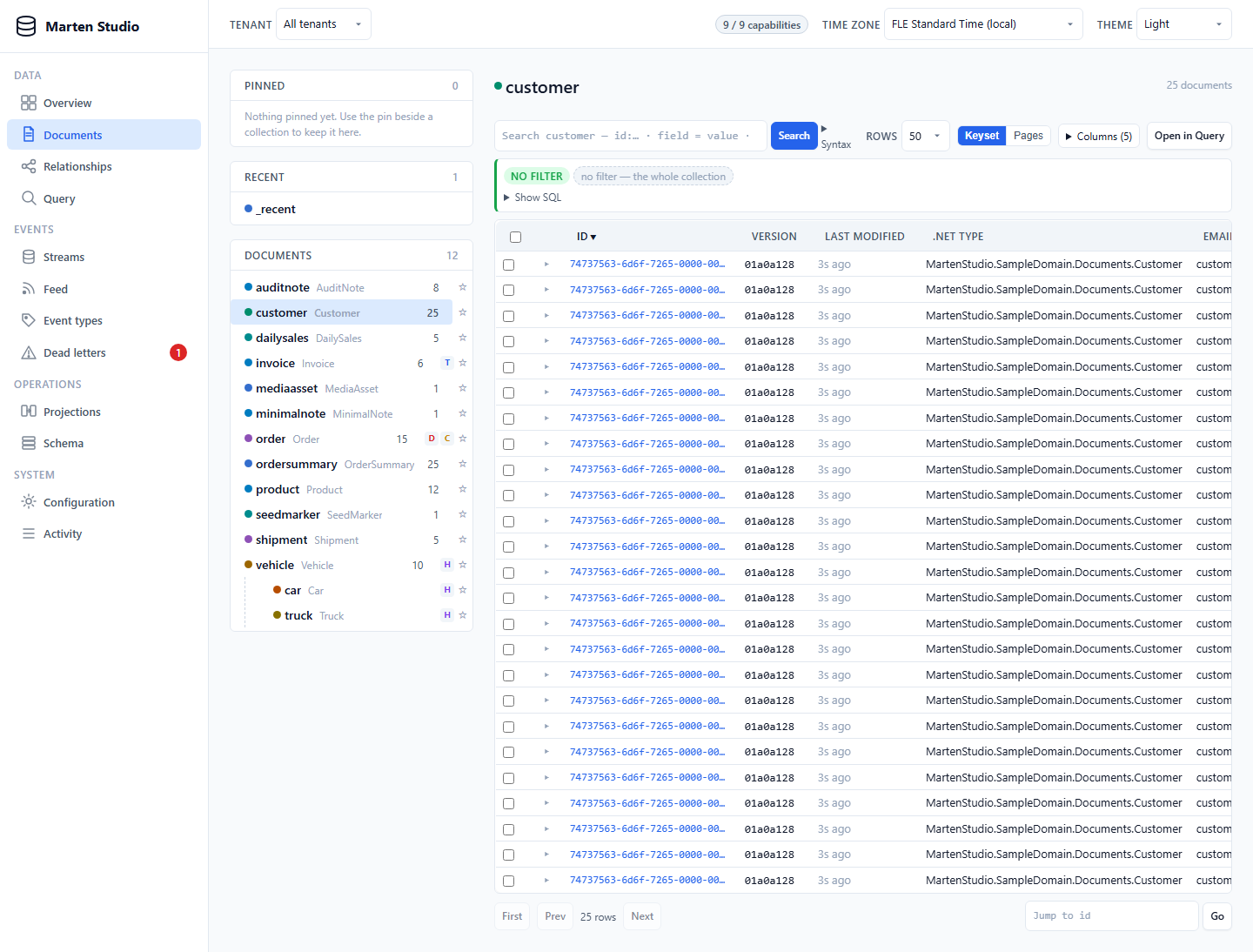
| Documents — the collections rail, the search grammar and its index verdict | One document: JSON on the left, everything the row's metadata columns say on the right |
 |
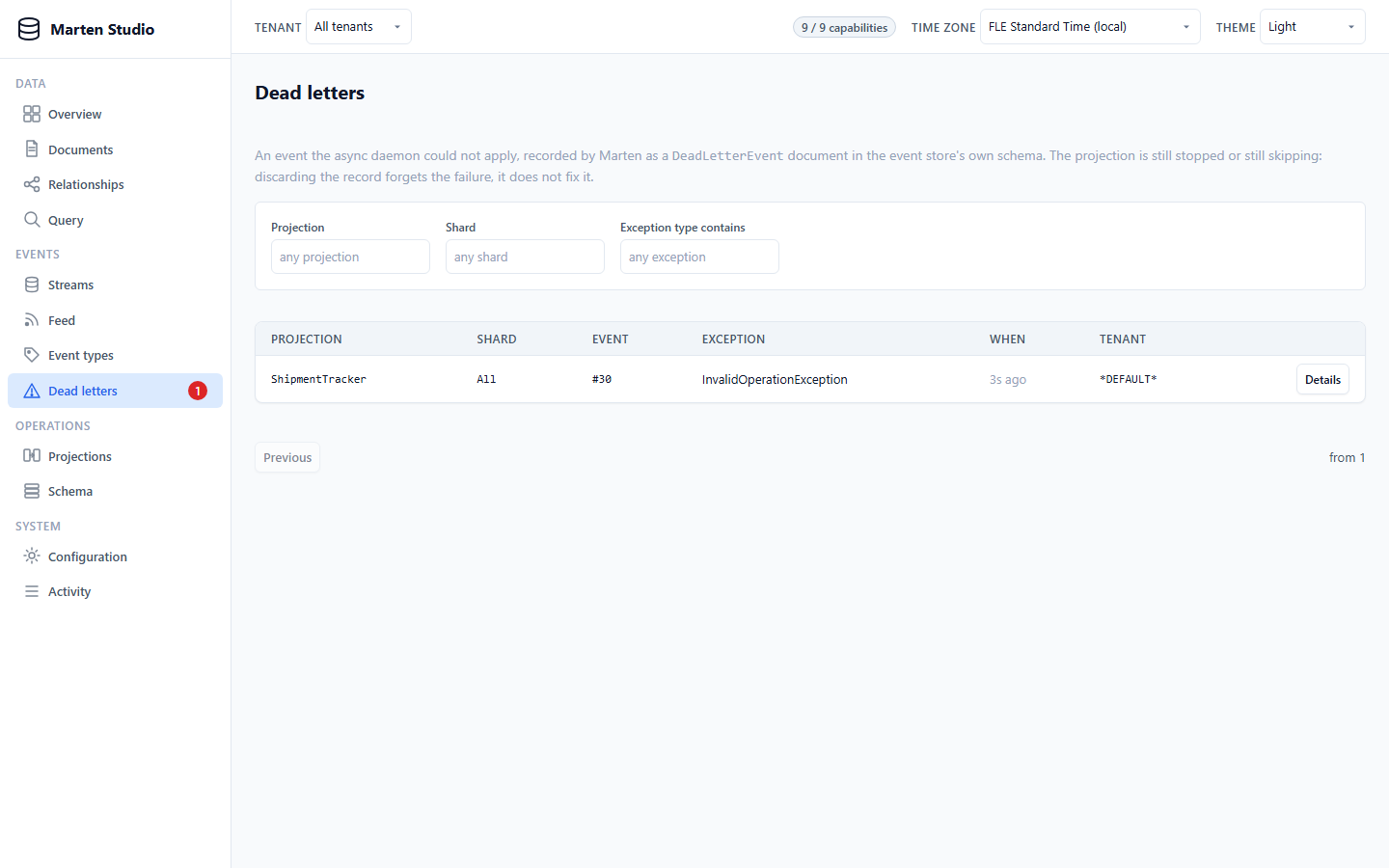 |
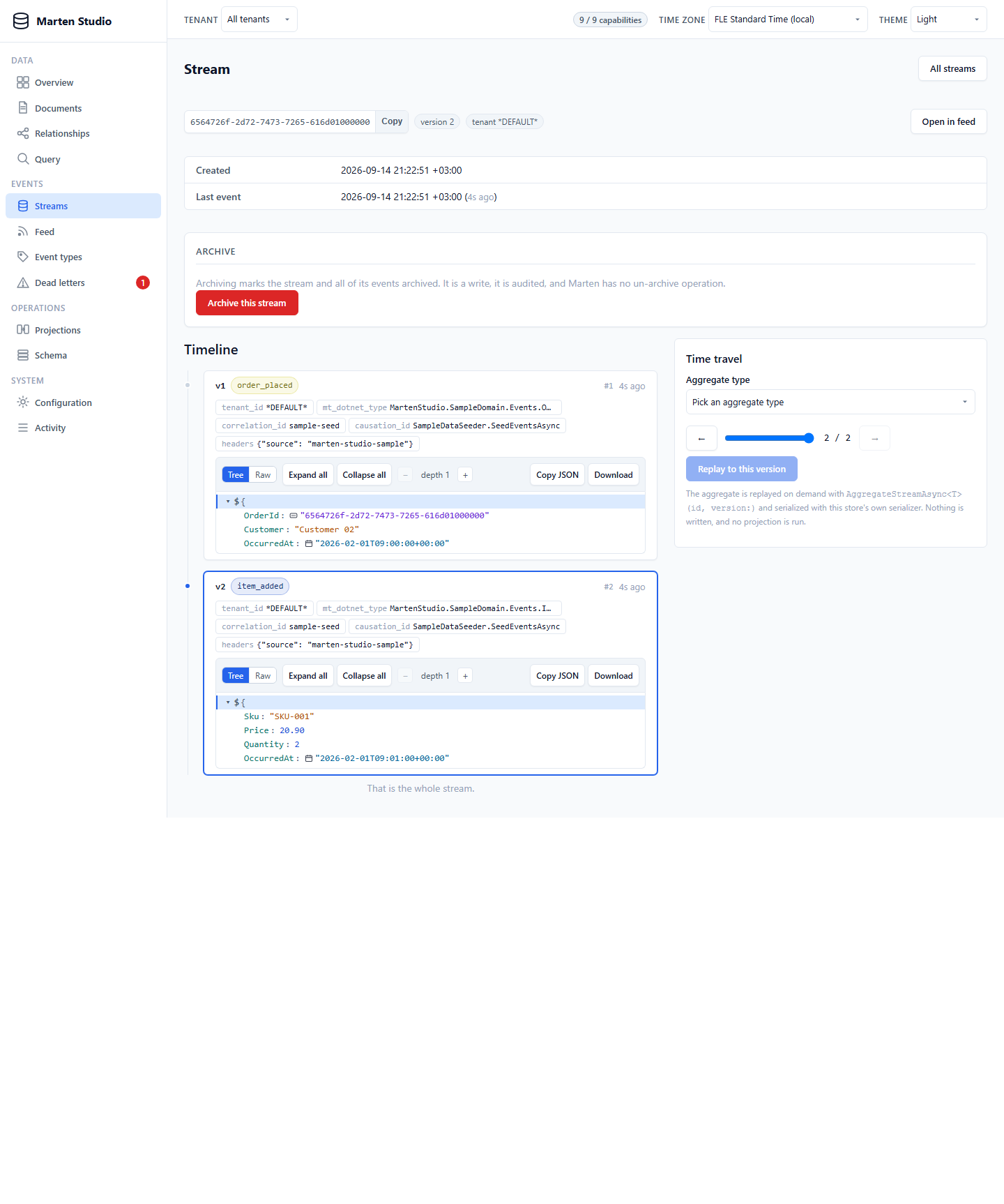
| A stream's timeline, each event's JSON and headers, with aggregate time travel beside it | Dead letters, expanded to the failing event and its exception |
 |
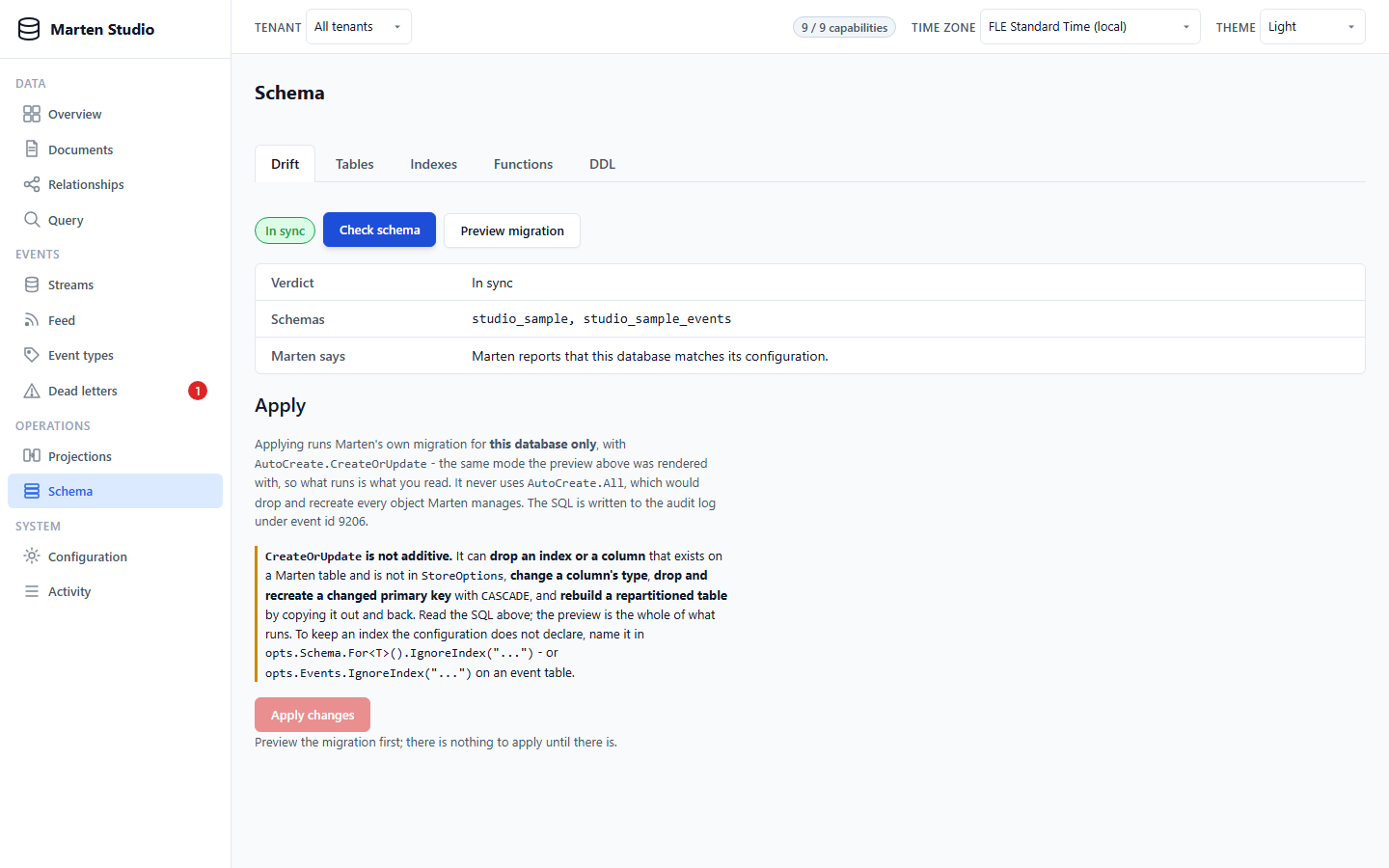 |
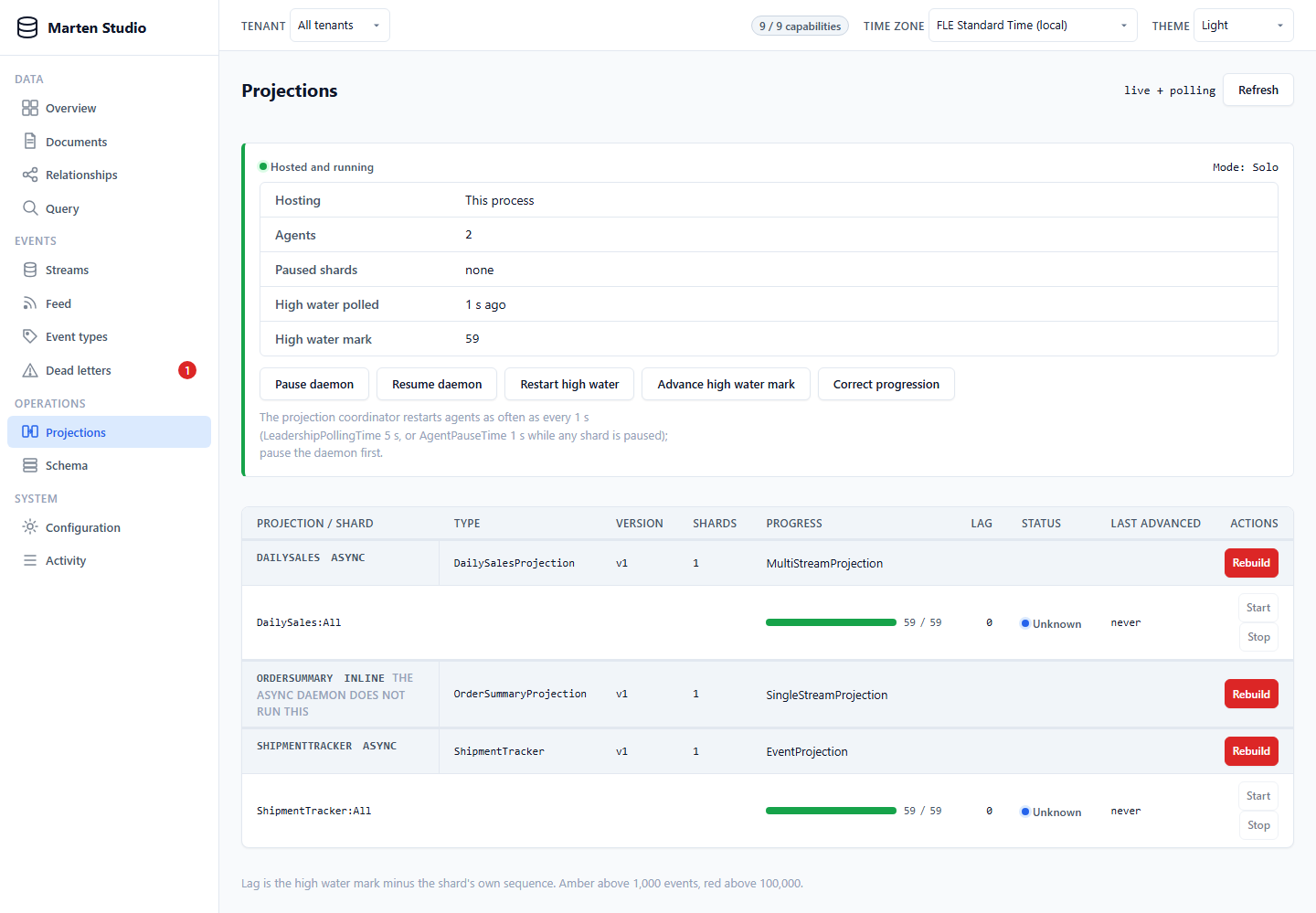
| Projections and the async daemon: shard state, progression and the high-water mark | Schema — what Marten would change, before anything is applied |
 |
|
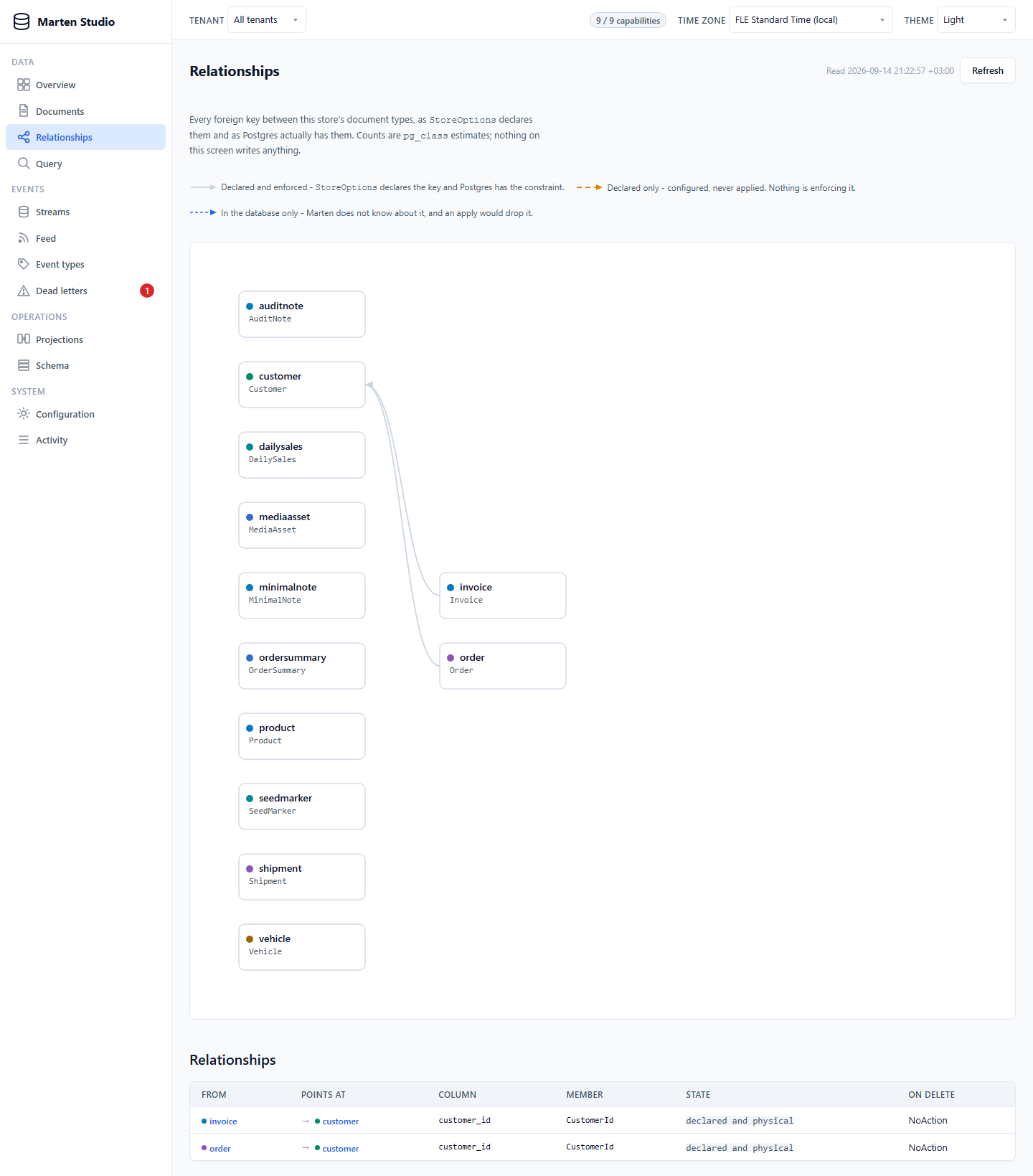
Relationships — the foreign keys StoreOptions declares, cross-checked against the ones Postgres holds |
|
 |
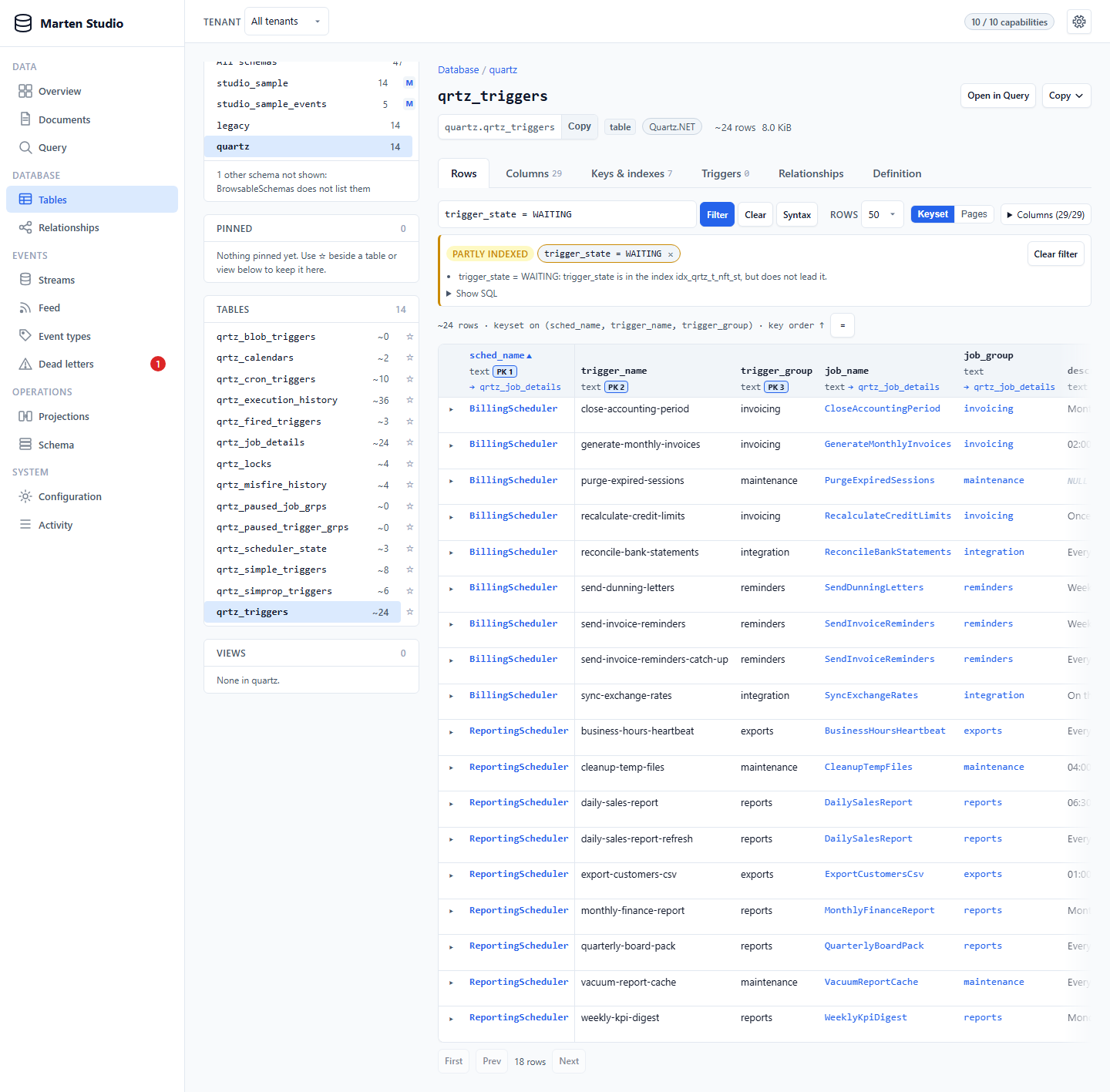 |
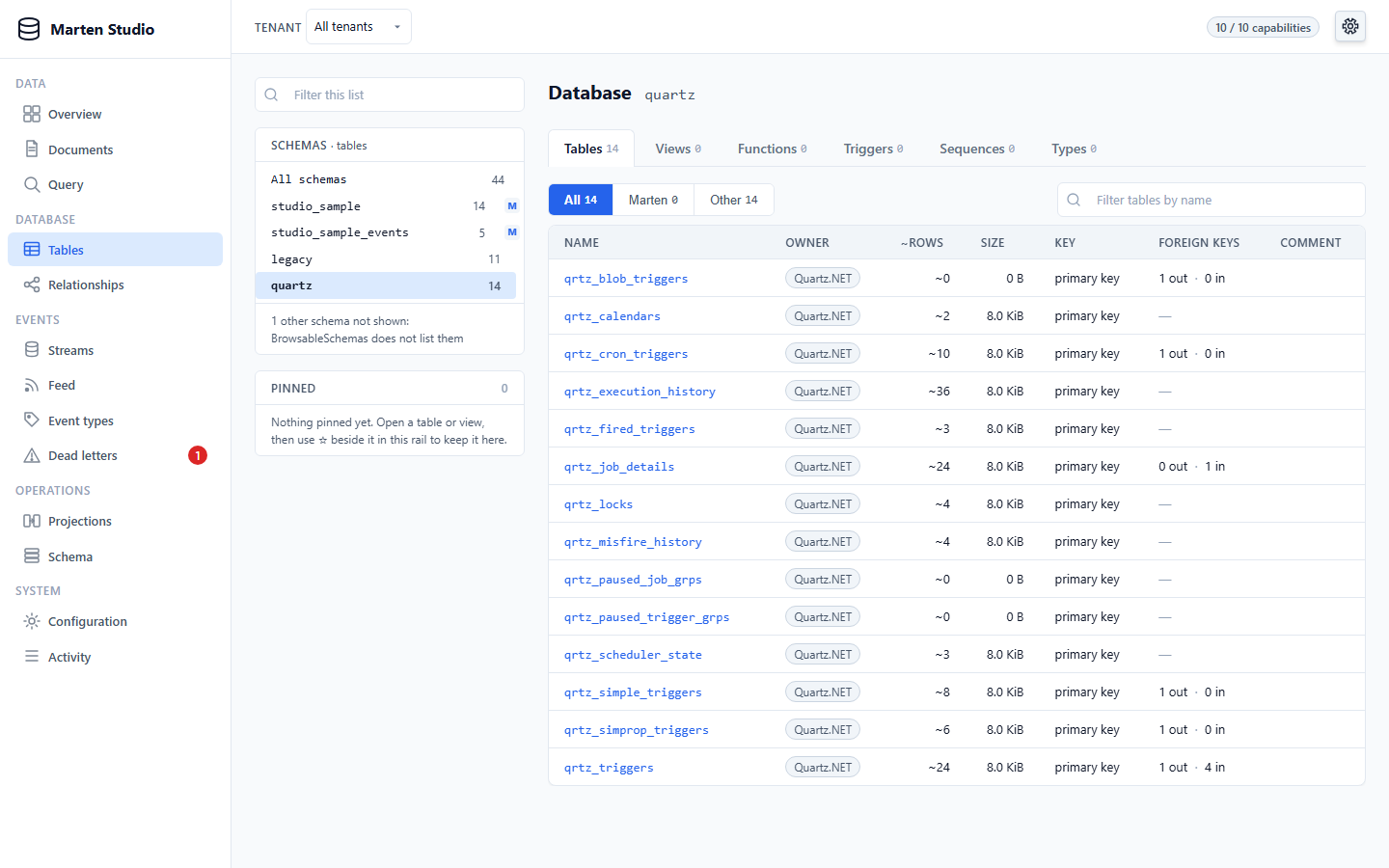
| Database — every table, view, function, trigger, sequence and type beside the store, Marten's own told apart; here a Quartz.NET job store | A table's rows: a filter with its index verdict, keyset paging over a composite key, typed headers and "≈ date" hints |
 |
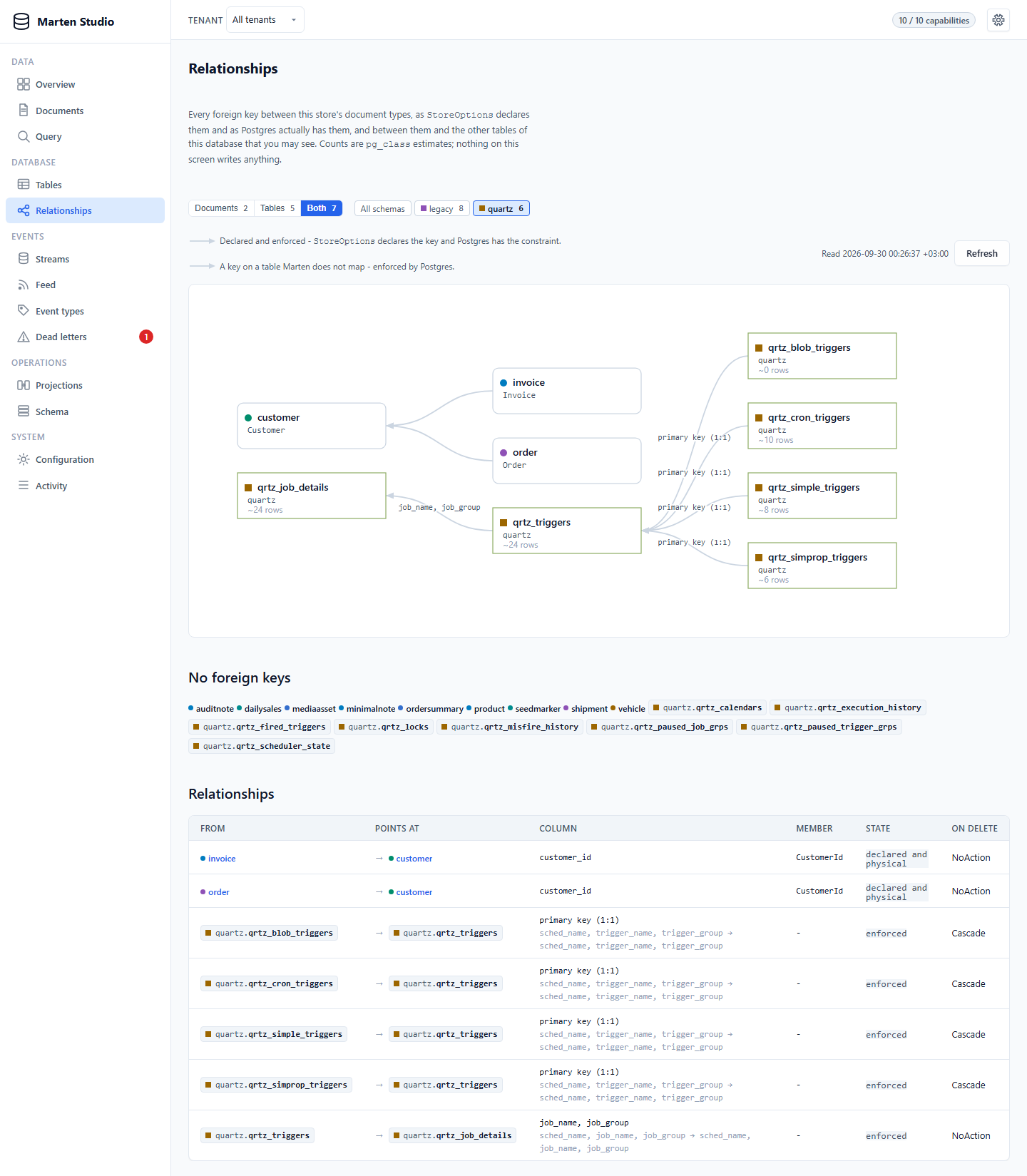 |
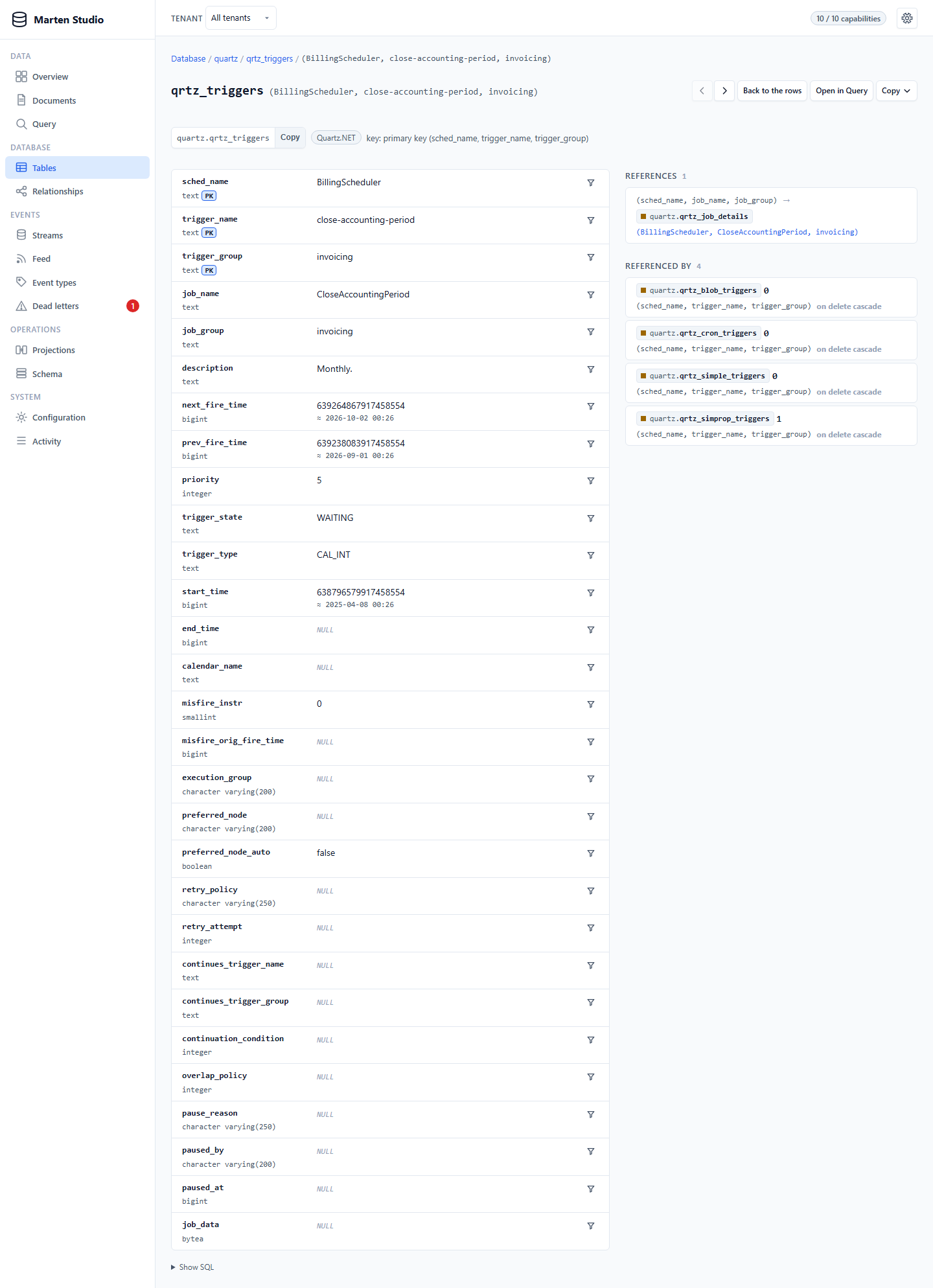
| One row: every column, what it points at and what points at it | Relationships over plain tables beside the document types |
Install
dotnet add package MartenStudio
One package reference. The studio brings Marten (floor 9.31.0) and
Microsoft.AspNetCore.App.Internal.Assets (floor 10.0.12, three .js files and an MSBuild target, no
runtime assembly) and takes everything else — Blazor, SignalR, authorization, endpoint routing — from
the shared framework, so it pins no ASP.NET Core patch onto your application. Target framework:
net10.0.
Register and mount
The minimum is two calls, and a decision about who may open it:
builder.Services.AddMartenStudio();

// ...

app.MapMartenStudio().RequireAuthorization();
The studio is then at /marten, read-only, behind whatever RequireAuthorization() means in your
application. The sample host does the same thing with every option spelled out — this block is compiled
from samples/MartenStudio.Sample/Program.cs, so it cannot
drift:
builder.Services
    .AddMarten(options => SampleStore.Configure(options, connectionString))
    .UseLightweightSessions()
    // --no-daemon: Disabled registers no coordinator, which is a host whose projections run elsewhere.
    .AddAsyncDaemon(sample.NoDaemon ? DaemonMode.Disabled : DaemonMode.Solo)
    .InitializeWith<SampleDataSeeder>();

builder.Services.AddMartenStudio(options =>
{
    // Who gets in, and who may change anything: the studio evaluates both against the host's own
    // authorization, and never authenticates anybody itself.
    //
    // --anonymous leaves AuthorizationPolicy unset on purpose. AllowAnonymous() on the mapping does win
    // over a configured policy - the studio's endpoints carry both and AllowAnonymous is what the
    // authorization middleware honours - but saying "this policy governs the studio" and then "anyone
    // may open it" in the same application is two answers to one question, and a demo should show the
    // one it means.
    options.AuthorizationPolicy = sample.Anonymous ? null : SamplePolicies.Studio;
    options.WriteAuthorizationPolicy = SamplePolicies.StudioWrite;

    // Every mutating operation is off until the host says otherwise. `All()` is the one-line, greppable
    // opt-in; `ReadOnly` overrides it whatever it says.
    options.Capabilities = sample.ReadOnly ? new MartenStudioCapabilities() : MartenStudioCapabilities.All();
    options.ReadOnly = sample.ReadOnly;

    // The database browser (Capabilities.BrowseDatabase, part of All()) may also show these schemas: the
    // Quartz.NET job store and the legacy relational schema the sample seeds beside the store. "*" would
    // open every schema the studio's role can use - fine for a scratch database, not for a shared one.
    options.BrowsableSchemas.Add(RelationalDemoSchema.QuartzSchemaName);
    options.BrowsableSchemas.Add(RelationalDemoSchema.LegacySchemaName);

    // The demo's invoices are conjoined multi-tenant. Naming the tenants here is the cheapest of the
    // three discovery tiers and the only one that can answer before any events have been written.
    foreach (string tenantId in SampleStore.TenantIds)
    {
        options.KnownTenantIds.Add(tenantId);
    }
});
and the mapping:
IEndpointConventionBuilder studio = sample.Path is { Length: > 0 } path
    ? app.MapMartenStudio(path)
    : app.MapMartenStudio();

if (sample.Anonymous)
{
    // --anonymous: what an unauthenticated studio looks like. The startup guard accepts this because it
    // is an answer; it refuses only a mapping that says nothing at all.
    studio.AllowAnonymous();
}
else
{
    studio.RequireAuthorization(SamplePolicies.Studio);
}
sample.Anonymous, sample.ReadOnly and sample.Path are the demo's own command-line switches; in
your host they are just values. AddMartenStudio() may be called before or after AddMarten() — the
scan that finds your stores runs lazily, on first use, when the container is complete.
MapMartenStudio("/ops/marten") mounts the studio somewhere else. The pattern wins over
MartenStudioOptions.Path, and the pages, the static assets, the Blazor circuit and the framework
script all move with it.
Authorization
There are three layers, and two process-wide switches on top of them. All five are yours to configure; the studio authenticates nobody.
AuthorizationPolicy— who gets in. Applied to every studio endpoint: the pages, the Blazor circuit and the static assets.RequireAuthorization()on the builder returned byMapMartenStudio()does the same job, and covers the pages and the circuit.StoreAuthorizationPolicy— which store, database and tenant. Resource-based, evaluated against aMartenStoreResource, and asked on every data call rather than only at the scope selector. Listings are filtered rather than annotated: a tenant you may not see is one you never learn exists.WriteAuthorizationPolicy— each mutating call, against the same resource with the capability name attached. Falls back toStoreAuthorizationPolicywhen you configure only one.
On top: ReadOnly turns every capability off whatever Capabilities says, and Capabilities
decides which mutating operations exist at all.
The startup guard
A mapping that answers none of this refuses to start, before the web host binds a listener:
Marten Studio is mapped with no authorization. Its pages can read and edit every document in every Marten store in this process, archive event streams, control the projection daemon, apply schema changes and run SQL, so Marten Studio refuses to start rather than serve that by accident. Say which you meant:
app.MapMartenStudio().RequireAuthorization()authorizes its pages and its Blazor circuit;services.AddMartenStudio(options => options.AuthorizationPolicy = "...")authorizes those and the static assets with them;app.MapMartenStudio().AllowAnonymous()serves it to anyone, deliberately.A non-null
AuthorizationOptions.FallbackPolicysatisfies this too, since it covers every endpoint that states nothing.
"I forgot to add RequireAuthorization" must not be a silent state, so it is a startup failure instead.
What protects the circuit
Both MartenStudioOptions.AuthorizationPolicy and RequireAuthorization() on the returned builder
cover the Blazor circuit as well as the pages — the builder holds the studio's page endpoints and its
/_blazor endpoints, so a statement about the studio is a statement about both. That matters: the
circuit is the dangerous half, because it is the half that runs components. The studio stamps no
AllowAnonymous of its own on /_blazor.
The static assets under _content/MartenStudio/ are package content — CSS and a little JS. With a
studio policy configured they carry it too; without one they opt out explicitly, so an application with
a fail-closed FallbackPolicy can still load the stylesheet.
Resource-based authorization
MartenStoreResource is what the two store policies are evaluated against:
public sealed record MartenStoreResource(
    string StoreName,           // "default", or the marker interface name of an ancillary store
    string DatabaseIdentifier,  // Marten's database identity - never a connection string
    string? TenantId,           // the selected tenant, or null for a view spanning all of them
    string? Capability);        // "EditDocuments", "RunSql", ... - or null for a read
One handler answers for the scope selector, the page frame and every data call. This example is illustrative — it is not compiled from the sample, which uses plain claim policies:
// Illustrative, not compiled.
public sealed class MartenStudioRequirement : IAuthorizationRequirement;

public sealed class MartenStudioHandler
    : AuthorizationHandler<MartenStudioRequirement, MartenStoreResource>
{
    protected override Task HandleRequirementAsync(
        AuthorizationHandlerContext context,
        MartenStudioRequirement requirement,
        MartenStoreResource resource)
    {
        // Reads: the tenant has to be one this user owns - and a resource with no tenant is every
        // tenant at once, so it takes an explicit all-tenants claim rather than passing for everyone.
        bool mayRead = resource.TenantId is null
            ? context.User.HasClaim("tenant", "*")
            : context.User.HasClaim("tenant", resource.TenantId);

        // Writes: the capability name arrives on the resource, so one handler can be as coarse or as
        // fine as you like - "ops may rebuild, nobody but me may run SQL".
        bool mayWrite = resource.Capability switch
        {
            null => true,
            "RunSql" or "BrowseDatabase" => context.User.IsInRole("dba"),
            _ => context.User.IsInRole("ops"),
        };

        if (mayRead && mayWrite)
        {
            context.Succeed(requirement);
        }

        return Task.CompletedTask;
    }
}
A null tenant is not "no tenant to check" but every tenant at once — the all-tenants view, and every
BrowseDatabase read, every SQL console run and every operation that reaches a whole shared database (a
dead-letter rewind, a progression correction, a rebuild, a schema apply), which are always asked with
TenantId = null because nothing narrows them to a tenant — so a handler that let it through for everybody would hand a user scoped to one tenant
all of them.
Register it the usual way and name the policy:
// Illustrative, not compiled.
builder.Services.AddSingleton<IAuthorizationHandler, MartenStudioHandler>();
builder.Services.AddAuthorizationBuilder()
    .AddPolicy("MartenStudioStore", policy => policy.AddRequirements(new MartenStudioRequirement()));

builder.Services.AddMartenStudio(options =>
{
    options.AuthorizationPolicy = "MartenStudio";
    options.StoreAuthorizationPolicy = "MartenStudioStore";
    options.WriteAuthorizationPolicy = "MartenStudioStore";
});
With no store policy configured, nothing is asked and everything passes — which is what keeps an application that never set the option exactly as it was.
Capabilities
Ten booleans, all false by default. A freshly mapped studio is a read-only browser of Marten's own data.
| Capability | What it allows |
|---|---|
EditDocuments |
Edit a document's JSON and save it through the store's own serializer and session |
DeleteDocuments |
Delete, soft-delete and undelete documents, one at a time or a selection |
ArchiveStreams |
Archive an event stream |
ManageDeadLetters |
Discard dead-letter records, mark events as skipped, and rewind a subscription to the event that failed (a rewind reaches every tenant in the database, so it is asked with TenantId = null unless the database holds only the selected tenant) |
ControlDaemon |
Pause and resume the async daemon hosted in this process, start and stop individual projection agents while it is paused, and restart the high-water agent |
RebuildProjections |
Rebuild a projection |
CorrectProgression |
Advance the high-water mark, or correct projection progression in the database |
ApplySchemaChanges |
Apply pending schema migrations |
RunSql |
Run read-only SQL from the Query page's console. Authorized like a write and always with TenantId = null — the console is not limited to a tenant — which also governs the Mode A EXPLAIN and the subquery lift |
BrowseDatabase |
Browse the rows and definitions of non-Marten tables, views, functions, triggers, sequences and types in the schemas BrowsableSchemas names. A read, authorized like RunSql as a write, and always with TenantId = null |
options.Capabilities = MartenStudioCapabilities.All();   // everything: the one-line, greppable opt-in
options.Capabilities.RebuildProjections = true;          // or one switch at a time, from all-off
options.ReadOnly = true;                                 // and this overrides whichever you wrote
Every disabled control says the exact property you would set, spelled the way you would write it:
Editing documents is not enabled. Set
MartenStudioOptions.Capabilities.EditDocumentstotrue, orMartenStudioOptions.Capabilities = MartenStudioCapabilities.All()to enable all of them.
and with the master switch on:
MartenStudioOptions.ReadOnlyistrue, which turns every capability off: the mutating operations, and the reads beyond the store (RunSqlandBrowseDatabase).
Hiding a button is a convenience. The refusal itself lives in the service layer, where the operation does, because a Blazor circuit is a long-lived object a client can drive — and every refusal is written to the audit log just like a success.
Options
Every property of MartenStudioOptions. Validation runs at startup: a value outside the range given here
fails the host with a message that names the option.
| Option | Default | |
|---|---|---|
Path |
/marten |
Where the studio is mounted. A plain rooted URL path. MapMartenStudio(pattern) overrides it. |
Title |
Marten Studio |
Browser tab and sidebar heading. |
AuthorizationPolicy |
null |
Policy applied to every studio endpoint — pages, circuit and static assets. |
StoreAuthorizationPolicy |
null |
Policy evaluated against MartenStoreResource before a store, database or tenant is listed, framed or read. |
WriteAuthorizationPolicy |
null |
Policy evaluated against MartenStoreResource with the capability named, before every mutation. Falls back to StoreAuthorizationPolicy. |
ReadOnly |
false |
Master switch: every capability off, mutating controls not rendered, services refuse. |
Capabilities |
all off | Which mutating operations, and which reads beyond the store (RunSql, BrowseDatabase), are enabled. |
DefaultPageSize |
50 |
Rows per page when a list is first shown. 1 … MaxPageSize. |
MaxPageSize |
500 |
The largest page a user may pick. 1 … 5000. |
QueryTimeout |
30 seconds | How long a studio query may run. It is a server-side statement_timeout where the studio owns a transaction — the SQL console, the Marten where clause, the recent-documents scan — and Npgsql's client-side CommandTimeout everywhere else. 1 second … 10 minutes. |
MaxInlineDocumentBytes |
512 KiB | Documents larger than this are not fetched into list views and show as raw text in the detail view. 1 byte … 64 MiB. |
MaxSqlConsoleRows |
500 |
Row cap for the SQL console; the reader stops there rather than rewriting your statement. 1 … 10 000. |
SqlConsoleRole |
null |
A Postgres role the SQL console and the Marten where clause switch to with SET LOCAL ROLE inside their read-only transaction. Must be a plain identifier — and must be able to select from the document tables, or the Query page answers 42501. |
ExactCountThreshold |
100000 |
Above this estimated row count, collection counts stay pg_class.reltuples estimates, prefixed ~, instead of becoming count(*) — and asking for an exact count is refused, with the reason on the badge, rather than being paid for. A conjoined collection under a tenant scope is the exception: that count is where tenant_id = …, which Marten makes index-backed by putting tenant_id first in the primary key, so it is always counted exactly and this threshold never applies to it. |
RefreshInterval |
5 seconds | How often live pages poll. Paused while the tab is hidden. 1 second … 5 minutes. |
RebuildShardTimeout |
1 hour | The per-shard replay budget handed to Marten's rebuild. At least 1 minute — see the warning below. |
IsDocumentTypeVisible |
null |
Func<Type, bool> filter over the registered document types, applied in the data layer and not only in navigation. |
IncludeAncillaryStores |
true |
Whether stores registered with AddMartenStore<T>() appear beside the default IDocumentStore. |
KnownTenantIds |
empty | Tenant ids to offer in the selector. When non-empty, discovery is skipped. |
DiscoverTenantIds |
true |
When KnownTenantIds is empty, whether to discover tenants from Marten's descriptors and then from a bounded query. |
BrowsableSchemas |
empty | Schemas beyond the store's own that the database browser may show, and whose non-Marten rows and definitions it may read (with Capabilities.BrowseDatabase). Exact schema names, or "*" for every schema the studio's role has USAGE on except Postgres' own and extensions'. It limits what the screens show, not what RunSql can read — SqlConsoleRole is the real boundary. |
RebuildShardTimeoutis not a nicety. A rebuild tears the projection's tables down before the timeout starts applying to the replay, so a rebuild that exceeds it stops with the tables already emptied and the operation recorded as failed. The default is an hour, where Marten's own no-timeout overload would have silently used five minutes. Set it generously.
Screens
Overview — one card per registered store: databases, document types, event types, the PostgreSQL version, tenancy, stream identity, event append mode and the schemas in play. A store that will not build gets its own error region rather than blanking the page for the ones that do.
Documents — a collections rail with per-collection counts (estimates, prefixed ~; below
ExactCountThreshold the = beside a collection pays for an exact count(*), and above it the studio
declines and says so on the badge), then a list with column chooser, keyset paging and a search
grammar (field:value, >=, is:deleted, tenant:…) that compiles to parameterised SQL against the
duplicated columns and JSON paths Marten actually created. Each search gets an index verdict —
green/amber/red with the StoreOptions line that would fix it — and a "Show SQL" disclosure with the
statement that ran. The detail view puts the JSON viewer (tree or raw, search, copy, download, "copy as
C# record") beside a metadata panel of the row's real columns. With EditDocuments you edit the JSON
in place and see a round-trip diff before saving: Marten has no untyped write path, so the edit is
deserialized into the CLR type and serialized back, and any property the type does not have is gone —
the dialog lists dropped, changed and added properties and refuses the save until you acknowledge the
drops. Saves are optimistically concurrent (UpdateExpectedVersion / UpdateRevision); a row that
moved comes back as a conflict with nothing written. With DeleteDocuments you get delete (soft where
the mapping says soft, hard otherwise), undelete, and a bulk delete over the selection.
Database — everything else in the store's Postgres database, for a host that keeps a Quartz.NET job
store, a legacy schema or another library's tables beside Marten. A schema rail, and kind tabs for
tables, views, functions, triggers, sequences and types; Marten's own objects are quieter, sorted last and
linked to where their data is really read, and a Quartz.NET, Wolverine, EF Core, Hangfire or Flyway object
is hinted by name. Each object has a detail page — columns, keys and indexes, foreign keys both ways,
triggers, a view's query, and its neighbourhood in the relationships diagram — and a table, view or
materialized view that is not Marten's has a Rows tab: a col = value / col ~ text / col is:null
filter with an index verdict (and "Run anyway" before an unindexed read of a large table), keyset paging
over composite keys, typed and sortable headers, JSON and bytea cells opening in the viewer, a "≈ date"
hint under bigint columns holding .NET ticks or epoch times, and row detail that follows foreign keys
both ways. The structure of the store's own schemas is shown to every visitor, as the Schema screen always
did; everything else — other schemas, definitions of what Marten does not own, and every row — needs
Capabilities.BrowseDatabase, a schema BrowsableSchemas names (or "*"), and the write policy asked
with TenantId = null, because nothing filters those tables by tenant. It is read-only, runs in the same
read-only transaction as the SQL console as SqlConsoleRole, locks nothing it lists, and audits the first
read of every relation. It never reads the rows of Marten's own document or event tables (they are read in
Documents and Events, where tenancy, soft delete and the serializer apply), never reads a foreign table,
directly or through a view, never shows a hidden document type or anything built on it, and masks the name
of a schema the visitor may not see as ‹withheld› wherever Postgres prints it.
Relationships — the document types of the store as a graph: one node per registered type with its
collection colour, its .NET type and a reltuples estimate, one arrow per foreign key. What
StoreOptions declares and what pg_constraint actually holds are cross-checked, so an arrow is
declared and enforced, declared only — configured, never applied, nothing enforcing it — or in the
database only, which Marten does not know about and an apply under CreateOrUpdate would drop. Keys
into the database's other tables are drawn too, as square, schema-coloured nodes — a Documents / Tables /
Both switch and schema chips narrow the picture, composite-key labels leave out the leading columns both
primary keys share, and a NOT VALID key is dashed — while a key into a schema the visitor may not see is
counted, never named, and a type hidden by IsDocumentTypeVisible appears nowhere at all. Clicking a node opens the collection; hovering an arrow
names the column, the target and the delete action. Beside the picture — and, on a narrow screen,
instead of it — a table carries the same relationships with the same links, which is also what a screen
reader gets. There is no pan, no zoom and no JavaScript: the layout is computed on the server and is a
pure function of the configuration, so the same store draws the same diagram every time. On a document's
detail page, Referenced by names each collection that points at it and how many of its documents do
— exact up to a thousand and "1,000+" beyond that, so the answer never costs a sequential scan — each row
linking to that collection already filtered on this document.
Query — two modes, and the asymmetry between them is the design. Mode A, a Marten where clause,
is a read against one document type and needs no capability, so the service holds it to being a
clause: no ;, no statement of its own, brackets that balance, a tail that is
[order by …] [limit n] [offset n] and nothing else, no function that reads, writes or waits outside
the row, no ::regclass cast — and, without RunSql, no subquery, union, join, lateral or
returning either. It runs inside the same BEGIN; SET TRANSACTION READ ONLY; …; ROLLBACK as the
console, under the same QueryTimeout and the same optional SqlConsoleRole. Results come back as the
data column itself, never round-tripped through a CLR type, the composed statement is shown, and a plan
is offered where RunSql allows one (EXPLAIN, never EXPLAIN ANALYZE). Mode B, the SQL console, is arbitrary
read-only SQL against the whole database, is gated on RunSql, and is limited by MaxSqlConsoleRows,
QueryTimeout, a 3-second lock timeout, a 60-second idle-in-transaction timeout and an optional
SqlConsoleRole — inside BEGIN; SET TRANSACTION READ ONLY; …; ROLLBACK. The row cap stops the reader;
it never appends a LIMIT to your statement. See Security model and limits.
Events — Streams lists and filters streams; stream detail draws the timeline with each event's
JSON, headers and metadata, offers aggregate time travel (replayed on demand with
AggregateStreamAsync<T>(id, version:), writing nothing and running no projection), and archives the
stream with ArchiveStreams. Feed is the global sequence, newest first, filtered by event type,
sequence range, stream, tenant and the archived/skipped flags the store actually has, with a follow
mode. Event types counts what the store has seen. Dead letters lists the daemon's failures with the
exception, and with ManageDeadLetters discards a record, marks the underlying event as skipped — only on
a store that enabled event skipping, because it writes mt_events.is_skipped and a store without that
column has no way to express the idea — or rewinds the projection's subscription to the event that failed,
behind a typed confirmation that states what gets replayed, where the daemon is hosted in this process.
Projections — every registered projection with its shards, their state and progression against the
high-water mark, refreshed from a lazy observer on ShardStateTracker where the daemon is hosted in
this process and from polling where it is not. With the capabilities on: pause and resume the projection
daemon, restart the high-water agent (ControlDaemon), rebuild a projection behind a typed confirmation
(RebuildProjections), and advance or correct progression (CorrectProgression). Pausing is
process-wide — it stops the coordinator's leadership runner and then every agent of every database this
process hosts for that store — and it is the only stop that holds: with the coordinator running, it
restarts any agent it finds missing within LeadershipPollingTime, so per-agent Start and Stop are
offered only while the daemon is paused and are refused with that reason while it is not. A rebuild
outlives the circuit that started it and is tracked by name. Where no daemon is hosted in this process,
the page says so — that is a value, not an error, and the studio never starts a daemon of its own.
Schema — five tabs: Drift (what Marten would change), Tables, Indexes, Functions and DDL.
Nothing here executes DDL on a read path: schema names, declared indexes, managed tables and installed
functions come from StoreOptions and Marten's own feature schemas, and Check, Preview and DDL sit
behind buttons that say on the button what they may create. What those three show spans the whole
database — every tenant's partition by name, every document type's table — so they answer only a visitor
the store policy allows for the database with no tenant selected, and, while IsDocumentTypeVisible
hides a document type, one past the database browser's gate (Capabilities.BrowseDatabase and the write
policy). An apply migrates the whole database, every tenant, whichever tenant is selected, so both
policies are asked about the database as a whole. Tables says whose each table is by the database
browser's rules, rolls partitions into their parent without listing them, leaves hidden document types
out, and shows a partition count or a Marten tenancy table's row count only past that gate, because
either is the number of tenants. Functions reads a body when you open its row: Marten's own for
everybody, the application's own only with Capabilities.BrowseDatabase and a schema BrowsableSchemas
admits. A name in a schema you may not see reads ‹withheld›, as in the browser. If a registered store
cannot be built, the tabs keep what the other stores declare and withhold, and say, what that store could
own. The reads give up after three seconds behind a migration's lock rather than wait for it.
An apply runs under
AutoCreate.CreateOrUpdate, andCreateOrUpdateis not additive. Weasel's update path emitsdrop indexfor every physical index your configuration does not declare,drop columnfor every extra column,alter column … typefor a changed one,alter table … drop constraint … CASCADEfor a changed primary key, and for a changed partition scheme acreate table … as select/drop table … cascadepair that copies the whole table out and back. The preview is rendered under the same mode so what you read is what would run, and the destructive statements are listed in the dialog before a typed confirmation. A hand-made index is dropped by the next apply unless you declare it, or name it inopts.Schema.For<T>().IgnoreIndex("…")— oropts.Events.IgnoreIndex("…")on an event table, andtable.IgnoreIndex("…")on a projection's or anExtendedSchemaObjectstable, which an apply migrates just the same — which takes it off both sides so it is neither created nor dropped. The Indexes and Drift tabs say this on screen, and name the index.
Configuration — everything your application told Marten, read back out: serializer, tenancy, schema names, metadata columns, projections, the databases. Never a connection string and never a credential; a database is identified by server, port, name and schema. The studio changes nothing here.
Activity — the last 500 actions taken through the studio in this process, newest first, with user,
scope, action, target, outcome, capability and message. It is in memory and goes away with the process.
The durable record is your own ILogger, under event ids 9200–9211.
Multi-tenancy, multiple databases and multiple stores
Scope is a triple — store, database, tenant — chosen in the header and carried in the query string
(?store=&db=&tenant=), so a link you paste into a chat reopens the same thing. Every data call
resolves that scope and re-asks StoreAuthorizationPolicy about it.
- Stores. The default
IDocumentStoreisdefault; every store registered withAddMartenStore<T>()appears under its marker interface's name.IncludeAncillaryStores = falsehides the ancillary ones. A store that will not build is shown as an unavailable row with the reason, not silently omitted. - Databases. A
MultiTenantedDatabasesor otherwise multi-database store lists its databases; sessions are always opened withSessionOptions.ForDatabase(tenantId, database)so the reads come from the database the selector named and the audit entry recorded. Everything schema-related is per database, never per store. - Tenants. Three discovery tiers, cheapest first:
KnownTenantIds(you said so — nothing is discovered); Marten's ownDescribeDatabasesAsync, which answers for a static configuration without touching the database; and, whenDiscoverTenantIdsallows it, a boundedselect distinctover every table in the store that has a tenant column, capped at 201 rows and cached for a minute. Past 200 tenants the selector becomes a free-text box, because a picker that silently omits tenants is worse than no picker. The selector says which tier answered.
Conjoined tenancy is per document type, so a store whose documents are tenanted while its event store is not is the normal case and is handled: a single-tenanted collection is not filtered by the scope's tenant, because there is nothing to filter on and hiding it would hide something genuinely shared.
Hosting notes
- It works in an API-only host. No
.razorfile of your own is needed, and you do not need to setRequiresAspNetWebAssets— the package referencesMicrosoft.AspNetCore.App.Internal.Assets, whosebuildTransitivetargets define_framework/blazor.web.jsas your project's static web asset. Verified against a scratch API-only host that has no Blazor components at all. - You do not need
app.UseAntiforgery(). The studio has no<form>and no<EditForm>; every mutation is a Blazor event over the circuit, and SignalR's own same-origin check is what stands between a cross-site page and that circuit. The studio's component endpoints say.DisableAntiforgery(), so a host that never calls the middleware still gets a 200 forGET /marten. A host that does call it is unaffected — the middleware simply has nothing to validate here. - Sub-path mounting is a first-class shape.
MapMartenStudio("/ops/marten")moves the pages, the/_blazorcircuit, theopaque-redirectendpoint,blazor.web.jsand the_content/MartenStudio/mirror under the path, and the shell renders a studio-rooted<base href>. Every mount is studio-rooted — including the default/marten— so a host that has a Blazor app of its own does not end up with two endpoints on/_blazor. - Behind a reverse proxy, forward the studio prefix and it works: the studio's plumbing is all under
its own path. If the proxy strips a prefix, give the application the same prefix with
app.UsePathBase("/…")so that the routes and the<base href>agree; mounting atMapMartenStudio("/ops/marten")and stripping/opsat the proxy without a matchingUsePathBaseis the shape that renders locally and 404s in production. - Static assets.
app.MapStaticAssets()(orUseStaticFiles()) serves the stylesheet and the studio's browser helpers the normal way. The studio also maps its own_content/MartenStudio/{**path}endpoints as a fallback, so an API-only host that configures neither still gets a styled, interactive studio. Both are asked for by the studio's own pages and by nothing else: the package ships no Blazor JS initializer, so a host that runs a Blazor app of its own never fetches anything of the studio's on pages that have nothing to do with it. - Not trimmable.
IsTrimmable=falseis stated in the csproj on purpose. Blazor Server sets[Parameter]properties by name from the render tree and the document viewer deserializes into types discovered fromIDocumentType.DocumentTypeat run time; a trimmer told it may cut has no way to see either. An application that publishes trimmed or native AOT does so without the studio. - There is no "integrate into my own Blazor app" mode. The studio maps its own
MapRazorComponents<MartenStudioApp>()root and re-roots it. Adding its pages to your own router is not supported in v1.
Sample application
dotnet run --project samples/MartenStudio.Sample
Then open http://localhost:5210. With no connection string configured, the sample starts a throwaway
PostgreSQL container, prints a loud banner saying it did, and seeds a demo domain chosen to make the
studio's screens worth looking at: a duplicated unique column, a soft-deleted type with a foreign key and
optimistic concurrency, a strong-typed id, a subclass hierarchy in one table, application-assigned string
keys, one type with every optional metadata column on and one with all of them off, a two-megabyte
document, conjoined multi-tenant invoices, and an event store with three projections, one archived stream
and one deliberately poisoned stream that the async daemon turns into dead letters. It never falls back
to localhost silently; without Docker it throws with guidance. Set ConnectionStrings:Marten to point
it at a database of your own.
Sign in as admin, ops or viewer — the password is the user name. They differ by claim: admin has
read, write and destroy, ops read and write, viewer read only, which is how you can see what each
layer of the authorization contract does.
| Switch | |
|---|---|
--anonymous |
Map the studio with AllowAnonymous() instead of a policy, to show what an unauthenticated studio looks like. The landing page draws a red banner saying so. Never do this anywhere real. |
--readonly |
Set MartenStudioOptions.ReadOnly, which turns every mutating capability off however they were configured. |
--path /ops/marten |
Mount the studio somewhere other than /marten, which is what exercises the sub-path re-rooting. |
--no-daemon |
Host no async daemon (AddAsyncDaemon(DaemonMode.Disabled)), the shape of a production host whose projections run elsewhere. The studio shows progress from the database and logs nothing about it above Debug. |
Argument order does not matter. The sample's boolean switches —
--anonymous,--readonly,--allow-data-generation,--no-daemon— are switches, not--key valuepairs: writing one meanstrueand the token after it is left alone, sodotnet run -- --anonymous --urls http://localhost:5000anddotnet run -- --urls http://localhost:5000 --anonymousdo the same thing. An explicit value is still accepted where a script wants to pass a variable (--readonly false,--readonly=false), and only a literaltrueorfalsecounts as one.--path /ops/martenis a pair and does take the token after it. This needs saying because .NET's own command-line configuration provider does not work that way — it reads--key valuepairs, so a bare switch would otherwise swallow your--urlsand then drop the URL without a word;SampleOptions.HostArgumentsreconciles the two before the host sees the arguments.
Demo data generator
In the Development environment (or with --allow-data-generation elsewhere) the sample's landing page
carries a Demo data panel for the admin user — presets Small, Medium (about 100 k documents
and 100 k events), Large (about 1.2 M documents, 1.25 M events across 250 k streams) and Custom —
that runs as a cancellable background job with a progress bar, rows per second, an ETA and the async
daemon's lag, plus a truncate that removes exactly what was generated. Documents go in through a binary
COPY; order streams go through Marten sessions so the inline projection runs and the async ones have
something to catch up on, with one poisoned stream per 10 000 so the dead-letter screen has real content.
The studio's own services are measured against the Medium set in every integration run; the Large set
runs under MARTENSTUDIO_LARGE=1. See samples/MartenStudio.Sample/README.md.
Security model and limits
The long form is in docs/security.md. The short form:
Nothing mutating is on by default. Nine capability flags, all
false, plusReadOnly. The dashboard that is dangerous by default is the one somebody maps without reading the docs.Refusals live in the service layer, not in the markup, and are audited whether they succeed or fail:
StudioCapabilityGuard.Require(…)→ scope resolution with the write policy → the operation → the audit record.The SQL console's real guard is the transaction, not the parser. Every statement runs inside
BEGIN; SET TRANSACTION READ ONLY; …; ROLLBACKwithstatement_timeout,lock_timeout,idle_in_transaction_session_timeoutand an optionalSET LOCAL ROLE, all set withset_configparameters rather than interpolated text.ReadOnlySqlGuard— which allows onlyselect,with,explain,tableandvalues, and only one statement — exists to produce a better message than SQLSTATE25006, and treating it as the security boundary is how these features get CVEs.A read-only transaction is not a sandbox.
select pg_terminate_backend(pg_backend_pid())runs happily inside one; so dopg_read_file,lo_export,pg_ls_dir,dblinkand the session-level advisory-lock family. Those are refused by name through a denylist (ReadOnlySqlGuard.DisallowedFunctions, quoted in full indocs/security.md), and that refusal is worth exactly what a parser's refusal is worth: a determined caller can reach the same function through a view, aSECURITY DEFINERwrapper or an alias, and the list will not see it.The only true narrowing is
SqlConsoleRole. A Postgres role that was never grantedEXECUTEon those functions, and can read only what you meant it to read, cannot be talked around however the call is spelled. Configure one if you enable the console. Without it, the console reads everything the store's own Postgres role can read — every table in the database, Marten's or not.Grant
RunSqlonly to people you would givepsqlto. That is the whole of it.Mode A is guarded differently, because it needs no capability. The studio composes the statement itself —
select … from <table> as d where 1 = 1 and <tenant> and <not deleted> and ( <your clause> ) and <tenant> and <not deleted>— so the tenant in the header and the soft-delete rule apply exactly as they do in the Documents browser, and the SQL the page shows is the SQL that ran. The studio's terms are repeated after your predicate as well as before it, because a parenthesised predicate only contains anorwhile the parentheses hold. The clause may not carry a second statement, be a statement of its own, leave a bracket unbalanced, hang anything but a sort list offorder by, call a function that reads, writes or waits outside the row, or cast toregclass/regproc— none of whichRunSqllifts. WhatRunSqllifts is reaching another relation: subquery, union, join,lateral,returning. The scanner errs towards refusing, and every refusal names what would lift it.Audit. Every mutating operation and every refusal is written to a 500-entry in-memory ring (the Activity page) and to your
ILoggerunder event ids 9200–9211, which is the copy that survives a deployment. 9200ActionPerformed, 9201ActionFailed, 9202CapabilityDenied, 9203ScopeAuthorizationDenied, 9204SqlExecuted, 9205SqlRejected, 9206SchemaChangeApplied, 9207ProjectionRebuildStarted, 9208ProjectionRebuildFinished, 9209DaemonControlRequested, 9210StoreUnavailable, 9211DocumentWriteRoundTripDropped. The range 9200–9299 is reserved.Log levels. A state the host configured is not a warning. No async daemon in this process, a daemon run by an external system (
AsyncMode = ExternallyManaged, which Wolverine's managed distribution sets), event tables that do not exist yet, a speculative count or a query of your own running out of its budget — each is a value the page already shows, logged atDebugat most. A real anomaly on a path the studio polls everyRefreshIntervalis logged atWarningonce per store, database and exception type per ten minutes, and atDebugin between, so filter on the event id rather than muting the category:Id Event Logged when 9202, 9203 CapabilityDenied,ScopeAuthorizationDeniedAlways Warning: a capability or policy refused an action9210 StoreUnavailableA registered store will not build 9211 DocumentWriteRoundTripDroppedAlways Warning: an edit was saved and the round trip dropped properties9212 DaemonUnreachableA registered coordinator answered with something other than a daemon for this database, or could not be constructed for a reason other than Wolverine's unknown-store shape 9213 StoreDatabasesUnreadableA store's databases could not be listed 9214 PostgresVersionUnreadableThe server version could not be read 9215 ShardTrackerUnobservableThe in-process shard tracker could not be observed 9216 ProjectionSummaryUnreadableThe Overview's or the navigation's projection summary failed 9217 EventReadFailedAn event-store read failed for a reason other than a statement timeout 9218 StreamTimestampMissingA hand-migrated mt_streamshas a row with a null timestamp9219 TenantDiscoveryFailedThe scope selector could not discover a store's tenants 9220 LiveUpdateHandlerFailedA page's own refresh-failure handler threw 9221 TenantPolicyFailedThe store policy threw while the scope selector filtered a database's tenants What the studio never does: start a second projection daemon, execute DDL on a read or navigation path, write document DML of its own, replace your
StoreOptions.Logger, or show a connection string or a credential anywhere.
Current limitations
- Mode A takes no parameters. The clause is handed to Marten as SQL text; there is no
?/@pbinding, so a literal you paste in is SQL too. What keeps that from being an ungated console is the clause guard — no second statement, balanced brackets, the function denylist, and withoutRunSqlno nested read — together with the read-only transaction it runs in; not a parameter you could have put the value in safely. - No push, no hub. Live pages poll at
RefreshIntervalthrough a single-flight snapshot cache, paused on hidden tabs; only projection state gets sub-second updates, and only where the daemon is hosted in this process. There is no SignalR hub of the studio's own in v1 — adding one would add a host-visible endpoint for something polling covers. - No patch, no bulk update. Documents are edited one at a time through a full round trip. Deleting a selection is supported; changing one is not.
- Earlier versions of a document are only visible where there is an event stream. Marten keeps one row per document, so the studio can show you the current document and — for an aggregate — replay its stream to any version. There is no per-document history for a plain document type.
- Editing a hierarchy row has edges. A subclass row is previewed and saved as the subclass, but a row stamped with a subclass this process does not map, or a hierarchy row with no discriminator under an abstract root, is refused by name rather than rewritten as its root type. Undelete is refused outright for a document whose id the studio cannot build a typed expression for.
- No "integrate into my own Blazor app" mode. The studio maps its own component root; its pages cannot be added to your router (D11).
- No keyboard cheat sheet. The JSON viewer, its search bar and the editor have keyboard handling, but there is no global shortcut map and no page that lists what exists.
- No live SQL tail. It would require replacing your
StoreOptions.Logger, which is exactly the "registration changes host behaviour" failure this project refuses. Every generated grid carries a "Show SQL" disclosure instead. - Read-only and the capabilities are process-wide, not per store, per database or per tenant. Which
scopes a visitor sees is expressible, through
StoreAuthorizationPolicy; "this tenant may edit but not delete" is not. - Counts are estimates above
ExactCountThreshold. A~prefix says so. The=beside a collection asks for an exactcount(*): below the threshold you get one, bounded by Npgsql'sCommandTimeout(fromQueryTimeout) rather than by a server-sidestatement_timeout; above it the answer is the same estimate marked "estimate only", with the reason on the badge, and the button is not offered again. The exception is a conjoined collection under a tenant scope: that count iswhere tenant_id = …, which Marten makes index-backed by puttingtenant_idfirst in the primary key, so it is always counted exactly — and such a visitor is never shown the whole-table estimate at all, becausereltuplescounts every tenant's rows. - A mapping made after the host has started is never checked by the startup guard — from a hosted
service, or a lazily built
EndpointDataSource. Map the studio while the application is being built. - Marten Studio is a store console, not an ETL tool. Import, dumping a whole collection, copying between stores and scripted migration are outside it. The Query page exports the page you are looking at — the row cap has already stopped the reader by then — and never a table.
Building from source
.\build.ps1 Test                 # restore, compile, run both test projects
.\build.ps1 Test --playwright    # ... and install the Chromium build the browser suite drives first
.\build.ps1 Pack                 # the NuGet package into artifacts/packages
The fast suite needs nothing:
dotnet test tests\MartenStudio.Tests
The integration suite needs Docker — run docker info first. It starts one postgres:17-alpine through
Testcontainers and reuses it between runs locally. Any run that might overlap another must opt out,
because schema names derive from test class names and two runs on one reused container drop each other's
tables:
$env:MARTENSTUDIO_PG_REUSE='false'
dotnet test tests\MartenStudio.Integration.Tests
(TESTCONTAINERS_REUSE_ENABLE is not read by Testcontainers 4.x and must not be used.)
.\build.ps1 Browsers installs the Chromium build the browser tests drive. It is deliberately opt-in
locally — a developer should not pay a 150 MB download for a test run — and automatic on CI, where a
missing browser has to be a failure rather than a silent skip.
Contributing
AGENTS.md at the repository root is the single source of truth for this codebase: the hard rules, the
numbered design decisions with their rationale, the package budget and the directory layout. Read it
before opening a pull request — several of the rules exist because the obvious thing was tried and broke
something.
License
MIT. See LICENSE.
| Product | Versions Compatible and additional computed target framework versions. |
|---|---|
| .NET | net10.0 is compatible. net10.0-android was computed. net10.0-browser was computed. net10.0-ios was computed. net10.0-maccatalyst was computed. net10.0-macos was computed. net10.0-tvos was computed. net10.0-windows was computed. |
-
net10.0
- Marten (>= 9.31.0)
- Microsoft.AspNetCore.App.Internal.Assets (>= 10.0.12)
NuGet packages
This package is not used by any NuGet packages.
GitHub repositories
This package is not used by any popular GitHub repositories.