Willmsy.AsyncTryResult
1.0.1
dotnet add package Willmsy.AsyncTryResult --version 1.0.1
NuGet\Install-Package Willmsy.AsyncTryResult -Version 1.0.1
<PackageReference Include="Willmsy.AsyncTryResult" Version="1.0.1" />
<PackageVersion Include="Willmsy.AsyncTryResult" Version="1.0.1" />
<PackageReference Include="Willmsy.AsyncTryResult" />
paket add Willmsy.AsyncTryResult --version 1.0.1
#r "nuget: Willmsy.AsyncTryResult, 1.0.1"
#:package Willmsy.AsyncTryResult@1.0.1
#addin nuget:?package=Willmsy.AsyncTryResult&version=1.0.1
#tool nuget:?package=Willmsy.AsyncTryResult&version=1.0.1
AsyncTryResult
A lightweight library providing out-variable-like functionality for async methods in C#.
Built-in Functionality and Example
Using the [NotNullWhen] attribute from System.Diagnostics.CodeAnalysis it is possible to inform the compiler that the out parameters of a method will not be null depending on the return value. This is shown below.
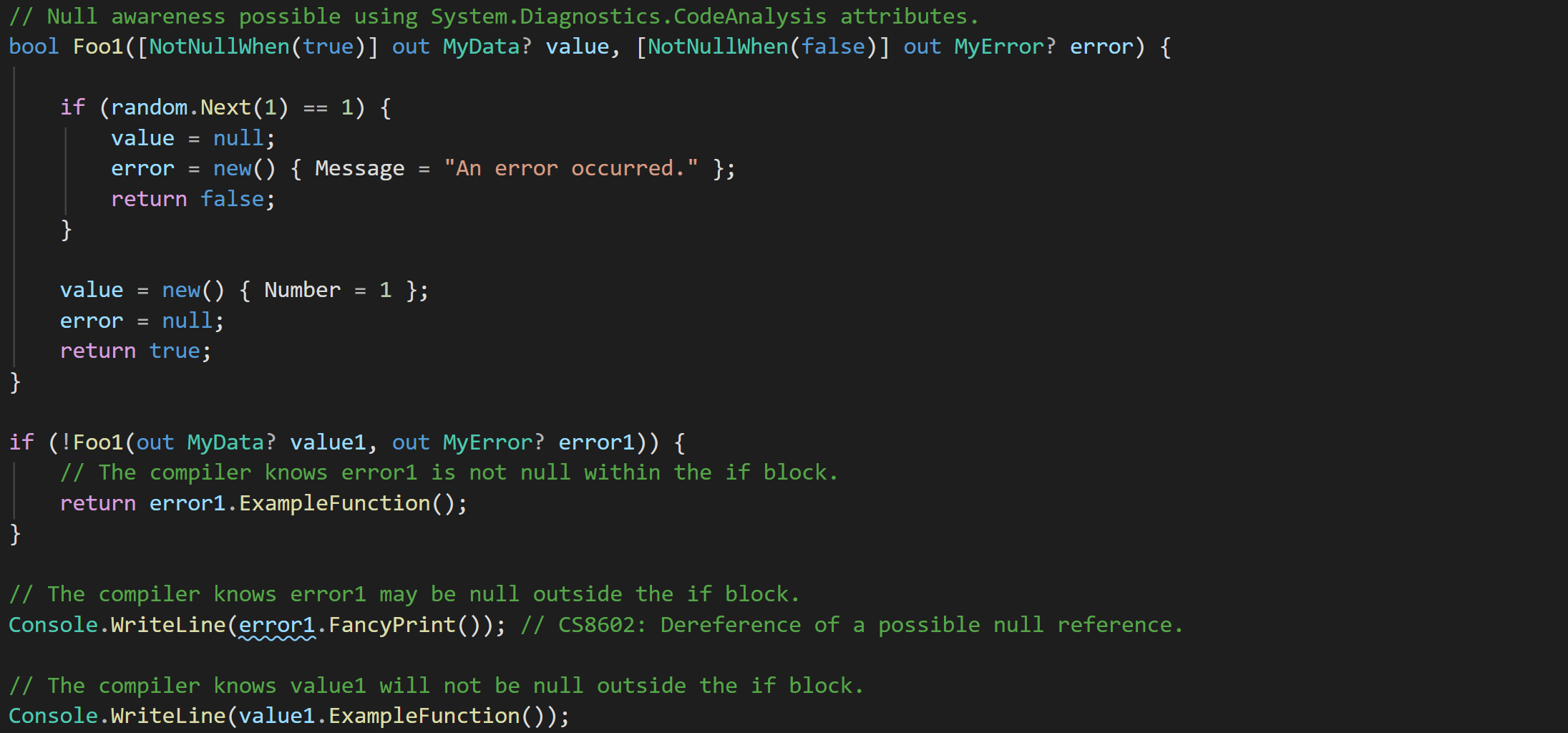
Unfortunately, this is not possible for asynchronous methods because out parameters on async methods are not supported in C#. This library provides the AsyncTryResult<TValue, TError> and AsyncTryValueResult<TValue, TError> to fill this gap. Using these types you can write concise error handling code that is null-checked by the compiler.
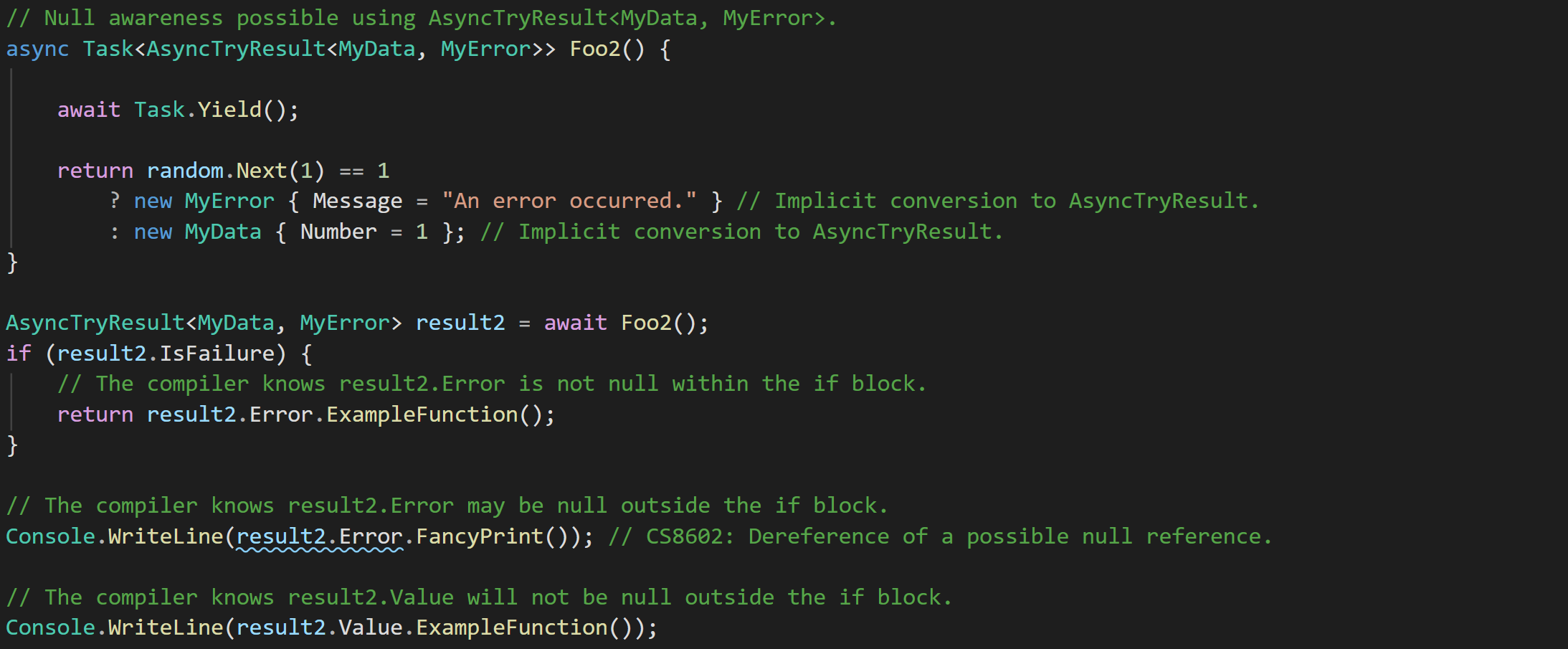
But Why This Result Type
A vast host of result type libraries are available in C#, each of which has a slightly different primary focus and feature set. Some focus on ASP.NET compatibility and out of the box conversions to HTTP results, some add discriminated-union-like functionality, and some provide more functional features and allow the fluent chaining of many operations.
AsyncTaskResult is optimized for the following:
- Very small and simple to understand (73 LOC excluding comments and whitespace).
- Does not provide opinionated errors. You are required to bring your own.
- Error handling that takes advantage of the compiler's null-checking.
- Extremely concise error handling when you only care if an operation was a success or failure.

Value Type Weirdness
I am not a CLR expert. I believe the following to be a reasonable explanation, but feel free to correct me.
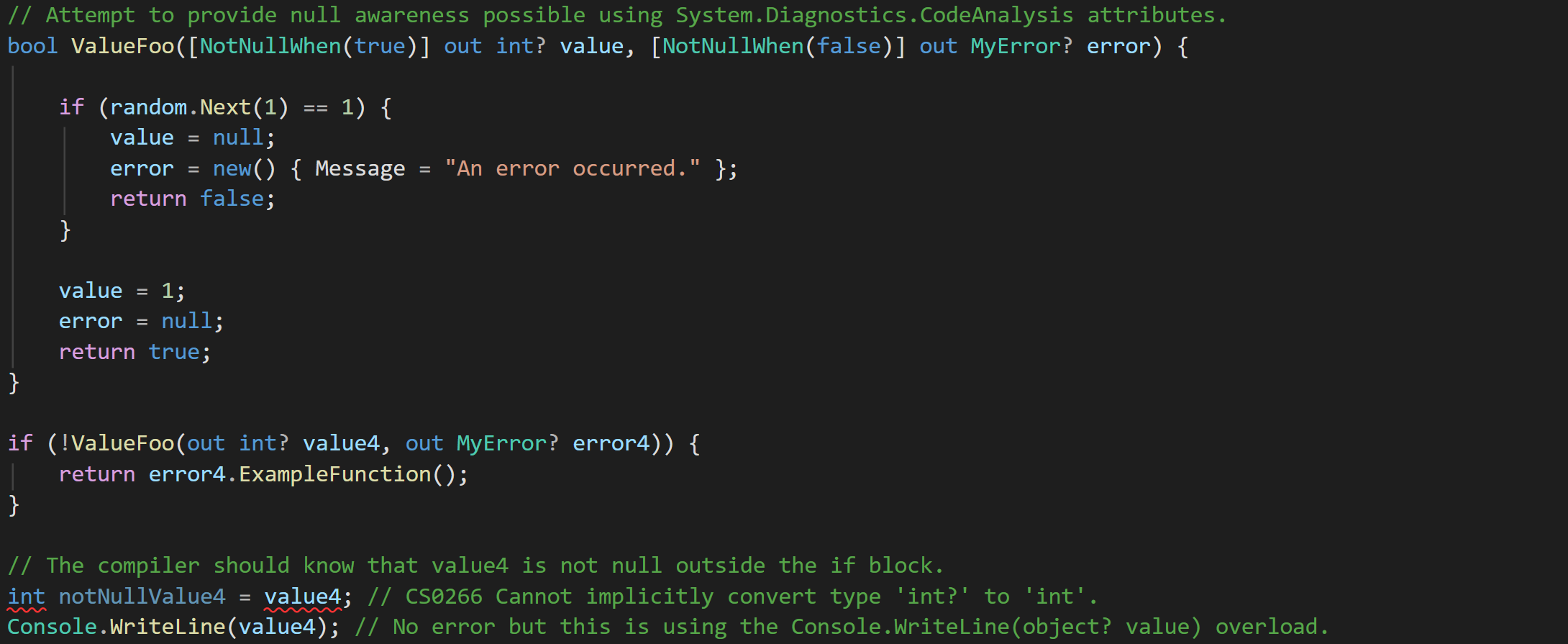
C# handles nullable value types differently than nullable reference types. Instead of tracking the nullability of reference types with compile time static analysis, nullable value types are syntactic sugar for System.Nullable<T>. The unfortunate side effect of this is that the System.Diagnostics.CodeAnalysis attributes – such as [NotNullWhen], which can be used to narrow nullable reference types at compile time, do not work with nullable value types. Some problematic examples caused by this are shown below.
In the first example, ValueFoo() uses a [NotNullWhen(true)] attribute to indicate that the out parameter, value, is not null when the function returns true. If this worked with value types as it does with reference types, the compiler would know that value4 was not null after the close of the if-block. However, as can be seen in the example below, this is evidently not the case.
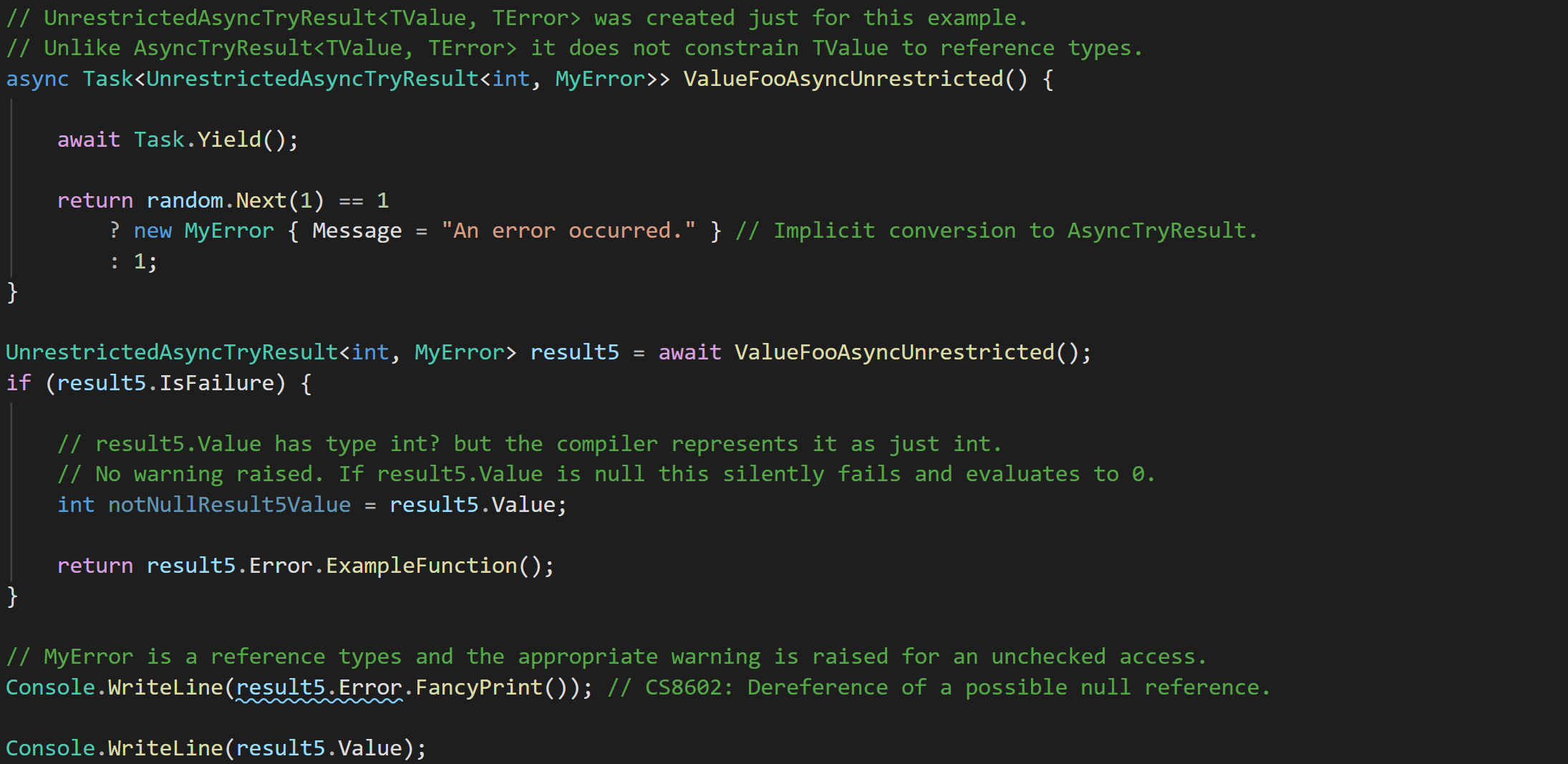
The second example is more dangerous and is the reason why TValue and TError are constrained to reference types in AsyncTryResult<int, MyError>.
In this example, ValueFooAsyncUnrestricted() returns a UnrestrictedAsyncTryResult<int, MyError> – a type created specifically for this example. This object has properties TError? Error, TValue? Value, bool IsSuccess, and bool IsFailure. The latter two properties are decorated with [MemberNotNullWhen] attributes indicating that the Value property is not null when IsSuccess is true, et cetera.
As shown in the code below, this works for the property Error, which is a reference type, and unchecked access to Error results in a compile time warning. In contrast, unchecked access to Value, which is a value type, does not yield any warning. Even more concerningly, if result5.Value is accessed while it is null, it silently fails and evaluates to 0. No NullReferenceException is raised.
Value Type Solution
To manage this difference, this library provides the AsyncTryValueResult<TValue, TError> type. This type restrict TValue to value types and wrap the value in a simple Box<T> reference type. The Box<T> defines implicit casts for converting to and from type T to allow for easy conversion. An example using AsyncTryValueResult<TValue, TError> is shown below.
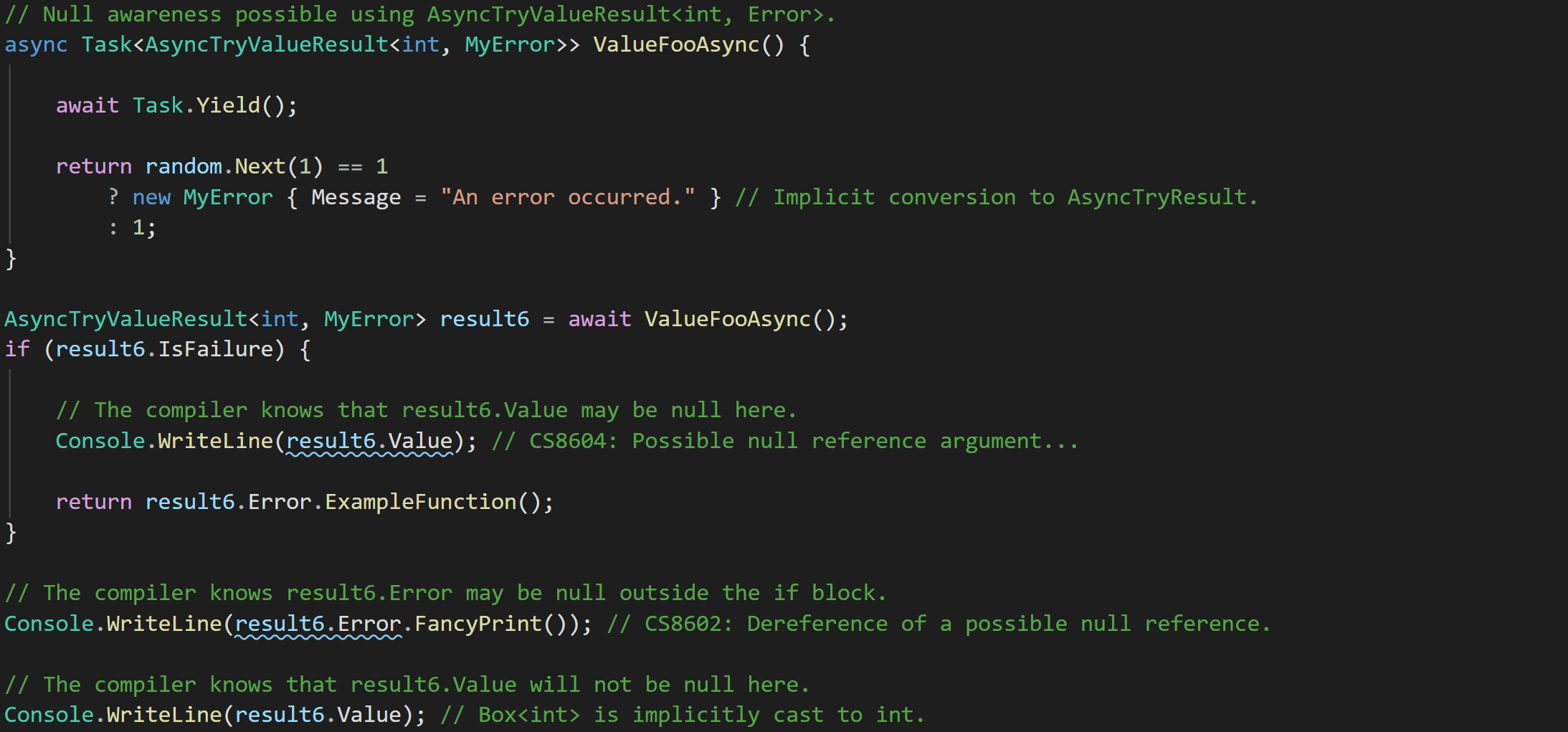
If desired, it is also possible wrap the out parameters of a synchronous method with the Box<T> type receive proper null type narrowing.
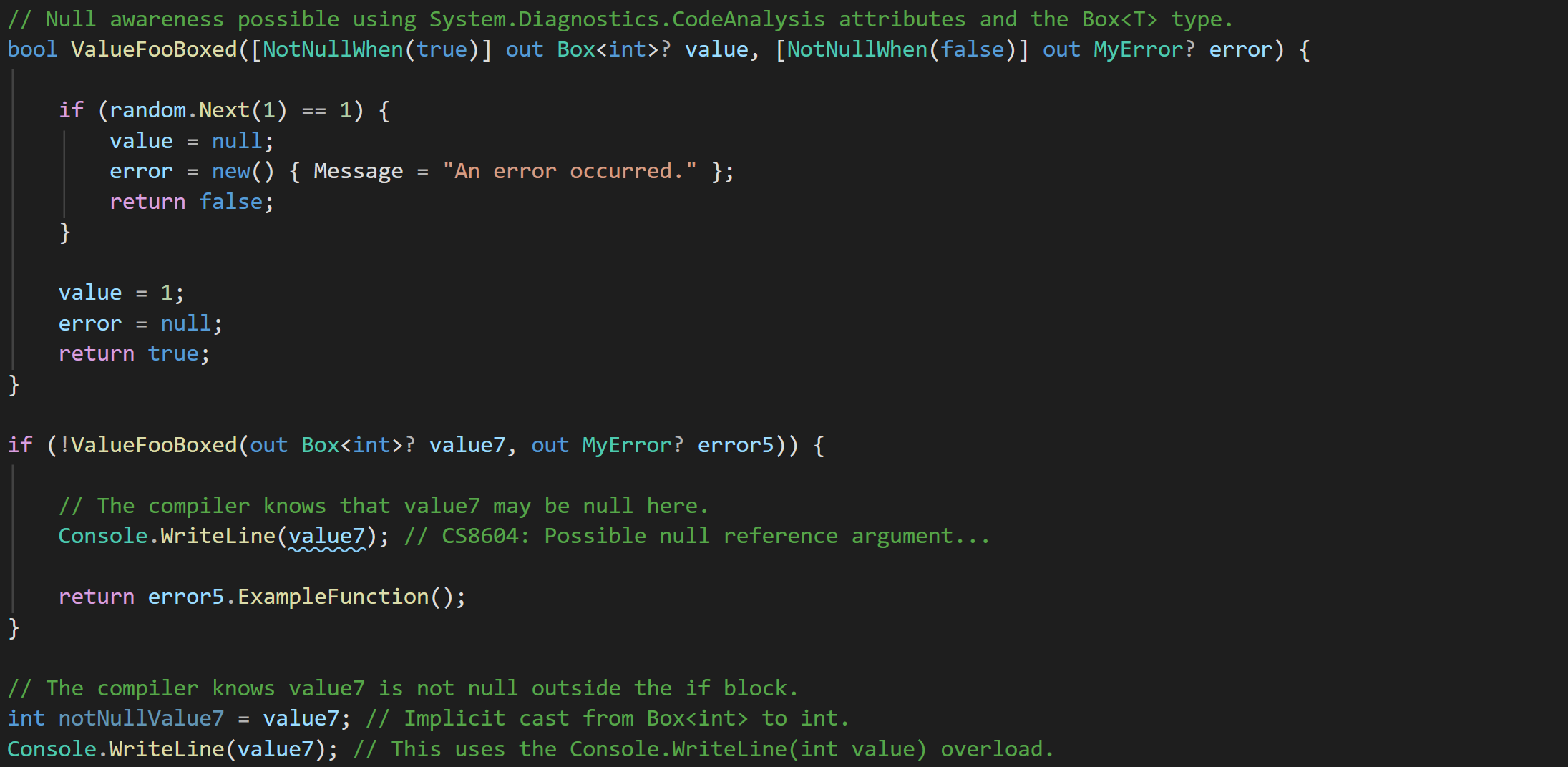
No alternative type is provided to support value types for TError. This choice was made because it is expected that most users will use strings or classes/records as TError, both of which are reference types.
It's a bit clunky that I need to have separate types for reference and value types, but if Microsoft can have Task<> and ValueTask<> then I can do this. I could have made AsyncTryResult box its values too and just had one result type, but I am afraid that dealing with Box<T> will be awkward in some situations; implicit casts can only take you so far in my experience. It would be ideal if C# treated nullable reference and value types the same, but I assume doing so would require substantial breaking changes. Perhaps its better we don't have ".NET Core 2: Electric Boogaloo".
| Product | Versions Compatible and additional computed target framework versions. |
|---|---|
| .NET | net10.0 is compatible. net10.0-android was computed. net10.0-browser was computed. net10.0-ios was computed. net10.0-maccatalyst was computed. net10.0-macos was computed. net10.0-tvos was computed. net10.0-windows was computed. |
-
net10.0
- No dependencies.
NuGet packages
This package is not used by any NuGet packages.
GitHub repositories
This package is not used by any popular GitHub repositories.