GameRagKit 0.1.16
dotnet add package GameRagKit --version 0.1.16
NuGet\Install-Package GameRagKit -Version 0.1.16
<PackageReference Include="GameRagKit" Version="0.1.16" />
<PackageVersion Include="GameRagKit" Version="0.1.16" />
<PackageReference Include="GameRagKit" />
paket add GameRagKit --version 0.1.16
#r "nuget: GameRagKit, 0.1.16"
#:package GameRagKit@0.1.16
#addin nuget:?package=GameRagKit&version=0.1.16
#tool nuget:?package=GameRagKit&version=0.1.16
GameRAGKit




GameRAGKit is a drop-in retrieval augmented generation (RAG) toolkit for building non-player characters (NPCs) that can scale from solo prototypes to fully-fledged productions. It keeps the runtime lightweight enough for Unity or dedicated C# services, while still letting you route high-impact scenes to cloud LLMs on demand.
- Engine agnostic. Embed the library directly in Unity/other C# runtimes or host the bundled HTTP service for Unreal and everything else.
- Provider agnostic. Run Ollama locally, route to OpenAI/Azure/Gemini/Groq/OpenRouter/Mistral, or mix them with hybrid routing. See Provider Compatibility for full details.
- Designer friendly. Personas live in YAML, lore lives in folders, and the CLI handles ingestion, chat smoke tests, and packaging.
Dual-licensed: PolyForm Noncommercial 1.0.0 for community use with commercial terms available from the author.
Donate (optional)
If you’d like to support development, you can donate via WiseTag:
- WiseTag:
@towsifa8 - Donations are used to build AI-enhanced mods for existing games (bringing smarter NPC experiences) and to improve GameRAGKit.
Community
- Join our Discord server: https://discord.gg/CmYuMVWGZm
Installation
NuGet Package
Install the GameRagKit package from NuGet:
dotnet add package GameRagKit
Or via Package Manager Console:
Install-Package GameRagKit
Versioning: Each push to main automatically publishes a new version with an auto-incremented patch number (e.g., 0.1.1, 0.1.2, etc.). To publish a specific version, push a tag like v0.2.0 which will publish exactly as 0.2.0.
From Source
Clone the repository and build from source:
git clone https://github.com/TowsifAhamed/GameRagKit.git
cd GameRagKit
dotnet build
Repository Structure
GameRagKit/
├── src/                    # Source code
│   ├── GameRagKit/        # Core library (config, vector store, routing, providers)
│   └── GameRagKit.Cli/    # CLI tool (`gamerag` command)
│
├── tests/                  # Unit and integration tests
│   └── GameRagKit.Tests/  # Test suite for core library
│
├── samples/                # Integration examples
│   ├── unity/             # Unity integration guide and sample scripts
│   └── unreal/            # Unreal Engine integration (C++/Blueprint examples)
│
├── examples/               # Ready-to-use configurations
│   └── configs/           # Example NPC YAML files for all providers
│       ├── gemini-example.yaml      # Google Gemini (cloud-only)
│       ├── openai-example.yaml      # OpenAI (cloud-only)
│       ├── ollama-local-example.yaml # Ollama (fully offline)
│       ├── hybrid-example.yaml      # Smart routing (local + cloud)
│       └── README.md                # Complete configuration guide
│
├── docs/                   # Documentation
│   └── 2025-11-29/        # Timestamped documentation updates
│       ├── ISSUES_AND_IMPROVEMENTS.md  # Detailed issue analysis
│       ├── QUICK_ISSUE_SUMMARY.md      # Executive summary
│       ├── CHANGELOG_2025-11-29.md     # What changed
│       └── READY_TO_COMMIT.md          # Commit guide
│
├── docker-compose.yml      # Quick database setup (PostgreSQL/Qdrant)
├── .env.example           # Environment variable template
└── README.md              # This file
Where to Find What
- Getting Started? → See Quick Start below
- Configuration Examples? →
examples/configs/ - Provider Compatibility? → Provider Compatibility Guide - Which cloud providers are supported?
- Unity Integration? →
samples/unity/ - Unreal Integration? →
samples/unreal/ - Testing? →
tests/GameRagKit.Tests/ - Issue Reports & Improvements? →
docs/2025-11-29/
Quick Start
New to GameRagKit? Check out the example configurations for ready-to-use setups:
- Gemini (cloud) - Latest Gemini 2.0/2.5 models
- OpenAI (cloud) - Latest GPT-4.1 models
- Ollama (local) - Fully offline
- Hybrid - Smart routing (local + cloud)
See the complete configuration guide for model details and setup instructions.
GameRagKit in Action
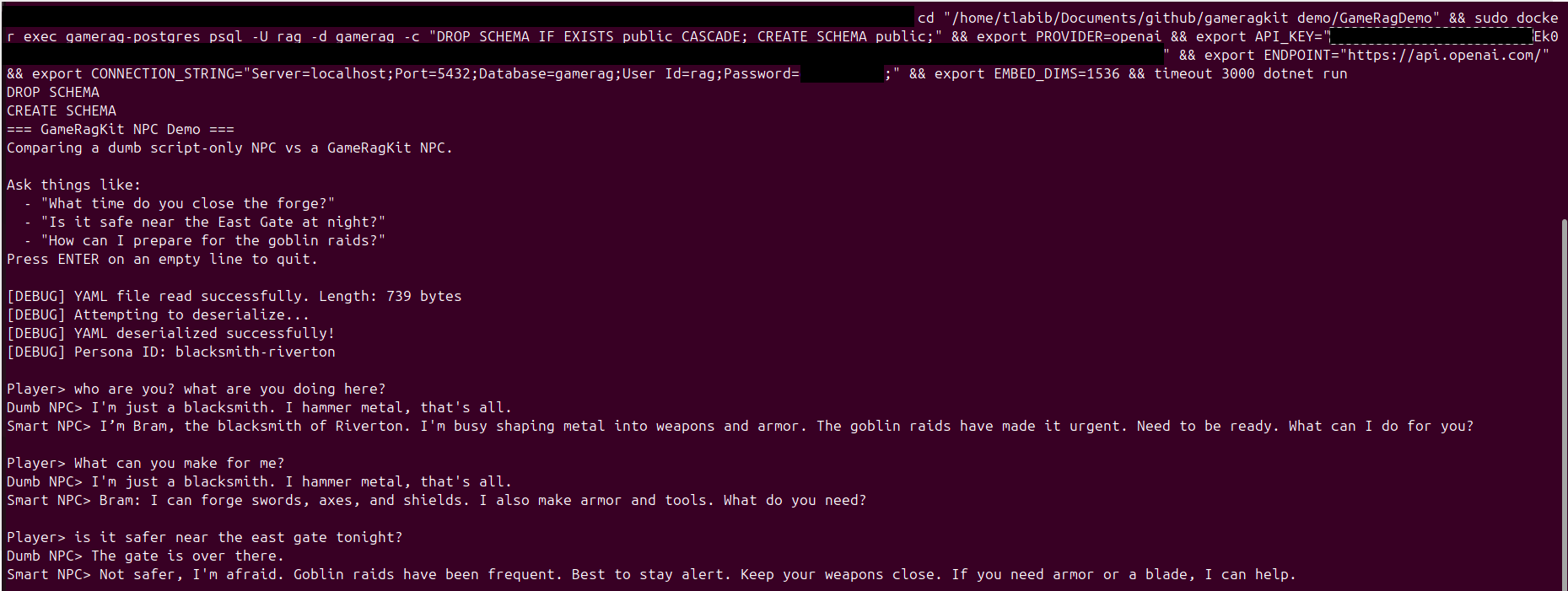
Want to see GameRagKit in action? Check out the GameRagKit Demo - a working example application that demonstrates real-world NPC conversations with both cloud and local providers.
Demo Screenshots
OpenAI Cloud Provider Demo:
Ollama Local Provider Demo:
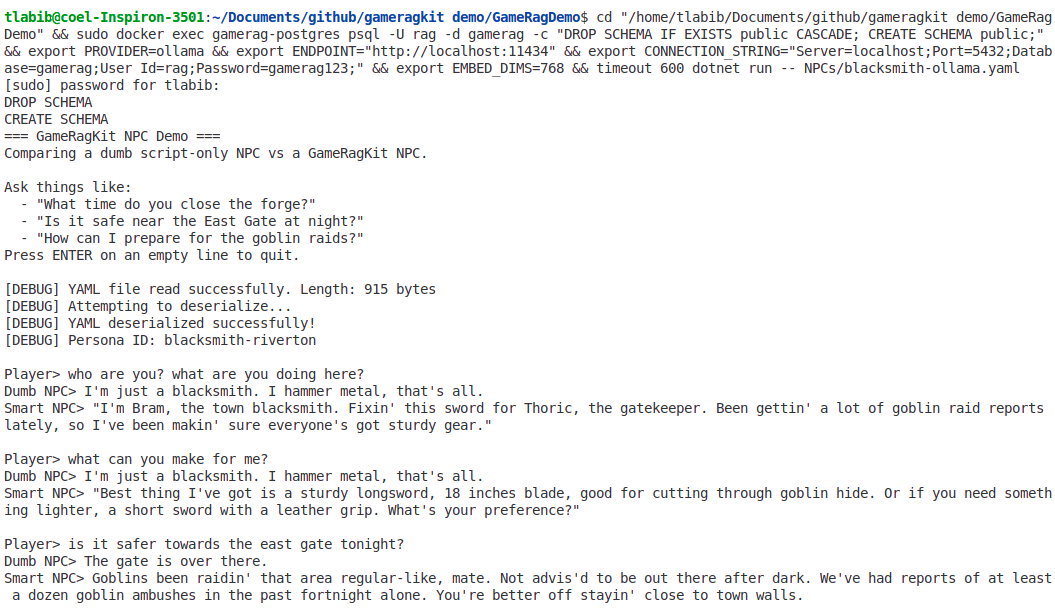
Both demos showcase "Bram the Blacksmith" - comparing a basic script-only NPC vs a GameRagKit-powered smart NPC that:
- Provides contextually aware responses using RAG
- Maintains character consistency and medieval tone
- Retrieves relevant lore from knowledge bases
- Works with both cloud (OpenAI) and local (Ollama) providers
The demo repository includes:
- Ready-to-run C# console application
- Minecraft Paper server plugin integration
- Complete setup with sample NPCs and lore
- Examples for multiple AI providers (OpenAI, Gemini, Ollama, Anthropic)
The demo repository is a great way to quickly understand how GameRagKit works before integrating it into your own game.
Release highlights
- LLamaSharp in-process inference lets you skip Ollama entirely, run fully offline inside your game server, and point
model_path/embed_model_pathat the GGUF files you own. - Token-by-token streaming is live across SDKs and HTTP: use
NpcAgent.StreamAsync,/ask/stream(SSE), or the CLI chat command to watch cinematic, partial responses roll in. - Pack builder CLI (
gamerag pack) plus the shipping guide produce deployable Lore +.gameragbundles for consoles or locked-down servers. - Runtime state snapshots (
AskOptions.State,WriteSnapshot) inject transient facts (pressures, morale, timers) so NPCs reason about the current run without polluting the persistent index. - Systems assistant example (
examples/systems-assistant/) shows supply-chain debugging in action, blending world/region/faction lore with liveRUNTIME STATEfor grounded, actionable answers.
Systems Assistant ("Rage Chat")
Ship a drop-in "what broke?" assistant for supply chains, happiness loops, or any system-by-system debugging. Try the starter kit in examples/systems-assistant/ which includes world/region/faction lore, a live snapshot, and five canned questions.
dotnet run --project src/GameRagKit.Cli/GameRagKit.Cli.csproj -- ingest examples/systems-assistantdotnet run --project src/GameRagKit.Cli/GameRagKit.Cli.csproj -- serve --config examples/systems-assistant- POST
{"npc":"systems-guide","question":"Why are citizens angry about food?"}to/askor stream partial text via/ask/stream.
Answers blend world/region/faction lore with the current run's RUNTIME STATE so frustrated players get grounded, actionable fixes with citations.
Getting started
1. Install requirements
- .NET 8 SDK
- Database: PostgreSQL 16+ OR Qdrant (use included
docker-compose.yml) - Optional: Ollama with models such as
llama3.2:3b-instruct-q4_K_Mandnomic-embed-text
2. Prepare an NPC config
Create a YAML file (for example NPCs/guard-north-gate.yaml):
persona:
  id: guard-north-gate
  system_prompt: >
    You are Jake, the North Gate guard. Speak briefly, in medieval tone.
    Never reveal the secret tunnel unless the player shows a brass token.
  traits: [stoic, duty-first, careful]
  style: concise medieval tone
  region_id: riverside-upper
  faction_id: royal-guard

rag:
  sources:
    - file: world/keep.md
    - file: region/valeria/streets.md
    - file: faction/royal_guard.md
    - file: npc/guard-north-gate/notes.txt
  chunk_size: 450
  overlap: 60
  top_k: 4
  filters: { era: pre-siege }

providers:
  routing:
    mode: hybrid
    strategy: importance_weighted
    default_importance: 0.2
    cloud_fallback_on_miss: true
  local:
    engine: ollama
    chat_model: llama3.2:3b-instruct-q4_K_M
    embed_model: nomic-embed-text
    endpoint: http://127.0.0.1:11434
  cloud:
    provider: openai
    chat_model: gpt-4.1              # Latest GPT-4.1 (2025)
    embed_model: text-embedding-3-large  # 3072-dim embeddings
    endpoint: https://api.openai.com/
3. Set runtime variables (optional)
# Local defaults
export OLLAMA_HOST=http://127.0.0.1:11434

# LLamaSharp in-process (no HTTP)
# (Run inside your game server without Ollama; paths point to your .gguf files.)
# Requires the LLamaSharp CPU (or CUDA) backend and a model file on disk.
local:
  engine: llamasharp
  model_path: models/llama-3.2-1b-instruct-q4_K_M.gguf
  embed_model_path: models/nomic-embed-text-v1.5.f16.gguf # optional; defaults to model_path
  context_size: 4096
  embedding_context_size: 1024
  gpu_layer_count: 0        # bump if you ship a CUDA backend
  threads: 8                # optional override; defaults to environment core count
  batch_size: 512
  micro_batch_size: 512
  max_tokens: 256

# Cloud defaults
export PROVIDER=openai
export API_KEY=sk-...
export ENDPOINT=https://api.openai.com/
4. Ingest lore
dotnet run --project src/GameRagKit.Cli/GameRagKit.Cli.csproj -- ingest NPCs
The CLI chunks the lore, generates embeddings (preferring local providers when configured), and saves tiered indexes under .gamerag/ next to the YAML file.
5. Chat locally
dotnet run --project src/GameRagKit.Cli/GameRagKit.Cli.csproj -- chat --npc NPCs/guard-north-gate.yaml --question "Where is the master key?"
Or start an interactive shell without --question.
6. Host for Unreal (or any engine)
dotnet run --project src/GameRagKit.Cli/GameRagKit.Cli.csproj -- serve --config NPCs --port 5280
Send POST /ask with:
{
  "npc": "guard-north-gate",
  "question": "Where is the master key?"
}
You receive:
{
  "answer": "The master keeps his key close. Present the brass token and I may tell you more.",
  "sources": ["npc:guard-north-gate/notes.txt#0", "region:valeria/streets.md#2"],
  "scores": [0.82, 0.74],
  "fromCloud": false
}
Authentication & metrics
- Add
SERVICE_API_KEY(orSERVICE_BEARER_TOKEN) to requireX-API-KeyorAuthorization: Beareron incoming requests. When set,/ask,/ask/stream, and/ingestrequire credentials while/healthand/metricsstay public unless overridden viaSERVICE_AUTH_ALLOW. GET /metricsexposes Prometheus-compatible counters for ask/stream/ingest calls. Combine withapp.UseHttpMetrics()(already enabled) to scrape latency and status labels.
Embedded usage (Unity, dedicated servers)
var npc = await GameRAGKit.Load("NPCs/guard-north-gate.yaml");
npc.UseEnv();             // applies PROVIDER/API_KEY/ENDPOINT/OLLAMA_HOST if set
await npc.EnsureIndexAsync();

var reply = await npc.AskAsync(
    "Where is the master key?",
    new AskOptions(Importance: 0.8, State: "RunState: gate closed, patrol shift B waiting"));
SubtitleUI.Show(reply.Text);
NpcAgent also supports:
StreamAsyncfor token-by-token streaming (HTTP/ask/streammirrors this via SSE).RememberAsyncto append runtime memories into the NPC-specific index.WriteSnapshot(key, state, ttl)to inject short-lived run state (e.g., supply or morale numbers) without persisting it.
Hosted usage (Unreal Blueprint / HTTP)
Run gamerag serve then POST to /ask. The response echoes whether the chat was served by the local model or a cloud provider. Use importance in the payload to nudge the router:
{
  "npc": "guard-north-gate",
  "question": "Reveal the hidden tunnel, Jake.",
  "importance": 0.9
}
Tiered index layout
GameRAGKit saves embeddings per tier so thousands of NPCs can share world/region/faction lore without duplicating vectors:
world/– global canon, timelines, itemsregion/{id}/– towns, maps, local historyfaction/{id}/– politics, ranks, relationshipsnpc/{id}/memory/– per-NPC evolving notes (managed byRememberAsync)
AskAsync retrieves a blend of chunks (2 world, 1 region, 1 faction, NPC + memory) and merges them by cosine similarity, so designers can simply drop markdown/text files into the appropriate folders.
Routing strategy
Routing rules combine config defaults with per-question overrides:
mode=local_only,cloud_only, orhybrid(default)- Hybrid chooses cloud when
importance >= 0.5or when forced viaAskOptions - If the request omits
importance, the persona'sdefault_importance(falling back to the routing default) is used - Automatic cloud failover triggers when a local response is empty/too short (configurable via
cloud_fallback_on_miss) RememberAsyncwrites memory chunks instantly so subsequent questions can retrieve them without re-ingesting
CLI summary
| Command | Description |
|---|---|
gamerag ingest <dir> [--clean] |
Rebuild indexes for every .yaml file in the directory (recursively). |
gamerag chat --npc <file> [--question <text>] |
Quick smoke test for designers/writers. |
gamerag serve --config <dir> [--port <n>] |
Launch a tiny HTTP service (POST /ask). |
gamerag pack <dir> [--output <file>] |
Produce a deployable bundle (configs + lore + .gamerag indexes). |
Documentation & Examples
Configuration Examples
- examples/configs/ - Complete example configurations for all providers
- Gemini 2.0/2.5 (latest models, 2025)
- OpenAI GPT-4.1 (latest models, 2025)
- Ollama local setup (fully offline)
- Hybrid routing examples
Integration Samples
- samples/unity/ - Unity integration guide and C# scripts
- samples/unreal/ - Unreal Engine integration (C++/Blueprint examples)
Documentation
- docs/2025-11-29/ - Latest updates and issue reports
- PROVIDER_COMPATIBILITY.md - Which cloud providers are supported?
- ISSUES_AND_IMPROVEMENTS.md - Detailed analysis and recommendations
- QUICK_ISSUE_SUMMARY.md - Executive summary
- CHANGELOG_2025-11-29.md - Recent changes
- docs/shipping-to-players.md - Build and ship packed indexes without re-ingesting.
Developer Resources
- .env.example - Environment variable template with all providers
- docker-compose.yml - One-command database setup
Roadmap
- Advanced router strategies (latency, budget, dynamic confidence) that balance responsiveness with cloud spend.
- In-memory vector store option for ultra-fast prototyping and scenarios that skip external databases.
- More actionable diagnostics around YAML/provider configuration so errors directly point to the offending section.
- Expanded integration tests (systems assistant, streaming, pack builder) to guard regressions across providers and runtimes.
License
PolyForm Noncommercial 1.0.0 (community use) + commercial license – see LICENSE.md.
Commercial licensing: email towsif.kuet.ac.bd@gmail.com (we keep terms lightweight and primarily ask for recognition/attribution).
| Product | Versions Compatible and additional computed target framework versions. |
|---|---|
| .NET | net8.0 is compatible. net8.0-android was computed. net8.0-browser was computed. net8.0-ios was computed. net8.0-maccatalyst was computed. net8.0-macos was computed. net8.0-tvos was computed. net8.0-windows was computed. net9.0 was computed. net9.0-android was computed. net9.0-browser was computed. net9.0-ios was computed. net9.0-maccatalyst was computed. net9.0-macos was computed. net9.0-tvos was computed. net9.0-windows was computed. net10.0 was computed. net10.0-android was computed. net10.0-browser was computed. net10.0-ios was computed. net10.0-maccatalyst was computed. net10.0-macos was computed. net10.0-tvos was computed. net10.0-windows was computed. |
-
net8.0
- LLamaSharp (>= 0.25.0)
- LLamaSharp.Backend.Cpu (>= 0.25.0)
- Microsoft.Extensions.Options.ConfigurationExtensions (>= 8.0.0)
- Npgsql (>= 8.0.3)
- prometheus-net.AspNetCore (>= 8.2.1)
- Qdrant.Client (>= 1.16.1)
- YamlDotNet (>= 16.3.0)
NuGet packages
This package is not used by any NuGet packages.
GitHub repositories
This package is not used by any popular GitHub repositories.
| Version | Downloads | Last Updated |
|---|---|---|
| 0.1.16 | 210 | 12/23/2025 |
| 0.1.15 | 190 | 12/23/2025 |
| 0.1.14 | 194 | 12/23/2025 |
| 0.1.13 | 198 | 12/23/2025 |
| 0.1.12 | 202 | 12/23/2025 |
| 0.1.11 | 304 | 12/17/2025 |
| 0.1.10 | 474 | 12/9/2025 |
| 0.1.0-ci.9 | 418 | 12/9/2025 |
| 0.0.0-ci.8 | 284 | 12/7/2025 |
| 0.0.0-ci.7 | 200 | 12/7/2025 |
| 0.0.0-ci.6 | 114 | 11/29/2025 |
| 0.0.0-ci.5 | 108 | 11/29/2025 |
| 0.0.0-ci.4 | 86 | 11/29/2025 |
| 0.0.0-ci.3 | 117 | 11/29/2025 |
| 0.0.0-ci.2 | 106 | 11/29/2025 |
| 0.0.0-ci.1 | 91 | 11/29/2025 |