MetricsReporter.Tool
0.4.1
dotnet tool install --global MetricsReporter.Tool --version 0.4.1
dotnet new tool-manifest
dotnet tool install --local MetricsReporter.Tool --version 0.4.1
#tool dotnet:?package=MetricsReporter.Tool&version=0.4.1
nuke :add-package MetricsReporter.Tool --version 0.4.1
MetricsReporter
Turn your C# chaos into Coupling < 5 and Complexity < 15. In one prompt. Measurably.





MetricsReporter is a .NET 8 CLI tool that aggregates code coverage, complexity, coupling, and analyzer violations from three independent sources into one interactive dashboard — then lets you (or your AI agent) fix everything via a structured refactoring loop.
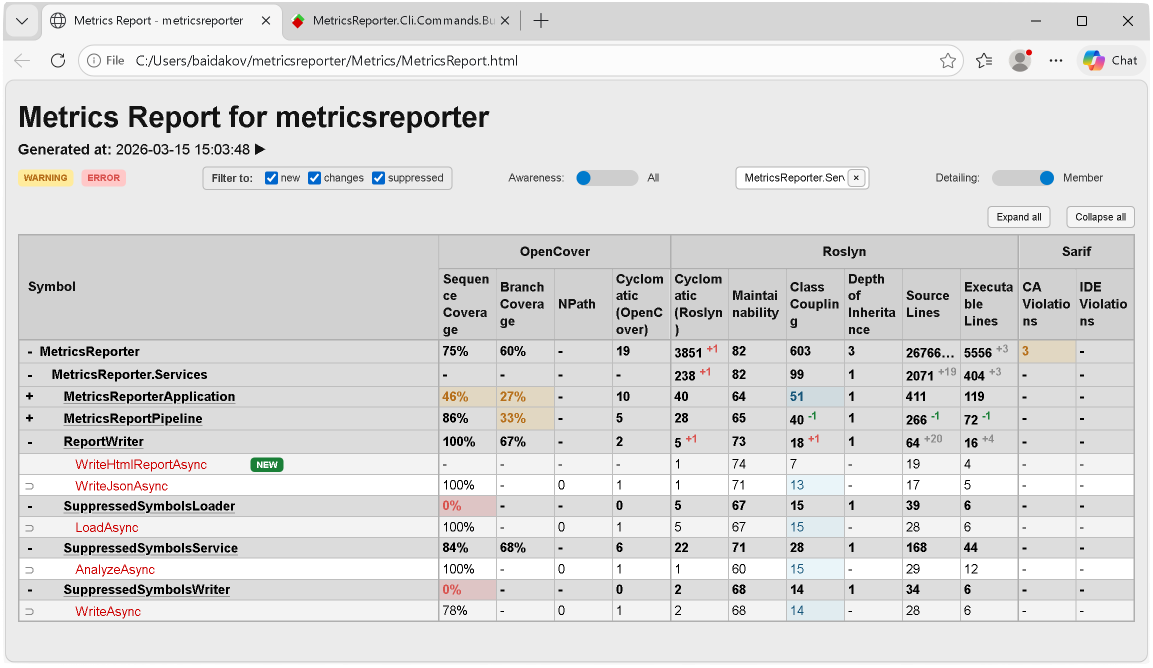
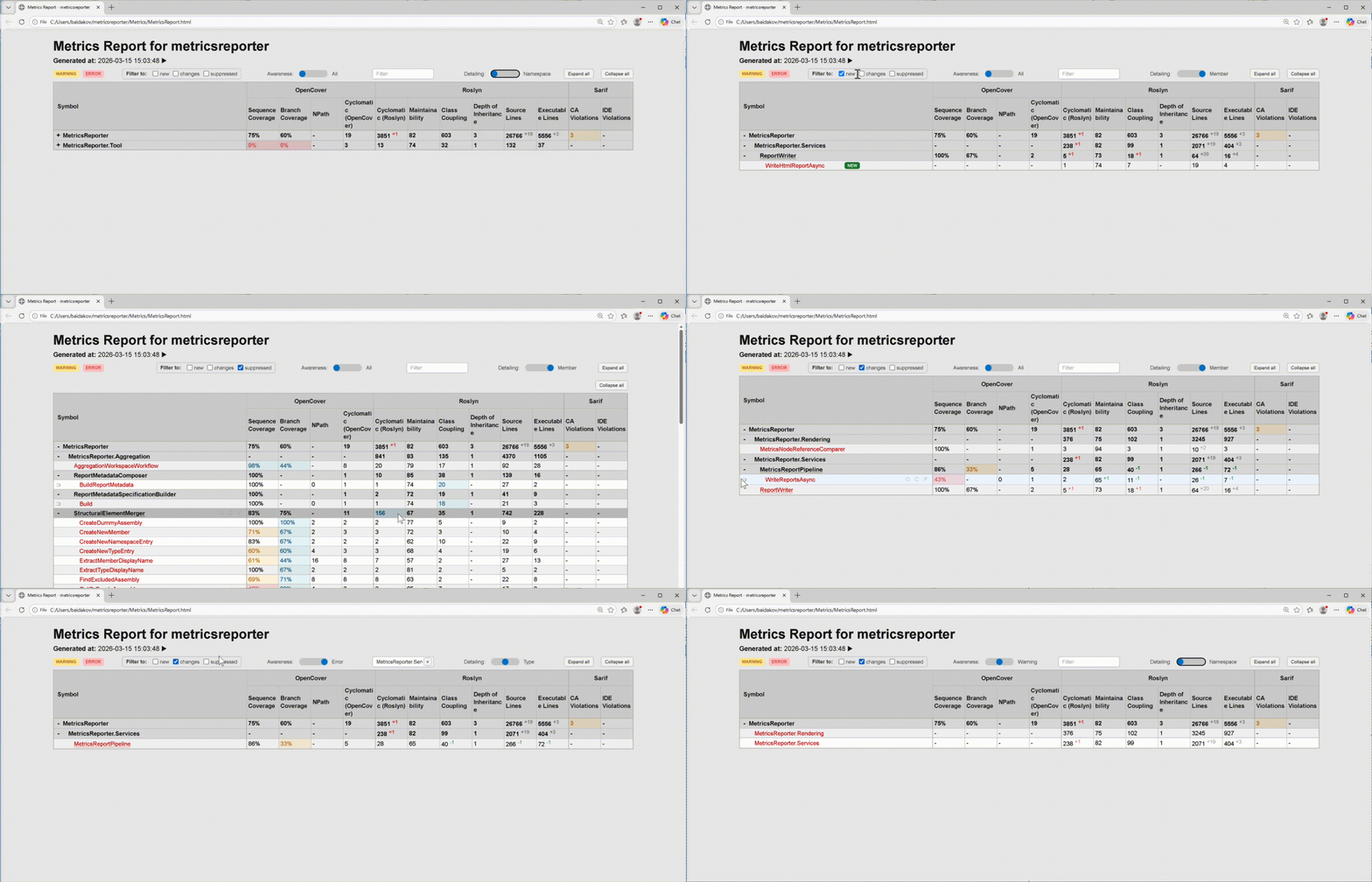
🎯 The Problem
Your C# project has growing tech debt. You feel the code is getting worse, but:
- Coverage data lives in OpenCover XML, Roslyn metrics are in a separate XML, SARIF violations in yet another file
- No single dashboard shows coupling, complexity, coverage, and analyzer violations together
- You can't measure whether a refactoring actually helped
- AI agents don't know which method to fix first or whether the fix worked
✅ The Solution
One command. Three sources. One dashboard. Measurable improvement.
MetricsReporter merges OpenCover (coverage), Roslyn (complexity & coupling), and SARIF (analyzer violations) into a unified report. Then it gives your AI coding agent a CLI to query, refactor, verify — in a loop — until every metric is green.
🤖 AI-Driven Refactoring
Hand your AI agent a namespace and a metric. It reads the violation, studies the code, refactors, rebuilds, verifies — all through the CLI. No human in the loop.
# AI agent asks: "what's broken?"
metricsreporter read --namespace MyApp.Services --metric Coupling --symbol-kind Any

# AI agent fixes the code, rebuilds, then verifies:
metricsreporter test --symbol MyApp.Services.OrderProcessor --metric Coupling
# → { "isOk": true }  ✅

Built-in refactoring prompts for complexity, coupling, and coverage — ready for Copilot, Cursor, or any AI agent
Cover 1,000 lines of code with tests. Automatically. The coverage workflow reads violations, writes NUnit tests with mocks, runs them, collects coverage, and verifies — until every branch is green.
📊 Interactive HTML Dashboard
Drill down from Solution → Assembly → Namespace → Type → Method. Filter instantly, toggle warning/error awareness, hover for metric details. No frameworks — pure JS, handles 50,000+ symbols without lag.
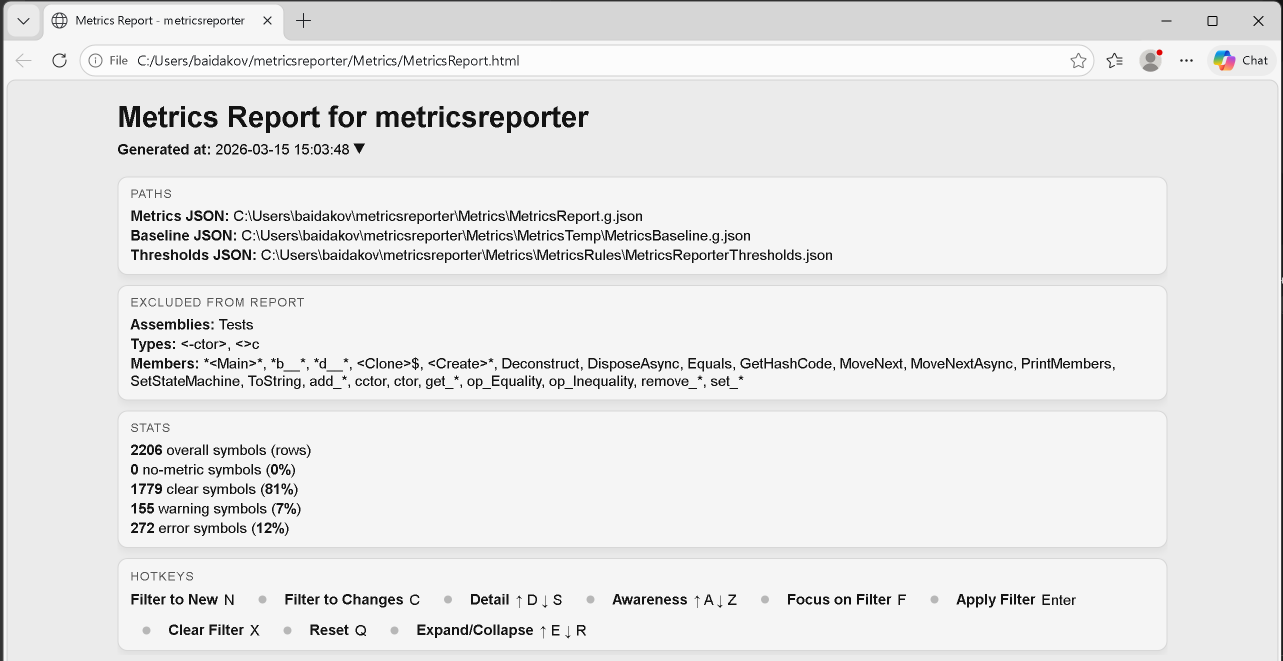
Aggregate statistics at a glance — coverage %, complexity distribution, violation counts
🔍 SARIF Violations with Breakdown
See exactly which CA/IDE rules fire at each level. Hover for rule descriptions, file paths, and line numbers.
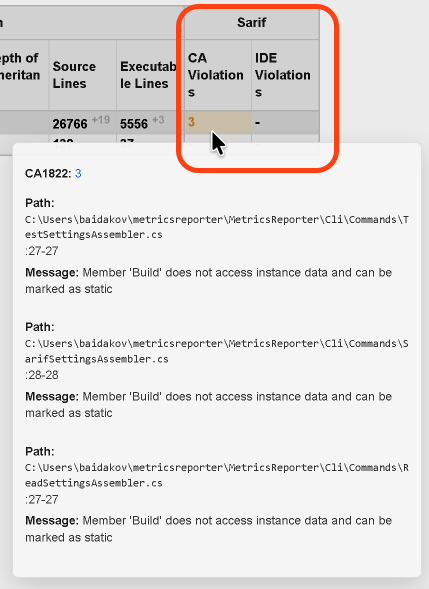
Hover any SARIF metric to see rule-by-rule breakdown with source locations
📈 ReportGenerator Integration
Seamless integration with ReportGenerator for interactive, line-by-line coverage visualization alongside your metrics dashboard.
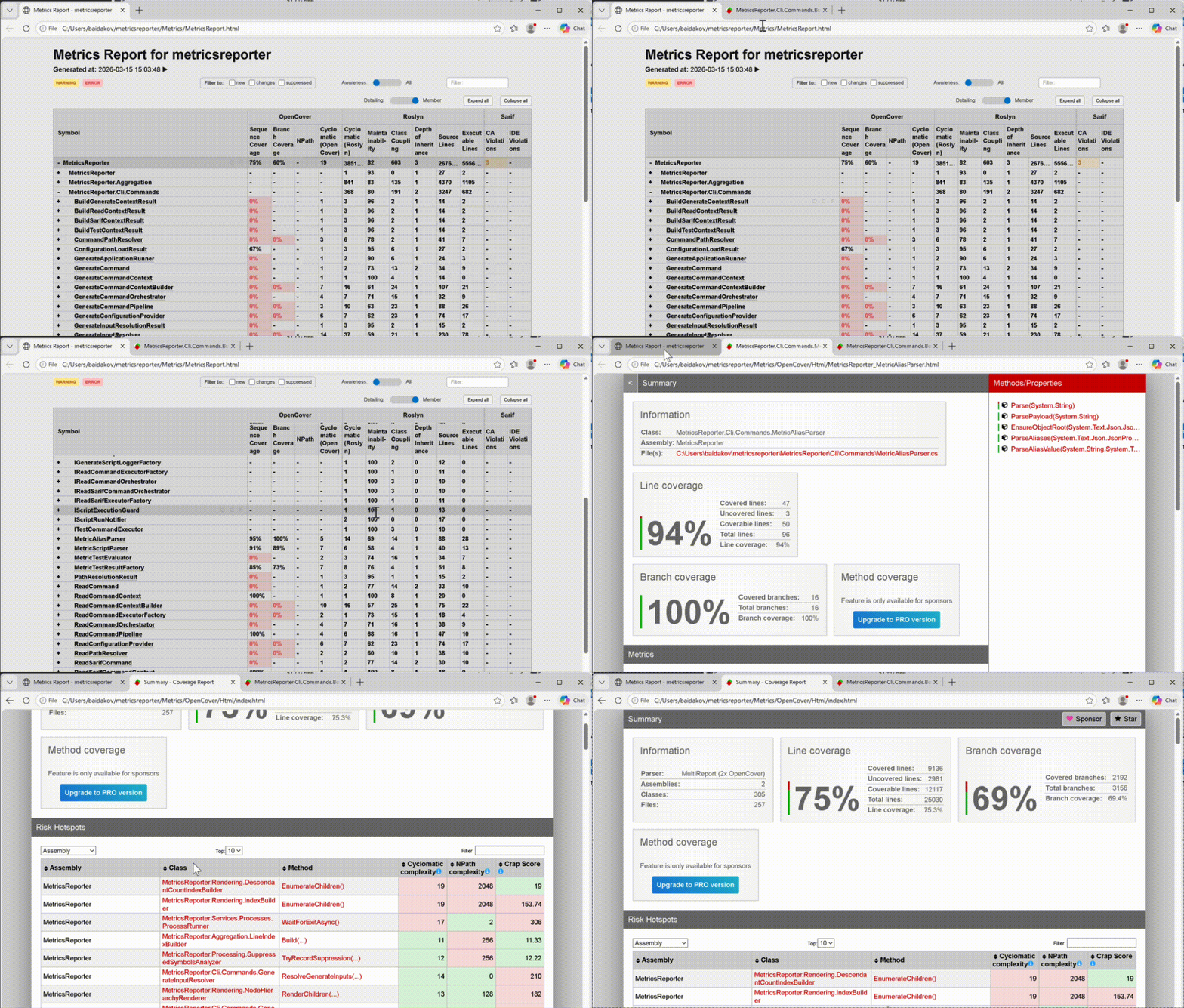
Line-by-line coverage maps powered by ReportGenerator
🛡️ Suppression System
Not every violation should be fixed. Mark intentional exceptions with [SuppressMessage] — they show up in the dashboard with justifications, not as false alarms.
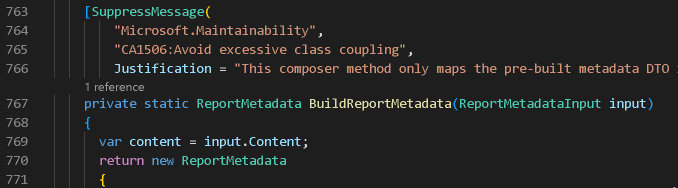
Suppression attribute in code
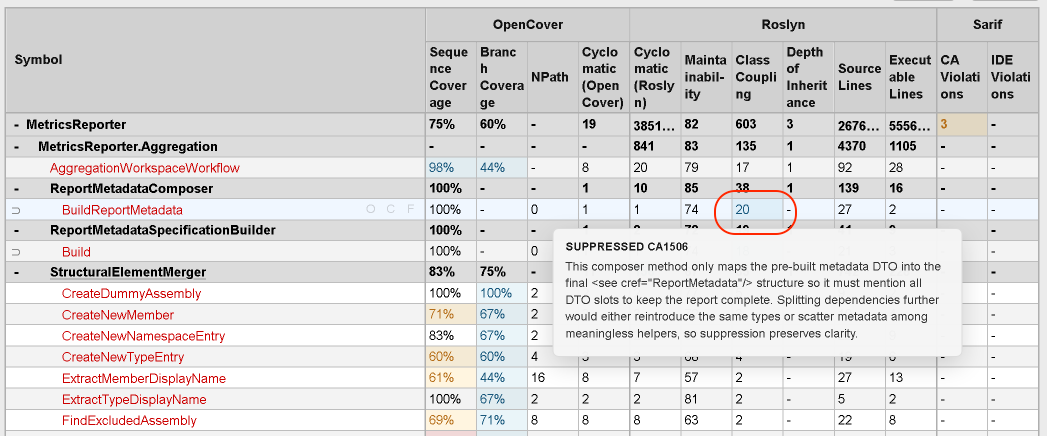
Suppression reflected in dashboard with justification tooltip
⚡ More Features
Baseline & Delta Tracking
Every run saves a baseline. Next run computes deltas automatically. See whether complexity went up or down, whether coverage improved, whether new violations appeared — per method.
Threshold Gates for CI
Define warning/error thresholds per metric per level. CLI exits with code 0 (pass) or non-zero (fail) — plug it straight into your pipeline.
{
  "RoslynClassCoupling": {
    "Type":   { "warning": 20, "error": 40 },
    "Member": { "warning": 5,  "error": 11 }
  },
  "RoslynCyclomaticComplexity": {
    "Type":   { "warning": 15, "error": 100 },
    "Member": { "warning": 15, "error": 100 }
  }
}
Smart Reconciliation
OpenCover assigns coverage to compiler-generated state machines. Roslyn lacks namespace data. MetricsReporter handles all of it — iterator coverage transferred to real methods, namespaces inferred, duplicates detected.
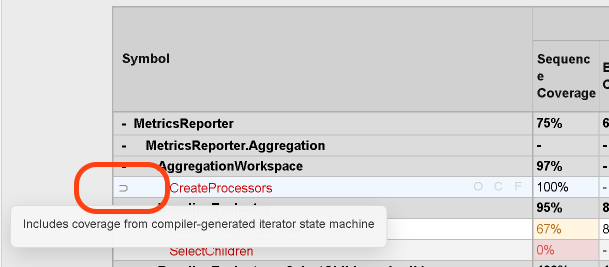
Iterator state machine coverage automatically attributed to the real method
🚀 Quick Start
Install
dotnet tool install --global MetricsReporter.Tool
Generate your first report
metricsreporter generate `
  --opencover coverage.xml `
  --roslyn metrics.xml `
  --sarif analyzers.sarif `
  --output-json report.json `
  --output-html report.html `
  --thresholds-file thresholds.json
Or use config-driven mode
Create .metricsreporter.json in your repo root and run:
metricsreporter generate
Query metrics
# Find coupling violations
metricsreporter read --namespace MyApp.Services --metric Coupling

# Verify a symbol passes thresholds
metricsreporter test --symbol MyApp.Services.OrderService.Process --metric Complexity

# Coverage violations grouped by type
metricsreporter read --namespace MyApp --metric OpenCoverBranchCoverage --group-by type
🤖 AI Agent Workflow
MetricsReporter ships with ready-to-use prompt files for AI agents:
| Prompt | What the agent does |
|---|---|
refactor-complexity.md |
Reduce cyclomatic complexity below thresholds |
refactor-coupling.md |
Reduce class coupling with DI, interfaces, DTOs |
refactor-coverage.md |
Write tests until branch coverage passes |
refactor-sarif.md |
Fix CA/IDE analyzer violations |
The loop:
1. metricsreporter read  → find violation
2. Study code            → plan refactoring
3. Refactor + build      → apply changes
4. metricsreporter test  → verify fix
5. Repeat until clean ✨
📋 Metrics Sources
| Source | Metrics |
|---|---|
| OpenCover | Sequence Coverage, Branch Coverage, Cyclomatic Complexity, NPath Complexity |
| Roslyn | Maintainability Index, Cyclomatic Complexity, Class Coupling, Depth of Inheritance, Lines of Code |
| SARIF | CA-prefix (FxCop), IDE-prefix analyzer violations with rule-level breakdown |
📖 Links
- GitHub: github.com/baidakovil/metricsreporter
- Documentation: Full Diataxis docs
- Changelog: CHANGELOG.md
- License: MIT
| Product | Versions Compatible and additional computed target framework versions. |
|---|---|
| .NET | net8.0 is compatible. net8.0-android was computed. net8.0-browser was computed. net8.0-ios was computed. net8.0-maccatalyst was computed. net8.0-macos was computed. net8.0-tvos was computed. net8.0-windows was computed. net9.0 was computed. net9.0-android was computed. net9.0-browser was computed. net9.0-ios was computed. net9.0-maccatalyst was computed. net9.0-macos was computed. net9.0-tvos was computed. net9.0-windows was computed. net10.0 was computed. net10.0-android was computed. net10.0-browser was computed. net10.0-ios was computed. net10.0-maccatalyst was computed. net10.0-macos was computed. net10.0-tvos was computed. net10.0-windows was computed. |
This package has no dependencies.