PouryaKit.ReverseProxy
0.1.0-preview.2
dotnet add package PouryaKit.ReverseProxy --version 0.1.0-preview.2
NuGet\Install-Package PouryaKit.ReverseProxy -Version 0.1.0-preview.2
<PackageReference Include="PouryaKit.ReverseProxy" Version="0.1.0-preview.2" />
<PackageVersion Include="PouryaKit.ReverseProxy" Version="0.1.0-preview.2" />
<PackageReference Include="PouryaKit.ReverseProxy" />
paket add PouryaKit.ReverseProxy --version 0.1.0-preview.2
#r "nuget: PouryaKit.ReverseProxy, 0.1.0-preview.2"
#:package PouryaKit.ReverseProxy@0.1.0-preview.2
#addin nuget:?package=PouryaKit.ReverseProxy&version=0.1.0-preview.2&prerelease
#tool nuget:?package=PouryaKit.ReverseProxy&version=0.1.0-preview.2&prerelease


PouryaKit.ReverseProxy
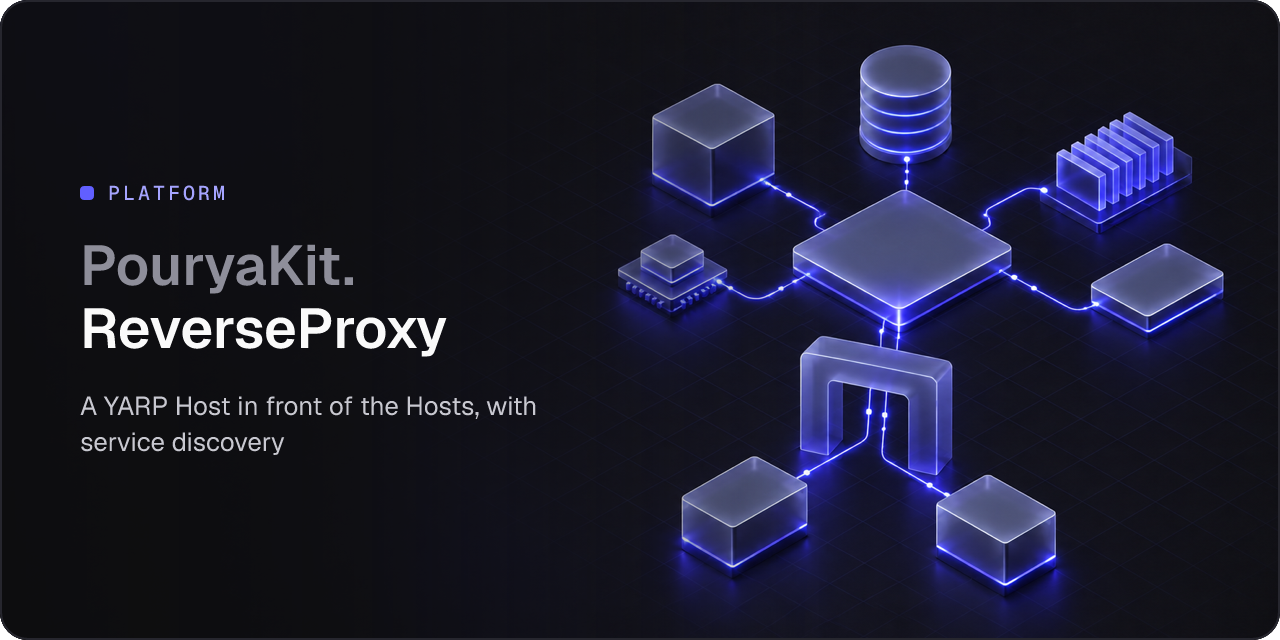
A Reverse proxy on YARP: an application of its own that sits in front of the system's Hosts. It forwards each request by the routes and clusters of its configuration to a Host that service discovery resolves, probes each Host's liveness path and takes a dead endpoint out of its cluster, and keeps the client's trace. It runs no Operation and references no Kit package.
Install
dotnet add package PouryaKit.ReverseProxy --prerelease
When to use it
- Several Hosts should answer clients on one address.
- A Module split out as a service keeps its paths, routed to its own Host.
- You want one trace from the client through the proxy to the Operation.
It sits in front of the Hosts of PouryaKit.Web, each of which authenticates its own clients, and an AppHost with PouryaKit.Aspire runs it locally.
Quick start
Compose the proxy as its own application, as the templates generate it. AddServiceDefaults() and MapDefaultEndpoints() are your solution's own service defaults, which no package ships: the templates generate them, and the Host recipes say what they hold:
var builder = WebApplication.CreateBuilder(args);
builder.AddServiceDefaults();
builder.AddPouryaKitReverseProxy();

var app = builder.Build();
app.MapDefaultEndpoints();
app.MapReverseProxy();
await app.RunAsync();
What you get
- Routes and clusters from configuration, which change with it at run time.
- Destinations resolved by service discovery.
- A liveness probe that takes a dead endpoint out of its cluster.
- One trace from the client through the proxy to the Operation.
Liveness only, and no gRPC: the proxy probes no readiness path, since readiness outside Development is the platform's probe, and as shipped it carries no gRPC, so a Host's gRPC client calls the other Host directly.
The proxy authenticates no one: each Host it fronts authenticates its own clients.
Learn more
| Product | Versions Compatible and additional computed target framework versions. |
|---|---|
| .NET | net10.0 is compatible. net10.0-android was computed. net10.0-browser was computed. net10.0-ios was computed. net10.0-maccatalyst was computed. net10.0-macos was computed. net10.0-tvos was computed. net10.0-windows was computed. |
-
net10.0
- Microsoft.Extensions.ServiceDiscovery.Yarp (>= 10.11.0)
- Yarp.ReverseProxy (>= 2.3.0)
NuGet packages
This package is not used by any NuGet packages.
GitHub repositories
This package is not used by any popular GitHub repositories.
| Version | Downloads | Last Updated |
|---|---|---|
| 0.1.0-preview.2 | 72 | 11/1/2026 |
| 0.1.0-preview.1 | 73 | 10/31/2026 |
| 0.1.0-preview.0.28 | 71 | 10/26/2026 |