RequestBatcher 0.2.0
dotnet add package RequestBatcher --version 0.2.0
NuGet\Install-Package RequestBatcher -Version 0.2.0
<PackageReference Include="RequestBatcher" Version="0.2.0" />
<PackageVersion Include="RequestBatcher" Version="0.2.0" />
<PackageReference Include="RequestBatcher" />
paket add RequestBatcher --version 0.2.0
#r "nuget: RequestBatcher, 0.2.0"
#:package RequestBatcher@0.2.0
#addin nuget:?package=RequestBatcher&version=0.2.0
#tool nuget:?package=RequestBatcher&version=0.2.0
RequestBatcher
RequestBatcher is an in-process .NET library with native support for single and batch requests. Callers submit
one request with ExecuteAsync(request) or a batch with ExecuteAsync(requests) and await the corresponding results.
RequestBatcher combines requests that are already queued, limits handler-batch concurrency and queue capacity, and invokes the application handler with a batch. It is intended for database, cache, and API operations that support processing multiple items together.
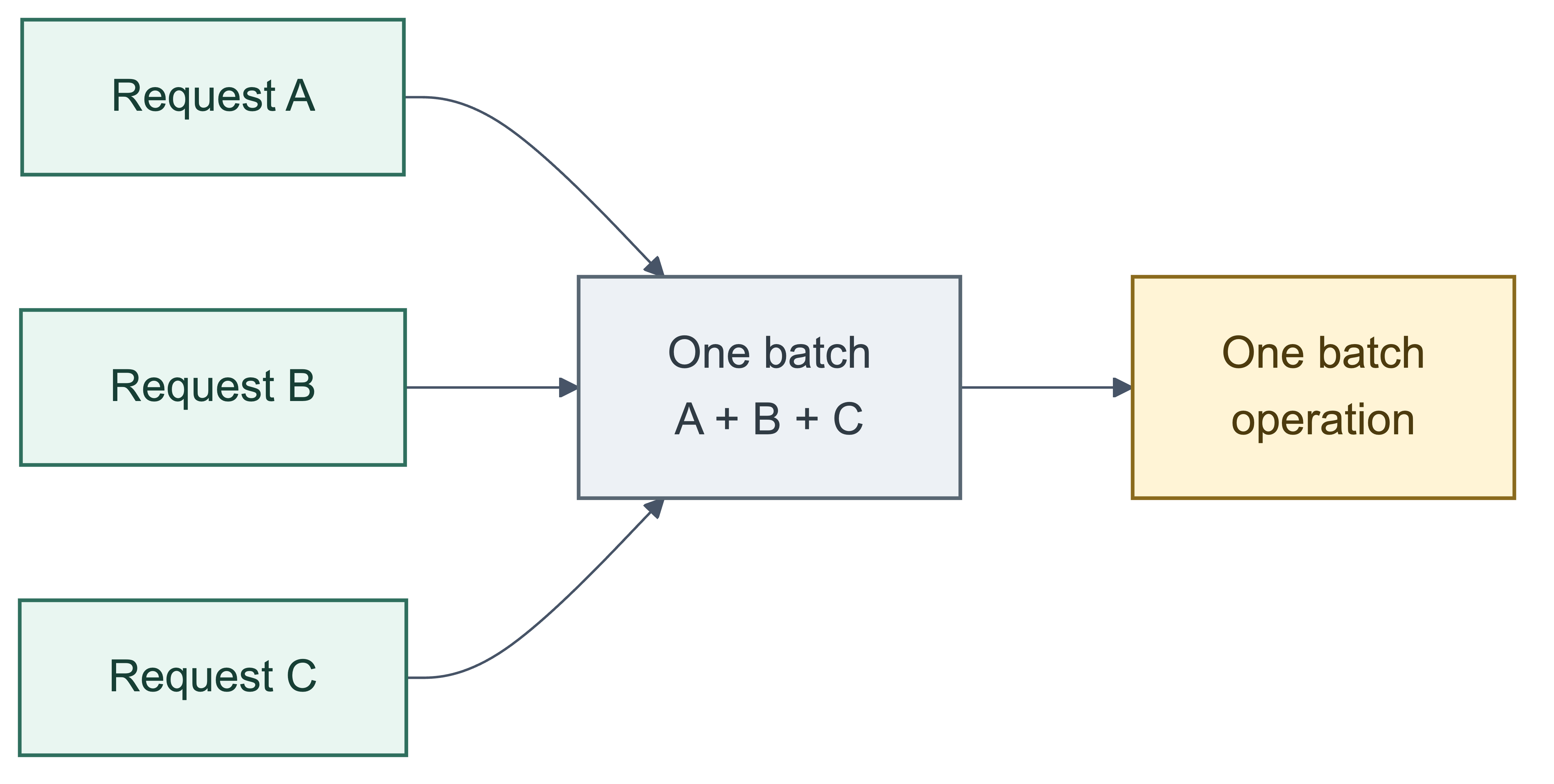
Separate concurrent requests can be combined into one batch before a downstream batch operation. The illustration is an example: only requests already queued in the same partition can be combined into one handler batch.
One batch API call does not imply one handler invocation. Below, A and B each make one batch API call,
submitting queries for products [101, 102, 103] and [102, 103, 104] respectively.
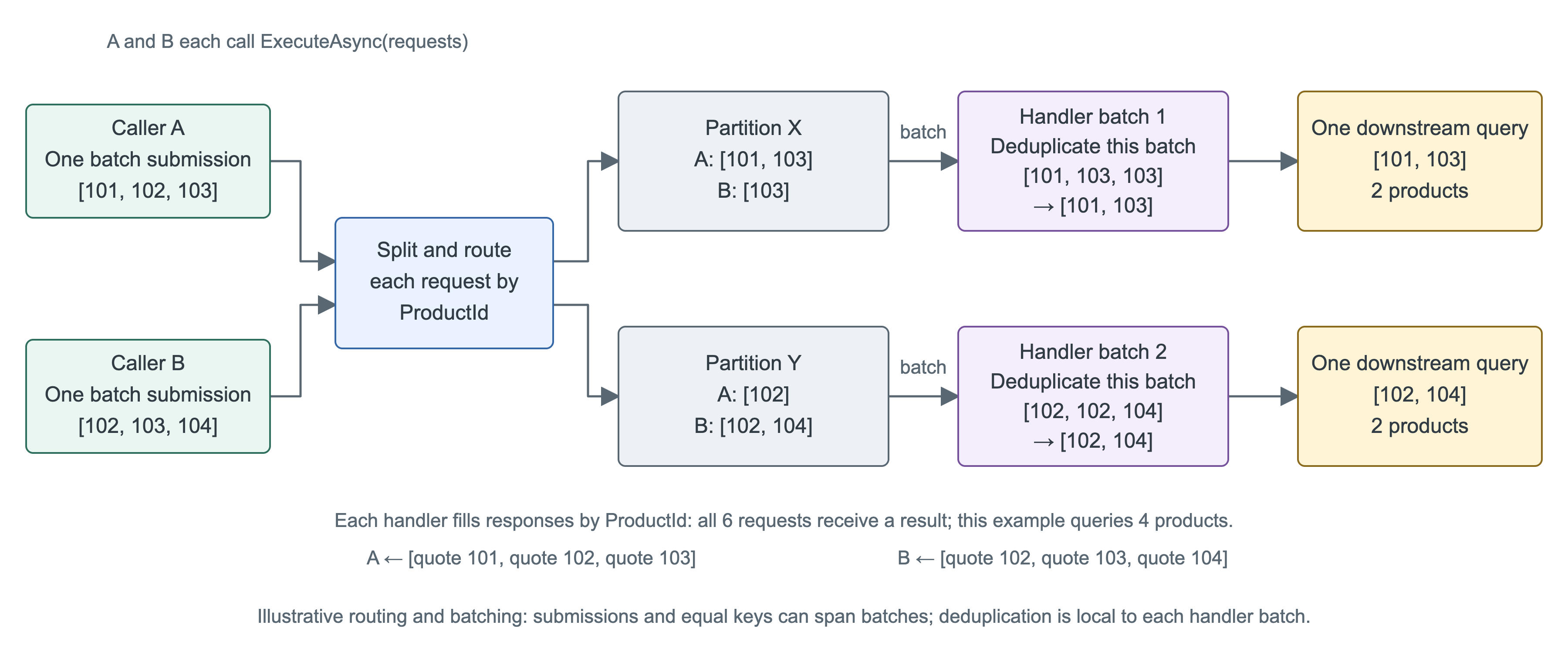
Requests route individually by ProductId. In this example, 101 and 103 share one partition, while 102 and 104 share
another. Each partition combines queued requests from both submissions into a handler batch.
Each handler deduplicates within its own batch. The two handlers query [101, 103] and [102, 104] respectively,
then assign responses by ProductId to their own requests: four products are queried, and all six requests get a result.
This is one possible grouping. Actual batches depend on enqueue timing, BatchSize, and scheduling; equal keys are
not guaranteed to arrive in one batch.
How Requests Are Batched: Opportunistic Merging
The illustration above shows how requests may be combined. This section explains how those handler batches are formed.
RequestBatcher uses BufferQueue to combine queued requests within a .NET process and pass them to an application handler. The current dependency is BufferQueue 2.0.3; applications do not register or configure it separately.
This is opportunistic batching: writing a request to BufferQueue sends a push notification that wakes an idle
consumer. Once it has an execution slot, the consumer pulls requests queued at that moment; it does not wait for a
fixed time window to fill BatchSize.
Callers obtain IRequestBatcher<TRequest> or IRequestBatcher<TRequest, TResponse> through DI, submit requests, and
await their individual results.
After dispatching a batch, the loop continues. If another slot is available, it can pull and dispatch the next batch without waiting for the previous batch to finish.
It waits for the next push notification only when none of the assigned partitions has data.
There is no periodic polling or fixed collection window. With a free slot, waiting mainly comes from wake-up and
scheduling; when all slots are occupied, requests must wait for capacity to execute. BatchSize limits the number of
requests per handler call: a batch may contain just one request at low traffic or several requests already queued in the
same partition during a burst.
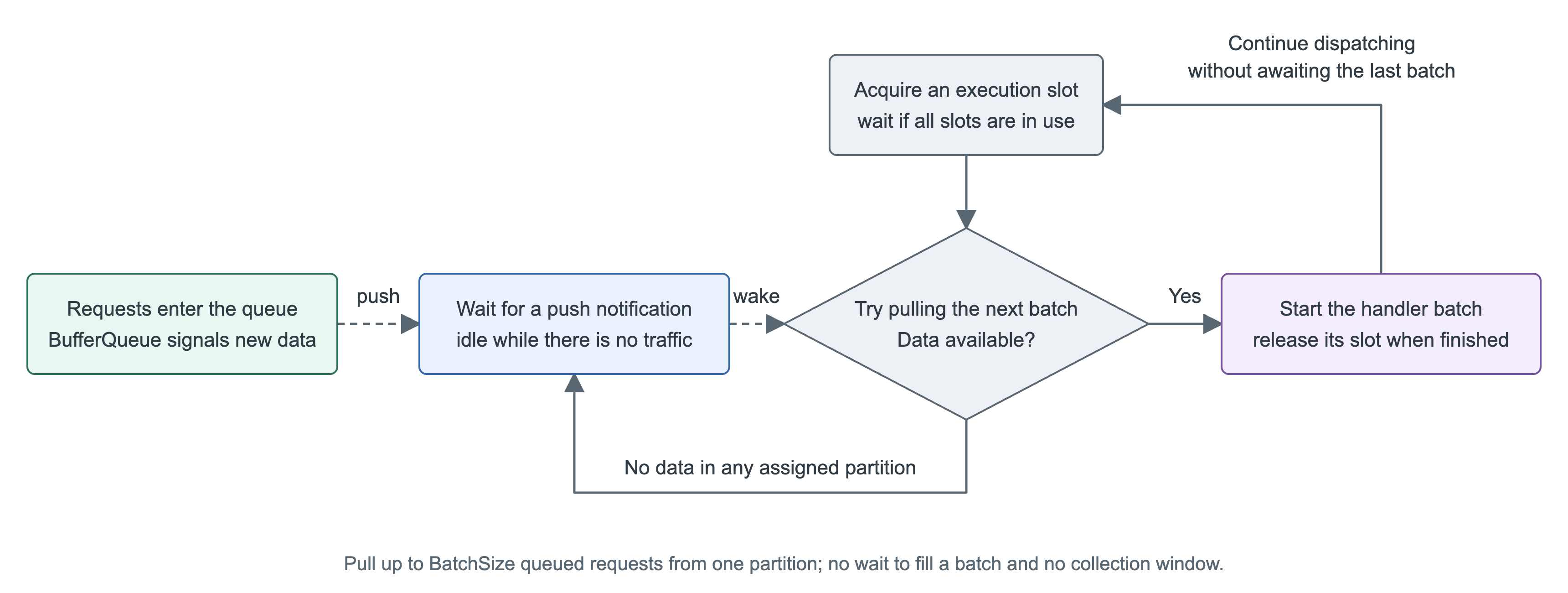
The diagram shows normal consumption and omits cancellation and shutdown. BufferQueue's consumer loop checks the notification version before waiting. If new data was signaled during the scan, it retries the pull to avoid a missed wake-up.
Requests are held in memory and cannot be recovered after a process failure.
Batching does not require callers to assemble a collection. Separate callers can each submit one
TRequestconcurrently. RequestBatcher coalesces requests already queued for the same partition into handler batches of up toBatchSize.ExecuteAsync(IEnumerable<TRequest>)is an additional submission option, not a prerequisite for batching.
Installation and DI Registration
dotnet add package RequestBatcher
The package supports .NET 8 and .NET 10 applications through net8.0 and net10.0 assets.
Register the response-enabled handler and batcher with AddRequestBatcher at startup. The handler depends on your
application's IPriceStore implementation. At the call site, resolve IRequestBatcher<PriceQuery, PriceQuote?> from
the same DI container or inject it into an application service's constructor.
using Microsoft.Extensions.DependencyInjection;
using RequestBatcher;

// At startup: register the store and response-enabled batcher.
services.AddScoped<IPriceStore, PriceStore>();
services.AddRequestBatcher<PriceQuery, PriceQuote?, PriceQueryHandler>(
    ServiceLifetime.Scoped,
    options =>
    {
        // Four concurrent handler batches, shared by all eight queue partitions.
        options.MaxConcurrency = 4;
        options.BatchSize = 100;
        options.MaxPendingRequests = 5_000;
        // Equal product IDs route to the same partition; separate batches can still run concurrently.
        options.UsePartitionKey(query => query.ProductId, partitionCount: 8);
    });

// At the call site: resolve the typed response interface from the application's service provider.
var batcher = serviceProvider.GetRequiredService<IRequestBatcher<PriceQuery, PriceQuote?>>();
var quote = await batcher.ExecuteAsync(new PriceQuery(ProductId: 101));
Use Microsoft.Extensions.DependencyInjection and RequestBatcher. The Request/Response Batching
section below defines PriceQuery, PriceQuote, PriceQueryHandler, and the IPriceStore dependency. In application
services, constructor-inject IRequestBatcher<PriceQuery, PriceQuote?> instead of resolving it manually.
Named Batchers and Primitive Requests
A request can be a primitive ID. Use the batcherName overload when several operations accept the same request type:
for example, "price" and "stock" can each register an independent int pipeline. Each name has its own handler,
options, queue capacity, and concurrency limit. Named and unnamed registrations may coexist.
using Microsoft.Extensions.DependencyInjection;
using Microsoft.Extensions.Options;
using RequestBatcher;

services.AddRequestBatcher<int, decimal?, PriceByIdHandler>(
    batcherName: "price",
    handlerLifetime: ServiceLifetime.Scoped,
    configure: options =>
    {
        options.BatchSize = 100;
        options.MaxConcurrency = 4;
        options.UsePartitionKey(id => id, partitionCount: 8);
    });

var batcher = serviceProvider.GetRequiredKeyedService<IRequestBatcher<int, decimal?>>("price");
var prices = await batcher.ExecuteAsync(new[] { 101, 102, 101 });
var options = serviceProvider.GetRequiredService<IOptionsMonitor<RequestBatchOptions<int>>>().Get("price");
The handler below uses the IPriceStore contract from the request/response example. Register its implementation
in the application's service collection as shown above:
public sealed class PriceByIdHandler(IPriceStore store) : IRequestBatchHandler<int, decimal?>
{
    public async ValueTask HandleAsync(
        IReadOnlyList<RequestBatchEntry<int, decimal?>> entries,
        CancellationToken cancellationToken = default)
    {
        var ids = entries.Select(entry => (long)entry.Request).Distinct().ToArray();
        var prices = await store.FindAsync(ids, cancellationToken).ConfigureAwait(false);
        var pricesById = prices.ToDictionary(price => price.ProductId);
        entries.SetResponses(id => pricesById.GetValueOrDefault(id)?.Price);
    }
}
Results follow input order, including duplicates; missing products return null. An explicit list can split into multiple handler batches.
In application services, inject the named batcher through the constructor. Register PriceLookup with
services.AddScoped<PriceLookup>(); the attribute selects the same "price" name used during batcher registration:
using Microsoft.Extensions.DependencyInjection;
using RequestBatcher;

public sealed class PriceLookup(
    [FromKeyedServices("price")] IRequestBatcher<int, decimal?> batcher)
{
    public Task<IReadOnlyList<decimal?>> FindAsync(
        IEnumerable<int> productIds,
        CancellationToken cancellationToken = default) =>
        batcher.ExecuteAsync(productIds, cancellationToken);
}
In ASP.NET Core MVC, the same attribute can inject the batcher directly into a Controller Action parameter:
using Microsoft.AspNetCore.Mvc;
using Microsoft.Extensions.DependencyInjection;
using RequestBatcher;

[ApiController]
[Route("api/prices")]
public sealed class PricesController : ControllerBase
{
    [HttpPost("query")]
    public Task<IReadOnlyList<decimal?>> FindAsync(
        [FromBody] int[] productIds,
        [FromKeyedServices("price")] IRequestBatcher<int, decimal?> batcher,
        CancellationToken cancellationToken) =>
        batcher.ExecuteAsync(productIds, cancellationToken);
}
Register MVC with builder.Services.AddControllers() and map it with app.MapControllers(). Minimal API handler
parameters support the same attribute, as shown in the runnable sample. See Microsoft's official documentation for
keyed services and constructor injection
and Controller Action injection.
The request-only overload also accepts batcherName. Names are case-sensitive and must not be null, empty, or
whitespace; a request type and name identify one pipeline, regardless of response type. Use the original overload
for the unnamed default. Configuration is captured at registration; named options expose that configuration and
do not provide runtime queue reconfiguration. UsePartitionKey routes requests within the selected batcher and
does not select a batcher or serialize its handler batches.
The named versus unnamed benchmark keeps request/response types, handlers and batching options identical, comparing single and explicit submissions with singleton and scoped handlers.
The runnable PostgreSQL sample uses a named int price-query batcher with
decimal? responses, widens IDs for its PostgreSQL bigint column, and accepts a JSON int[] at POST /prices/query.
Delegate Handlers
Delegate handlers keep short batch-processing logic next to the ExecuteAsync call that submits the work, so you
can read and update the submission and handling code together. They suit straightforward batch lookups or result
mapping. When the logic grows or needs to be reused and tested independently, use a separate IRequestBatchHandler
class.
Use AddDelegateRequestBatcher to declare the request/response contract and options, then supply a static lambda
at the call site:
using Microsoft.Extensions.DependencyInjection;
using RequestBatcher;

services.AddKeyedScoped<IPriceStore, PriceStore>("catalog");
services.AddDelegateRequestBatcher<int, decimal?>(
    batcherName: "price",
    configure: options =>
    {
        options.BatchSize = 100;
        options.MaxConcurrency = 4;
    });

var batcher = serviceProvider.GetRequiredKeyedService<IRequestBatcher<int, decimal?>>("price");
var prices = await batcher.ExecuteAsync(
    new[] { 101, 102, 101 },
    static async ValueTask (
        IReadOnlyList<RequestBatchEntry<int, decimal?>> entries,
        [FromKeyedServices("catalog")] IPriceStore store,
        CancellationToken batchCancellation) =>
    {
        var ids = entries.Select(entry => (long)entry.Request).Distinct().ToArray();
        var rows = await store.FindAsync(ids, batchCancellation).ConfigureAwait(false);
        var pricesById = rows.ToDictionary(row => row.ProductId);
        entries.SetResponses(id => pricesById.GetValueOrDefault(id)?.Price);
    });
This uses the IPriceStore contract from the request/response example below; register your own implementation
(shown as PriceStore). Omit batcherName for the default registration. Request-only pipelines use
AddDelegateRequestBatcher<TRequest>() and a first lambda parameter of IReadOnlyList<TRequest>. Both modes
support individual requests and explicit lists through ExecuteAsync extension methods; the original interfaces
have no added members. Choose either typed-handler or delegate registration for each request type and name.
Delegate registrations require the handler argument on every submission; typed-handler registrations use the
original overloads.
The first valid call binds one delegate to that pipeline. Repeated calls from the same static lambda call site reuse it; a different delegate fails before enqueueing. Different lambda call sites are different handlers even when their bodies look identical, so use different batcher names for different operations. Concurrent first calls bind atomically. Services are supplied per dispatched batch, not captured from the caller's scope.
The first parameter must be the exact batch list type. Other parameters are required DI services, with
[FromKeyedServices(key)] selecting a keyed service. The key must be explicit; inherited keys are unsupported.
Web applications may write [FromServices] on ordinary
service parameters; it is optional because services are injected by convention. One optional batch lifecycle
CancellationToken parameter is supported (without a default parameter value). The lambda may return void,
Task or ValueTask; async void and result-bearing return types are rejected. Every response entry must still
receive a response. List results preserve order and duplicates even when submission spans multiple handler batches.
The delegate handler and its bound delegate are always singleton per pipeline; registration has no
ServiceLifetime argument. Injected services retain their registered lifetimes: singleton instances are shared by
the container, scoped instances are shared within one batch, and transient instances are resolved separately for
each parameter. Resolved services are never cached in the singleton handler. Typed-handler registrations continue
to honor their explicit handler lifetime.
Each batch that injects services owns an async DI scope, and callers complete after scope disposal. A delegate
without service parameters skips scope creation. Signature inspection and typed-invoker compilation happen once
on first binding; steady-state dispatch uses the cached invoker without reflection, DynamicInvoke or argument
arrays. This automatic binding mode requires dynamic code and is not supported for NativeAOT or trimming.
The package includes analyzer RB0001, an error by default, requiring a directly supplied static lambda.
Delegate variables and method groups are rejected by this rule. Ordinary typed-handler calls are unaffected.
The analyzer can be disabled by the consumer; runtime reflection cannot reliably prove that a lambda was written
as static. See the delegate-handler design and
performance comparison.
The standalone delegate PostgreSQL sample uses delegate handlers for both price updates and
POST /prices/query list lookups. Each static lambda injects a keyed scoped PriceStore per handler batch.
The typed-handler sample provides the original handler-class examples separately.
When to Use It
Use RequestBatcher for independent database, cache, or downstream operations that benefit from a batch API. It also fits short traffic bursts that need bounded internal queue capacity and downstream concurrency, related requests that benefit from batch-level merging without relying on handler ordering, and work where caller cancellation should remove only requests that have not yet been dispatched. Dispatched work is allowed to finish independently of that caller.
For database updates, if partial success within one handler invocation would leave inconsistent state, the handler should execute that invocation in one transaction. RequestBatcher propagates the handler outcome but cannot roll back writes that have already been committed.
When Not to Use It
Do not use RequestBatcher when work must survive process failure, remain inside the caller's transaction, wait for a minimum batch size, or rely on automatic retries or exactly-once effects. It is also not suitable when an in-flight downstream operation must stop as soon as its individual caller disconnects, times out, or cancels. One handler batch can contain requests from several callers, so caller cancellation tokens are not forwarded to the handler and cannot cancel the shared handler call.
APIs
The response wrapper is RequestBatchEntry<TRequest, TResponse>. When upgrading code that used
RequestBatchItem<TRequest, TResponse>, update that type and its extension class name to RequestBatchEntry
and RequestBatchEntryExtensions, then rebuild all consumers. This is a source and binary breaking change;
response assignment and completion behavior are unchanged.
Request-Only
IRequestBatcher<TRequest> returns Task after an IRequestBatchHandler<TRequest> has processed the submitted
request, or every request in an explicit group:
public interface IRequestBatcher<in TRequest>
{
    // Submit one request and wait for its actual handler outcome.
    Task ExecuteAsync(TRequest request, CancellationToken cancellationToken = default);

    // Submit an existing group; the task waits for every request in that submission.
    Task ExecuteAsync(
        IEnumerable<TRequest> requests,
        CancellationToken cancellationToken = default);
}

public interface IRequestBatchHandler<TRequest>
{
    // Process one handler batch. A successful return completes every request in the batch.
    ValueTask HandleAsync(
        IReadOnlyList<TRequest> requests,
        CancellationToken cancellationToken = default);
}
Request/Response
IRequestBatcher<TRequest, TResponse> returns Task<TResponse> for one request or Task<IReadOnlyList<TResponse>>
for an explicit group, with responses in input order. Its IRequestBatchHandler<TRequest, TResponse> assigns exactly
one response to each request item and returns ValueTask:
public interface IRequestBatcher<in TRequest, TResponse>
{
    // Submit one request and return its typed response.
    Task<TResponse> ExecuteAsync(
        TRequest request,
        CancellationToken cancellationToken = default);

    // Submit a group and return responses in the same order as the input sequence.
    Task<IReadOnlyList<TResponse>> ExecuteAsync(
        IEnumerable<TRequest> requests,
        CancellationToken cancellationToken = default);
}

public interface IRequestBatchHandler<TRequest, TResponse>
{
    // Process one batch and assign exactly one response to every entry.
    ValueTask HandleAsync(
        IReadOnlyList<RequestBatchEntry<TRequest, TResponse>> entries,
        CancellationToken cancellationToken = default);
}
Request-Only Batching
Define a request and a handler for one batch:
public sealed record OrderWriteRequest(long OrderId, decimal Amount);

public interface IOrderStore
{
    Task WriteBatchAsync(
        IReadOnlyList<OrderWriteRequest> requests,
        CancellationToken cancellationToken);
}

public sealed class OrderWriteBatchHandler(IOrderStore store)
    : IRequestBatchHandler<OrderWriteRequest>
{
    public async ValueTask HandleAsync(
        IReadOnlyList<OrderWriteRequest> requests,
        CancellationToken cancellationToken = default)
    {
        await store.WriteBatchAsync(requests, cancellationToken);
    }
}
The handler's ValueTask is an internal completion signal that RequestBatcher awaits once. Application callers always
receive Task.
Register the handler and choose its lifetime:
services.AddRequestBatcher<OrderWriteRequest, OrderWriteBatchHandler>(
    ServiceLifetime.Scoped,
    options =>
    {
        options.MaxConcurrency = 4;
        options.BatchSize = 256;
        options.MaxPendingRequests = 5_000;
        options.UsePartitionKey(request => request.OrderId, partitionCount: 8);
    });
Inject IRequestBatcher<TRequest> and submit requests:
public sealed class OrderService(IRequestBatcher<OrderWriteRequest> batcher)
{
    public Task SaveAsync(
        OrderWriteRequest request,
        CancellationToken cancellationToken = default) =>
        batcher.ExecuteAsync(request, cancellationToken);
}
The returned Task completes after the handler has processed that request. If the handler fails, the caller receives
the original exception.
Request/Response Batching
Use the response-enabled API when each request should return a value. The handler receives entries that wrap the
original request and its response slot; entry.Request is the original TRequest. This example deduplicates repeated
product IDs within the current handler batch before querying the store:
using System.Collections.Generic;
using System.Linq;
using System.Threading;
using System.Threading.Tasks;
using RequestBatcher;

public sealed record PriceQuery(long ProductId);
public sealed record PriceQuote(long ProductId, decimal Price);

public interface IPriceStore
{
    // The store returns at most one found quote per requested ID, in any order.
    Task<IReadOnlyList<PriceQuote>> FindAsync(
        IEnumerable<long> productIds,
        CancellationToken cancellationToken);
}

public sealed class PriceQueryHandler(IPriceStore store)
    : IRequestBatchHandler<PriceQuery, PriceQuote?>
{
    public async ValueTask HandleAsync(
        IReadOnlyList<RequestBatchEntry<PriceQuery, PriceQuote?>> entries,
        CancellationToken cancellationToken = default)
    {
        var keys = entries
            .Select(entry => entry.Request.ProductId)
            .Distinct()
            .ToArray();
        var prices = await store.FindAsync(
            keys,
            cancellationToken);
        var pricesByProductId = prices.ToDictionary(price => price.ProductId);

        entries.SetResponses(request => pricesByProductId.GetValueOrDefault(request.ProductId));

        // If query deduplication is unnecessary, remove Distinct() and keep the response factory.
        // Alternatively, replace the query and assignment above with ONE of these styles:
        // 1. Query all requested IDs, then assign each entry directly:
        // var prices = await store.FindAsync(entries.Select(entry => entry.Request.ProductId), cancellationToken);
        // var pricesByProductId = prices.ToDictionary(price => price.ProductId);
        // foreach (var entry in entries)
        // {
        //     entry.SetResponse(pricesByProductId.GetValueOrDefault(entry.Request.ProductId));
        // }
        // 2. If an already aligned response sequence is available, use the ordered overload:
        // var prices = await store.FindAsync(entries.Select(entry => entry.Request.ProductId), cancellationToken);
        // var pricesByProductId = prices.ToDictionary(price => price.ProductId);
        // var orderedResponses = entries
        //     .Select(entry => pricesByProductId.GetValueOrDefault(entry.Request.ProductId))
        //     .ToArray();
        // entries.SetResponses(orderedResponses);
        // Never pass raw backend results to the ordered overload: they may be unordered or omit missing keys.
    }
}

public sealed class PriceService(IRequestBatcher<PriceQuery, PriceQuote?> priceBatcher)
{
    public Task<PriceQuote?> FindAsync(
        long productId,
        CancellationToken cancellationToken = default) =>
        priceBatcher.ExecuteAsync(new PriceQuery(productId), cancellationToken);

    public Task<IReadOnlyList<PriceQuote?>> FindManyAsync(
        IEnumerable<PriceQuery> requests,
        CancellationToken cancellationToken = default) =>
        priceBatcher.ExecuteAsync(requests, cancellationToken);
}
Register your application's IPriceStore implementation (shown as PriceStore) and the batcher in the existing
service collection, then inject IRequestBatcher<PriceQuery, PriceQuote?> into application services. The runnable
PostgreSQL Web API sample uses Dapper and PostgreSQL with a named
IRequestBatcher<int, decimal?>: callers submit primitive IDs and receive price values.
using Microsoft.Extensions.DependencyInjection;
using RequestBatcher;

services.AddScoped<IPriceStore, PriceStore>();
services.AddRequestBatcher<PriceQuery, PriceQuote?, PriceQueryHandler>(
    ServiceLifetime.Scoped,
    options =>
    {
        options.MaxConcurrency = 4;
        options.BatchSize = 100;
        options.MaxPendingRequests = 5_000;
        options.UsePartitionKey(query => query.ProductId, partitionCount: 8);
    });
The handler must set exactly one response for every item before it returns. The example uses standard LINQ Distinct
to query each product ID once within the current handler invocation. Distinct also supports anonymous composite keys,
value tuples, and custom equality comparers. Missing product IDs are absent from the store result and map to null.
Deduplication is limited to the current handler batch: it does not combine entries across handler batches or queue partitions. The selector overload evaluates the raw request for every entry after the unordered backend result has been indexed by key, so duplicate entries receive the same response.
All responses are computed before assignment; a factory failure leaves unset entries unchanged. Reference-type results are shared, not cloned.
If deduplication is unnecessary, remove Distinct() and keep the same response factory. Alternatively, assign entries
individually with entry.SetResponse(response), or use the ordered entries.SetResponses(responses) overload after producing exactly one response per original entry in input order,
including duplicates and missing requests.
The keyed selector overload is recommended for unordered backend results; the ordered overload must receive the aligned
sequence, never raw backend rows. The explicit-group overload returns responses in input order even when RequestBatcher
splits the requests across handler batches or queue partitions.
The caller's Task<TResponse> completes only after the
handler succeeds, its item's response has been set, and its handler scope has been disposed.
Non-cancellation handler failures propagate the original exception. A handler OperationCanceledException produces a
canceled response task. For a single response, awaiting it throws TaskCanceledException with the original token;
the cancellation exception instance, message, and derived type are not preserved.
For a response-enabled batcher, the explicit-group overload returns one response per input request in the same order,
even when the requests are split across handler batches or queue partitions. If several handler calls fail for one
explicit group, await follows normal Task semantics and throws one original exception. All distinct exception
instances remain available through Task.Exception.InnerExceptions; one handler exception fanned out to several
requests is recorded once.
Explicit Group Submission
When requests already exist as a group, submit them together:
await batcher.ExecuteAsync(orderWriteRequests, cancellationToken);
This overload snapshots the group and submits it as one producer operation, then waits for every request. In Wait
mode, an oversized group enters the queue as consecutive capacity-sized slices. In Fail mode, the whole group must
fit immediately.
The submission does not force one handler call: it may still be split by BatchSize or partition routing.
An explicit group is not a partition boundary. With more than one partition, every item is routed independently;
the group stays in one partition when no partition key is configured or when every item produces the same partition
key. MaxConcurrency = 1 limits handler concurrency but does not merge keyed partitions.
Submission Behavior
| Behavior | Single request | Explicit group |
|---|---|---|
| Capacity | Reserves one request slot. | Wait admits oversized groups in consecutive capacity-sized slices; Fail requires the whole group to fit immediately. |
| Routing | Routes one request. | Routes every item independently and can span partitions. |
| Handler calls | May share a handler batch with other queued requests. | Can split by partition and BatchSize; it is not a handler-batch boundary. |
| Completion | Represents this request's actual outcome. | Waits for every item in the submission. |
| Failure | Fails when its handler batch fails. | Can contain both successful work and failed work; the returned Task faults without rolling back successes. |
| Cancellation | Cancels only before dispatch. | Applies one token to every item; dispatched items still report their actual outcome. |
Configuration
| Option | Default | Behavior |
|---|---|---|
BatchSize |
128 |
Maximum requests passed to one handler call. |
MaxConcurrency |
1 |
Maximum concurrent handler batches. It is independent of the keyed partition count. |
MaxPendingRequests |
8192 |
Internal BufferQueue capacity for requests that have not yet been pulled for execution. |
FullMode |
Wait |
Waits for capacity; Fail rejects immediately when capacity is unavailable. |
UsePartitionKey(selector, partitionCount) |
Not set (one partition) | Enables keyed routing with the explicitly configured partition count; partitionCount must be greater than one and equal keys use one partition. |
No ordering is guaranteed for handler execution, including when MaxConcurrency = 1.
Partition Count and Concurrency
Without UsePartitionKey, all requests use one partition, regardless of CPU count or MaxConcurrency.
A single partition can still supply several concurrent handler batches. Increase MaxConcurrency when you need more
downstream concurrency.
One partition is the preferred default when keyed routing is not needed. The existing partition benchmark
compared one and eight partitions at BatchSize = 64 and MaxConcurrency = 8. In the unkeyed cases, eight partitions
achieved 0.97–1.01 times the throughput of one partition, showing no consistent advantage.
A preloaded burst of 64 unkeyed requests produced one batch with one partition, versus eight batches with eight
partitions. Keeping one partition avoids this fragmentation and reduces partially filled handler calls while retaining
asynchronous concurrency controlled by MaxConcurrency.
When keyed routing is needed, set the partition count explicitly through UsePartitionKey. This configuration uses
eight queue partitions sharing four handler execution slots:
builder.Services.AddRequestBatcher<ProductQueryItem, ProductBatchHandler>(
    ServiceLifetime.Scoped,
    options =>
    {
        // Per-pod handler-batch limit. Six pods x four slots = at most 24 handler batches cluster-wide.
        options.MaxConcurrency = 4;
        options.BatchSize = 100;
        options.MaxPendingRequests = 5_000;

        // Routing/locality only. Eight queue partitions are independent of the four execution slots.
        options.UsePartitionKey(item => item.ProductId, partitionCount: 8);
    });
partitionCount controls how requests are distributed across queues; equal keys always route to the same partition.
MaxConcurrency limits concurrent handler batches for one registered batcher, with all partitions sharing those slots.
A single partition can also supply several concurrent batches.
Sizing MaxConcurrency with Little's Law
For queries, assume one handler batch makes one downstream batch call and other handler work takes negligible time. Then estimate concurrency using downstream batch-call QPS and mean response time (RT, in seconds):
Average concurrent calls = batch-call QPS × RT
MaxConcurrency_per_pod ≈ ceil(average concurrent calls / pod_count × headroom)
Use monitoring data for an existing operation, or expected values and load-test results for a new one. QPS and RT must refer to the same operation and configuration. Recalibrate with production metrics after launch.
For example, six active pods making a combined 1,920 downstream batch queries per second at a mean RT of 50 ms have
about 1,920 × 0.050 = 96 concurrent calls on average. With even traffic distribution, that is 96 / 6 = 16 per pod.
16 estimates average load; it is not a recommended concurrency limit by itself. Allow headroom within downstream rate limits and connection-pool capacity, then load-test to verify latency and throughput.
Tuning BatchSize, Partitions, and MaxConcurrency Together
Continuing the example, the existing calls each query 20 distinct products: 1,920 × 20 = 38,400 request items/s,
with possible duplicates across calls. Try BatchSize = 80: suppose a handler receives 80 items and deduplicates them
to 60 products. It queries those products in two parallel calls of 30, awaits both, and assigns results to all 80 items.
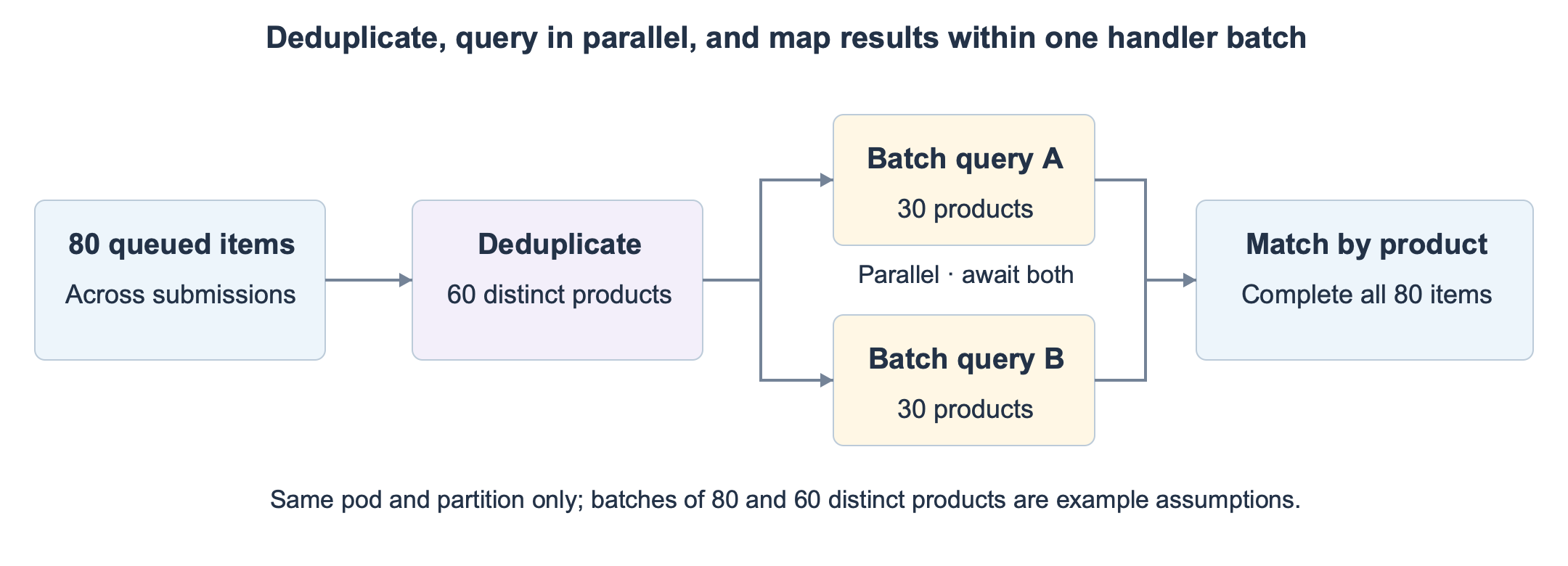
Merging lets different submissions share a deduplication opportunity; splitting keeps individual downstream calls
small. Choose the sizes separately: BatchSize limits items before deduplication, while the handler controls products
per downstream call.
Under these assumptions, handlers process 38,400 / 80 = 480 batches/s, making 480 × 2 = 960 downstream calls and
querying 960 × 30 = 28,800 product items/s. That is 50% fewer calls and 25% fewer product items queried, while
all requests still receive results.
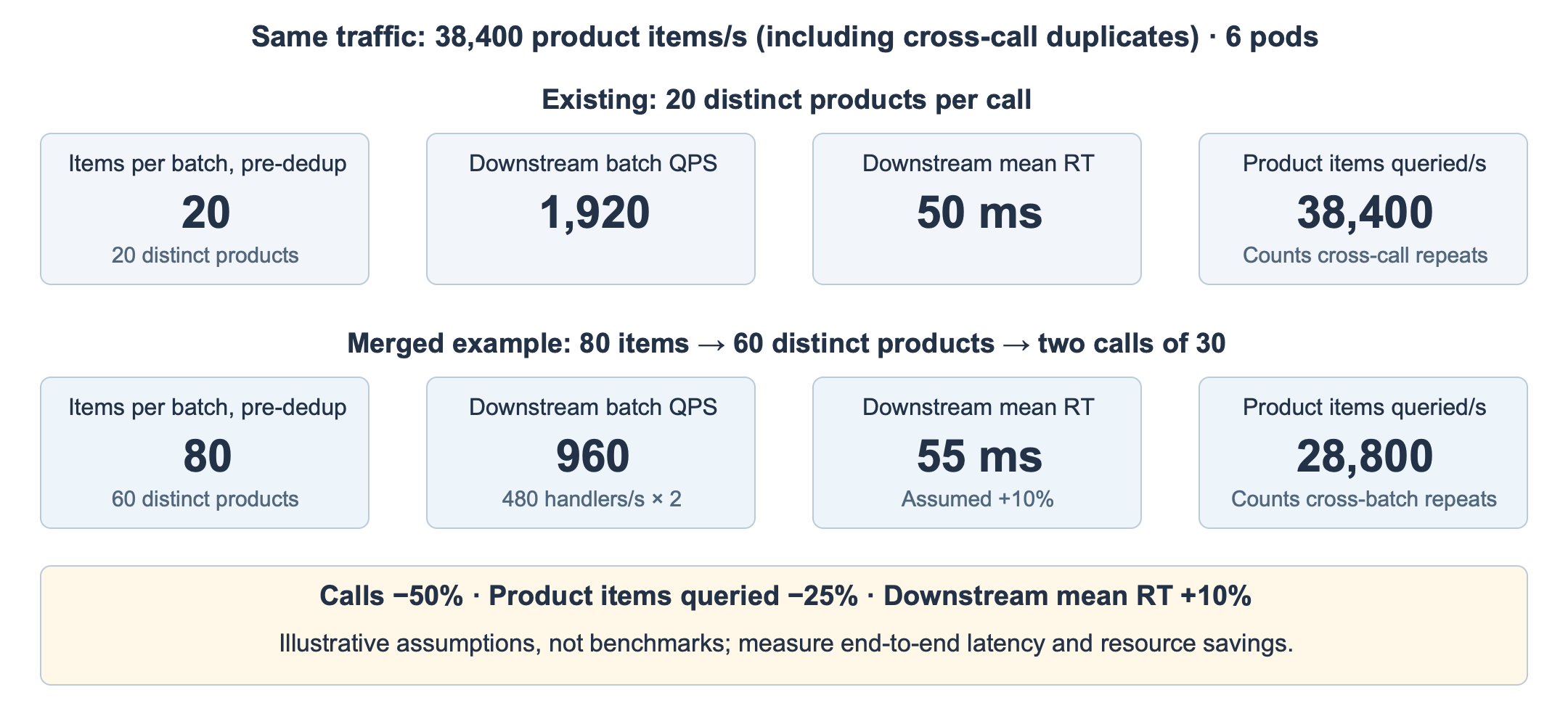
The diagram assumes downstream mean RT rises from 50 ms to 55 ms. These are illustrative estimates, not benchmark results. Fewer calls and repeated queries are potential benefits; longer RT is a cost. Compare end-to-end latency and actual resource use to decide whether the tradeoff is worthwhile.
BatchSize = 80 guarantees neither batches of 80 nor 60 distinct products after deduplication. Split the actual distinct
products: with no duplicates, the handler needs three calls of 30 + 30 + 20. Only requests currently queued in the same
pod and partition can merge, without an added wait to fill a batch. Partition count and consumption speed both
affect merging, so start load testing with fewer partitions.
Estimating Handler and Downstream Concurrency Separately
MaxConcurrency limits concurrent handler batches, not the downstream calls within each handler. In this example,
handler-batch QPS is 480. Estimate handler concurrency using the mean duration of the whole handler, including all child
queries, response mapping, and scope disposal, rather than a single downstream call's RT:
MaxConcurrency_per_pod ≈ ceil(handler-batch QPS × mean handler duration / pod_count × headroom)
Also check downstream concurrency against the maximum number of calls per handler. For example, with
MaxConcurrency = 4, batches of 80 can each split into three parallel queries, allowing 4 × 3 = 12 downstream calls
at once from one batcher. Account for all pods as well.
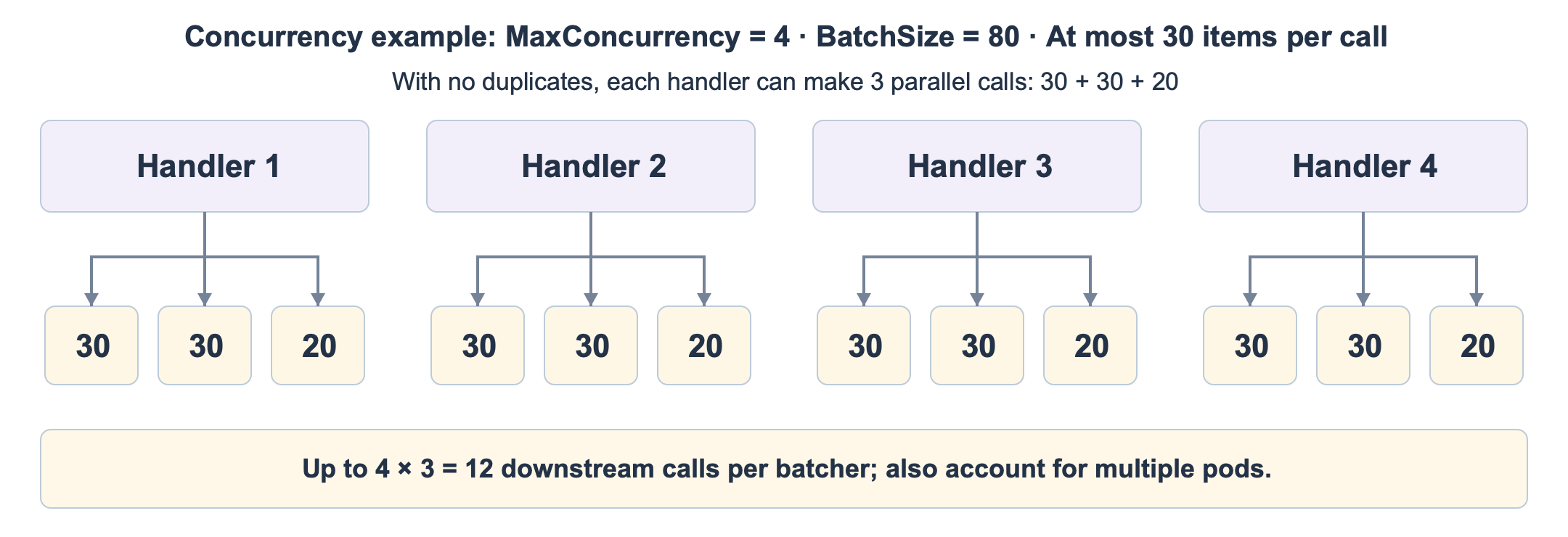
The value 4 illustrates the relationship; it is not a recommendation for the traffic above. To strictly limit downstream calls, use a shared concurrency limit for child queries in the handler.
Validating Merging and Deduplication with Load Tests
Use the existing 20-product batch calls as the baseline. Keep request data, arrival rate, duplicate fraction, hot-key distribution, and downstream resource limits consistent. Cover low, normal, and burst traffic, comparing:
- Work performed: actual batch sizes, distinct products per batch, downstream call counts, and total product items queried, counting repeated queries across batches.
- Latency and throughput: downstream and handler mean RT, caller end-to-end P95/P99, queue wait, throughput, errors, and throttling.
- Resource costs: application and downstream CPU, memory allocations, and connection-pool use.
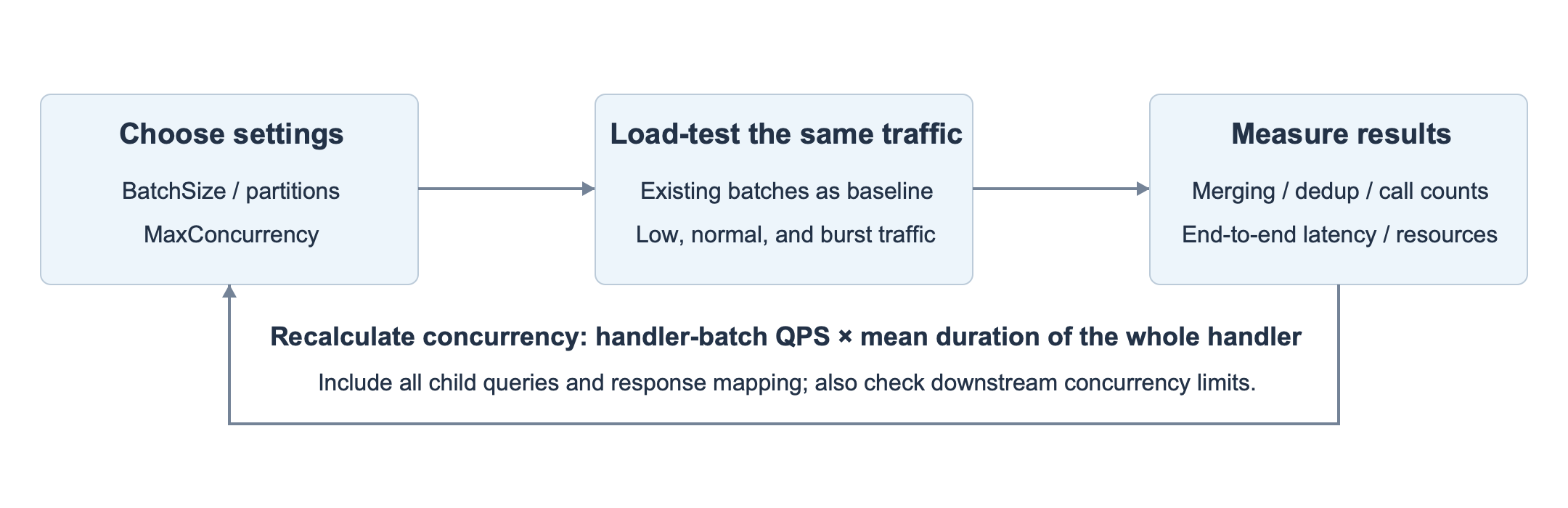
After each adjustment, recalculate concurrency using measured handler-batch QPS and duration, then retest merging. Aim to reduce downstream work while meeting latency and resource requirements; larger batches or lower downstream QPS alone do not determine the best configuration.
Size MaxPendingRequests, the queue capacity, from items/second per batcher × acceptable queue time, then verify
admission latency and memory use under bursts.
Batch Size and Capacity
- A handler batch contains at most
BatchSizerequests that are already queued. - RequestBatcher does not add a fixed delay or wait for a minimum batch size.
MaxPendingRequestsis the internal BufferQueue capacity for requests that have not yet been pulled. A pulled batch is auto-committed before its handler starts, so up toMaxConcurrency * BatchSizerequests can execute in addition to queued capacity. It does not limit the size of one explicit submission or the number of callers waiting for capacity.Waitadmits a group no larger than the capacity atomically and splits a larger group into consecutive capacity-sized slices.Failrejects the whole submission unless it fits immediately.- Caller cancellation removes a request only before handler dispatch. After dispatch, the caller observes the real handler outcome.
DisposeAsyncrejects new calls, drains accepted submissions including those waiting for capacity, and releases coordinator-owned resources. Concurrent and repeated calls share one operation; the application container owns async disposal. Requests still cannot be recovered after a process failure.
Routing Rules and Dispatch
The queue rotates pull opportunities among readable partitions. This does not promise equal handler execution time or fairness between individual keys. String routing considers the complete key, so a shared prefix alone does not force different keys into one partition. Exact partition assignments are internal and may change between versions; equal keys still route together within a batcher instance. Such changes can affect batch composition and the amount of duplicate work merged inside a handler batch.
A handler runs on the dispatch call path until it completes or reaches an incomplete asynchronous wait. CPU-heavy
or synchronously blocking work before that point can delay other batches even when execution slots remain free.
MaxConcurrency is an upper bound; it does not automatically parallelize synchronous handler code.
The queue partition count is not the handler concurrency level. Partitions organize queueing and routing, while
MaxConcurrency sets the global maximum number of concurrent handler batches.
Without a partition key, the queue uses one internal partition to avoid fragmenting unrelated requests. With a finite
integer numeric key or a non-null string key, it uses the explicit count supplied to UsePartitionKey, so equal keys
retain locality while different keys can progress independently.
Multiple batches from one partition can execute concurrently, and all partitions share the same execution slots. One
BatchDispatchLoop owns them all. It acquires an execution slot before pulling an auto-committed batch, so there is no
application-owned handoff queue behind BufferQueue. Each handler batch releases its slot independently when it finishes,
keeping at most MaxConcurrency handler batches in flight. The partition count is fixed at registration and independent
of CPU count.
| Configuration | Routing and dispatch |
|---|---|
No UsePartitionKey |
All requests use one queue partition; one partition can supply multiple asynchronous handler batches that compete for global execution slots. |
UsePartitionKey(selector, partitionCount) |
The partition-key function runs for every item. Equal finite integer numeric keys or non-null string keys use one of the configured partitions; separate handler batches for an equal key can execute concurrently. |
RequestBatcher provides no global, partition-local, or partition-key handler execution ordering guarantee.
Partition routing is optional:
services.AddRequestBatcher<PriceQuery, PriceQuote?, PriceQueryHandler>(
    ServiceLifetime.Scoped,
    options =>
    {
        options.BatchSize = 256;
        options.MaxConcurrency = 4;

        // Optional. Without a partition-key function, all requests use one shared partition.
        options.UsePartitionKey(query => query.ProductId, partitionCount: 8);
    });
Equal finite, integer-valued numeric keys or equal non-null string keys are routed to one queue partition. A partition key controls routing only: it does not force related requests into one handler batch, deduplicate them, or serialize their handler execution.
Example: Merging Repeated Queries
Several PriceQuery requests in one batch may refer to the same ProductId. The handler deduplicates product IDs,
issues one batch query, and maps results by ProductId to every original request, including duplicates. Response
assignment does not depend on database row order.
Routing by ProductId puts equal product IDs in one partition, but does not guarantee the same batch.
Deduplication applies only within the current handler batch; separate batches may query the same product again.
It is not a cache across batches.
The runnable PostgreSQL Web API sample uses primitive int IDs in its named
"price" pipeline. Its PriceQueryHandler deduplicates IDs with Distinct(), queries PostgreSQL, and maps rows by
product ID with entries.SetResponses(id => pricesById.GetValueOrDefault(id)?.Price). Callers receive decimal?
prices, with null for missing products. Both single-ID and list submissions use this handler; list results retain
input order and duplicates even when requests span several handler batches.
Sample Application
The PostgreSQL Web API sample demonstrates two pipelines in a Minimal API:
POST /pricessubmits a structuredPriceUpdateto the unnamed write batcher. The handler merges updates by product ID, keeps the highest version in its batch, and performs a PostgreSQL upsert.GET /prices/{productId}submits oneintID to the named"price"batcher and returns a price value, or404when the product is missing.POST /prices/querysubmits a JSONint[]to the same named batcher and returns adecimal?array in input order, preserving duplicates and returningnullfor missing products.
Both query endpoints inject [FromKeyedServices("price")] IRequestBatcher<int, decimal?>. With product 101 stored
at 17.90 and products 102 and 999 absent, submitting [101,102,101,999] returns [17.90,null,17.90,null].
The list can span multiple handler batches; duplicate IDs share a database lookup only within each handler batch.
See the sample README for Docker startup and complete curl commands.
The standalone delegate-handler PostgreSQL sample uses AddDelegateRequestBatcher and static lambdas
for both POST /prices updates and POST /prices/query list lookups. The query pipeline is named "price" and accepts
primitive int IDs with decimal? responses. Each lambda receives a keyed scoped PriceStore from its batch scope;
the delegate handler is singleton and registration has no lifetime argument. The original sample remains the
handler-class version. The delegate sample has its own HTTP and database ports; see its
README for startup and curl commands.
License
| Product | Versions Compatible and additional computed target framework versions. |
|---|---|
| .NET | net8.0 is compatible. net8.0-android was computed. net8.0-browser was computed. net8.0-ios was computed. net8.0-maccatalyst was computed. net8.0-macos was computed. net8.0-tvos was computed. net8.0-windows was computed. net9.0 was computed. net9.0-android was computed. net9.0-browser was computed. net9.0-ios was computed. net9.0-maccatalyst was computed. net9.0-macos was computed. net9.0-tvos was computed. net9.0-windows was computed. net10.0 is compatible. net10.0-android was computed. net10.0-browser was computed. net10.0-ios was computed. net10.0-maccatalyst was computed. net10.0-macos was computed. net10.0-tvos was computed. net10.0-windows was computed. |
-
net10.0
- BufferQueue (>= 2.0.3)
- Microsoft.Extensions.DependencyInjection.Abstractions (>= 10.0.11)
- Microsoft.Extensions.Logging (>= 10.0.11)
- Microsoft.Extensions.Logging.Abstractions (>= 10.0.11)
- Microsoft.Extensions.Options (>= 10.0.11)
-
net8.0
- BufferQueue (>= 2.0.3)
- Microsoft.Extensions.DependencyInjection.Abstractions (>= 10.0.11)
- Microsoft.Extensions.Logging (>= 10.0.11)
- Microsoft.Extensions.Logging.Abstractions (>= 10.0.11)
- Microsoft.Extensions.Options (>= 10.0.11)
NuGet packages
This package is not used by any NuGet packages.
GitHub repositories
This package is not used by any popular GitHub repositories.