SvgPath 0.3.0
See the version list below for details.
dotnet add package SvgPath --version 0.3.0
NuGet\Install-Package SvgPath -Version 0.3.0
<PackageReference Include="SvgPath" Version="0.3.0" />
<PackageVersion Include="SvgPath" Version="0.3.0" />
<PackageReference Include="SvgPath" />
paket add SvgPath --version 0.3.0
#r "nuget: SvgPath, 0.3.0"
#:package SvgPath@0.3.0
#addin nuget:?package=SvgPath&version=0.3.0
#tool nuget:?package=SvgPath&version=0.3.0
SvgPath


SvgPath is a geometry library for SVG paths in F#. It parses and serializes
SVG d and transform attributes and works directly with paths, subpaths,
lines, quadratic and cubic Beziers, and elliptical arcs. Operations preserve the
original curve types where possible rather than flattening them into polygons.
The package includes:
- construction, editing, evaluation, differentiation, splitting, and singularity-safe curve directions;
- isolated intersections, continuous overlaps, combined encounter queries, and closest-point pair projections;
- fill-rule-aware union, intersection, difference, and symmetric difference
under SVG
nonzeroandevenoddrules; - clipping, cutting, one- and two-sided offsets, stroke outlines, dashes, and marker layout;
- bounding boxes, convex hulls, containment, area, transforms, curve fitting, basic-shape conversion, and path effects;
- decimal-aware relative serialization that compensates for accumulated rounding drift.
Topology-sensitive operations use planar arrangements of the original curves. Segments are progressively split at intersections, endpoint contacts, and overlap boundaries; coincident portions retain directional multiplicities and source correspondence. This supports reconstruction without replacing the input geometry with a polygonal approximation.
SvgPath targets .NET 9. It is a behavior-preserving port of the Gleam
svg_path package, with F# units of
measure added to audit scalar usage.
dotnet add package SvgPath --version 0.1.0
open SvgPath

let tidyPathData input =
    Parse.path input
    |> Result.map (fun path ->
        Serialize.pathWith path (Serialize.decimalOptions 2))
open SvgPath

let prepareForArcAverseConsumer input =
    Parse.path input
    |> Result.map (fun path ->
        path
        |> Path.arcsToCubicBeziers
        |> Serialize.path)
Module Map
SvgPath: corePath,Subpath,Segment,Point,FillRule, and shared option and error types.Point: vector-style helpers forPoint<length>and other measured points.ParseandSerialize: SVG path-data parsing and serialization.Affine: raw six-value affine matrices, composition, and point mapping.Transform: applying affine transforms to SVG path geometry.TransformParseandTransformSerialize: SVGtransformattribute parsing and serialization.Trig: degree-based trigonometry helpers for SVG-facing angles.Ellipse: endpoint and center arc data, arc conversion, evaluation, splitting, bounding boxes, and cubic approximation.Congruency: ordered congruency checks under translation, rotation, and uniform scale.Area: signed area and SVG fill-rule area for subpaths and paths.Clip: curve clipping that keeps original geometry inside a filled clipping region without adding closure bridges.Intersections: segment, subpath, and path point-intersection queries, plus closest-point pair projections.Overlaps: continuous coincident intervals between segments, subpaths, and paths.Encounters: combined continuous-overlap and isolated point-intersection queries.Arrangement: planar arrangements built by progressively noding path segments, including endpoint clusters and coincident-edge multiplicities.ArrangementDrawing: drawing primitives for inspecting an arrangement graph.Csg: Boolean union, intersection, difference, symmetric difference, and nested contour reconstruction for filled paths.Cut: split subpaths and paths at intersections with cutter geometry.Offset: one-sided offsets, two-sided bands, and offset-map helpers.Stroke: SVG-style stroke outlines, caps, joins, dash extraction, and dashed stroke geometry.Marker: marker pose computation and marker layout transforms.Effects: one-off artistic path effects such as corner rounding.Degeneracy: normalization of near-degenerate geometry into simpler segments.Curvature: signed curvature and visual-left-normal radius helpers for segments.ConvexHull: convex hulls for segments, subpaths, paths, and point lists.Bezier: Bezier fitting and low-level Bezier geometry helpers.BasicShapes: conversions from SVG basic shapes to paths.Svg: small debugging helper for writing complete SVG documents.Inspect: stable, non-SVG inspection strings for debugging and tests.
Numeric Model
Public geometry uses SVG user-space coordinates, where positive y points down. Positive signed offsets use the visual-left normal. Clockwise and counterclockwise APIs likewise refer to visual SVG orientation.
F# units of measure annotate the scalar quantities that were plain Float
values in the Gleam package:
float<length>represents coordinates, distances, radii, and tolerances.float<length^2>represents squared lengths and areas.float<parameter>represents normalized curve parameters.float<degree>andfloat<radian>represent angles.
Curve parameters are dimensionless mathematically, but nominally measured in
F#. Derivatives retain parameter powers such as Point<length / parameter> and
Point<length / parameter^2>.
Most geometric operations return Result, keeping invalid geometry, numerical
failures, and violated topology assumptions explicit.
Core Model
The root namespace represents SVG path data with Path and Subpath types,
supported by lower-level Segment and Point primitives.
Points
A point stores measured X and Y coordinates:
open SvgPath

let p = Point.create 10.0<length> 20.0<length>
let q = Point.create 13.0<length> 24.0<length>
let d = Point.distance p q
Use Point for vector-style helpers such as Point.dot, Point.norm,
Point.project, Point.right, and Point.direction.
Segments
A Segment is one SVG path segment, expressed in absolute coordinates, not
relative to a previous current point:
type Segment =
    | Line of startPoint: Point<length> * endPoint: Point<length>
    | QuadraticBezier of startPoint: Point<length> * control: Point<length> * endPoint: Point<length>
    | CubicBezier of startPoint: Point<length> * control1: Point<length> * control2: Point<length> * endPoint: Point<length>
    | Arc of EndpointArcData
For Arc, XAxisRotation is measured in degrees, matching SVG path data.
Segments can be evaluated, differentiated, and split by their local parameter
t, where 0.0<parameter> is the segment start and 1.0<parameter> is the
segment end:
Segment.point segment 0.5<parameter>
Segment.derivative segment 0.5<parameter>
Segment.split segment 0.5<parameter>
Segment.between segment 0.25<parameter> 0.75<parameter>
Segment.betweenMany segment [ 0.25<parameter>; 0.75<parameter>; 0.5<parameter> ]
Values outside 0.0<parameter>..1.0<parameter> lead to silent extrapolation
along the same algebraic parameterization. Use Segment.splitInside and
Segment.betweenInside to surface parameter-domain errors instead.
For unit traversal directions that remain meaningful when the ordinary
derivative collapses to zero, use Segment.directions. It returns incoming and
outgoing directions separately, since a cusp can have two different one-sided
directions. Subpath.directions and Path.directions apply the same operation
at their respective parameter types; the With variants accept
DirectionOptions for controlling when a derivative candidate is treated as
collapsed.
Subpaths
A Subpath is opaque. It internally consists of a start point, a list of
end-to-end segments, and a flag indicating topological closure.
type Subpath =
    private
        { startPoint: Point<length>
          segmentList: Segment list
          isClosed: bool }
The public properties are Start, Segments, and Closed. The library
guarantees that the first segment, when present, starts at Start, and that
the last segment of a topologically closed subpath, when present, likewise ends
at Start.
Subpaths with Segments = [] can have any value of Closed. A subpath's
serialization ends in Z if and only if Closed = true.
Subpaths can be split by local segment addresses:
let at = { SegmentIndex = 1; T = 0.5<parameter> }

Subpath.split subpath at
Subpath.between subpath { SegmentIndex = 0; T = 0.5<parameter> } { SegmentIndex = 2; T = 0.25<parameter> }
Subpath.betweenMany subpath [ { SegmentIndex = 0; T = 0.5<parameter> }; { SegmentIndex = 2; T = 0.25<parameter> } ]
Subpath.point subpath at
Subpath.derivative subpath at
Subpath parameters are strict: SegmentIndex must address a real segment and
T must be inside 0.0<parameter>..1.0<parameter>. Unlike segment parameters,
subpath parameters do not extrapolate beyond a segment. The split helpers only
return positive-length pieces.
Use Subpath.create to construct an open subpath from a nonempty list of
contiguous segments, and Subpath.setClosed to change whether a subpath is
topologically closed. Subpath.setClosed true may return an error, but
Subpath.setClosed false cannot.
let closedTriangle () =
    let a = Point.create 0.0<length> 0.0<length>
    let b = Point.create 10.0<length> 0.0<length>
    let c = Point.create 5.0<length> 10.0<length>

    Subpath.create [ Line(a, b); Line(b, c); Line(c, a) ]
    |> Result.bind (Subpath.setClosed true)
    |> Result.map Serialize.subpath
Construction succeeds when required segment endpoints meet. Construct empty
move-only subpaths with Subpath.empty startPoint, where startPoint gives the
subpath's move point.
Use Subpath.normalizeZeroLengthLines to remove zero-length line segments from
a subpath. It preserves at least one zero-length segment of a nonempty subpath,
though it does not add any new segments when the input has no segments.
Paths
A Path is an ordered collection of independent subpaths.
let path = Path.ofSubpaths [ subpath ]
let subpaths = Path.subpaths path
The total widening conversions are Segment.asSubpath, Segment.asPath, and
Subpath.asPath. The narrowing Path.asSubpath succeeds when a path has at
most one nonempty subpath; empty subpaths are ignored unless they are all the
path contains.
Use Path.mapSubpaths and Path.filterSubpaths to transform or filter a path's
subpaths. Use Path.combine to assemble one path from a list of paths.
Use Path.start and Path.finish to get the endpoints of a full path. Empty
paths return Error EmptyPath; paths with subpaths use the first subpath's
start and the last subpath's end, including empty subpaths.
Subpath Building
Helper functions let users employ an EndpointPolicy option to specify how
adjacent endpoints should be reconciled:
type EndpointPolicy =
    | Strict
    | Wiggle
    | WiggleWith of float<length>
    | Bridge
    | WiggleThenBridge
    | WiggleThenBridgeWith of float<length>
    | Custom of (Segment -> Segment -> bool -> Segment list)
Strict is the behavior of Subpath.create, requiring exact endpoint equality.
Wiggle moves nearby endpoints together within the package's default wiggle
tolerance of 1e-9<length> while respecting the horizontality and verticality
of Line segments: horizontal and vertical lines stay horizontal and vertical.
If adjacent horizontal/horizontal or vertical/vertical lines are misaligned, a
bridge is inserted regardless of endpoint distance.
WiggleWith tolerance provides the same policy with an explicit tolerance.
Bridge keeps existing endpoints in place and inserts a straight line segment
when needed. WiggleThenBridge applies the pair-local wiggle behavior when
adjacent endpoints are within tolerance, and otherwise bridges that pair.
WiggleThenBridgeWith tolerance is its configurable counterpart.
Custom gives callers a hook for bespoke endpoint reconciliation. Its third
callback argument is true only for the closing join from the last segment back
to the first segment of a closed subpath.
Functions that accept an EndpointPolicy end in With:
Subpath.createWith Wiggle segments
Subpath.joinWith Bridge [ firstSubpath; secondSubpath ]
Subpath.spliceWith Wiggle startIndex deleteCount replacementSegments subpath
Subpath.setClosedWith Bridge true subpath
Subpath.rebuildWith WiggleThenBridge subpath
Path.rebuildWith Wiggle path
Failure to reconcile segment endpoints under a given policy results in a
Discontinuous SegmentError variant carrying the adjacent segment indices,
the expected and actual points, and their distance.
For hand-authored static geometry where invalid continuity is a programmer
error, use normal F# pattern matching or Result.defaultWith (failwithf "%A")
at the call site.
Custom receives adjacent segments as previous and next. For ordinary
adjacent pairs, its returned list replaces the pair. For the closing join from
the last segment back to the first segment of a closed subpath, the returned
list replaces only the last segment. An empty list deletes the replaced segment
or pair. If the returned list is nonempty, its first segment must start where
previous started; the constructor verifies the final subpath afterward. A
custom policy can adjust, delete, replace, or insert bridge-like segments. It
may be called even when the original adjacent endpoints already match, so it can
also perform coalescing or cleanup effects.
Joining Subpaths
Subpath.join combines open subpaths into one open subpath. With the default
Strict policy, each subpath's end point must exactly equal the next subpath's
start point. Empty open subpaths can act as identity values when their start
points line up. Subpath.join [] returns Error EmptySubpath.
Closed subpaths are rejected rather than implicitly opened. This keeps
closedness as explicit topology: if you want to discard it, use
Subpath.setClosed false subpath first.
Splicing Subpaths
Subpath.splice replaces a range of segments while preserving the subpath
invariant. startIndex is a zero-based segment index, deleteCount is the
number of segments to remove, and the replacement list is inserted in its place.
Subpath.splice 2 1 replacementSegments subpath
If startIndex + deleteCount extends past the end of the subpath, everything
from startIndex onward is deleted. Negative startIndex, negative
deleteCount, and a start index greater than the subpath length return
InvalidSplice.
With the default Strict policy, the edited subpath must still be continuous.
Closed subpaths preserve their closed state. If the splice result is nonempty,
the subpath start is updated to the first resulting segment's start point. If
the splice result is empty, the previous start point is preserved.
Opening and Reversing Subpaths
Subpath.openAt breaks open a closed subpath at a subpath parameter and returns
a single open subpath. The result traverses the whole loop from that point back
to itself. Use T = 0.0<parameter> to open at a segment boundary.
Subpath.openAt closedSubpath { SegmentIndex = 2; T = 0.5<parameter> }
Subpath.reverse subpath
Segment.reverse segment
Path.reverse path
Converting Arcs and Curves
Some SVG consumers and geometry workflows prefer to avoid elliptical Arc
segments. Use the arcsToCubicBeziers family to replace arcs with cubic Bezier
curves while preserving lines, quadratic Beziers, and existing cubics:
Segment.arcsToCubicBeziers segment
Subpath.arcsToCubicBeziers subpath
Path.arcsToCubicBeziers path
Elliptical arcs are approximated with one or more cubic Beziers, split into chunks of at most a quarter turn. The conversion preserves subpath closed/open state. If an arc is degenerate, it falls back to the straight-line cubic Bezier between the arc endpoints.
There is no tolerance option for this conversion. The approximation policy is deterministic: each arc chunk spans no more than 90 degrees. This is the common practical SVG arc-to-cubic approximation and is usually more than adequate for rendering and interchange.
If you want every segment represented as cubic Bezier curves, use the stricter helpers instead. Lines and quadratic Beziers are converted exactly.
Segment.toCubicBeziers segment
Subpath.toCubicBeziers subpath
Path.toCubicBeziers path
Use the toLines family to approximate every segment with straight lines:
Segment.toLines segment
Subpath.toLines subpath
Path.toLines path
The With variants accept LinearizeOptions. The default tolerance is
0.01<length> and the default recursion limit is 20. Beziers are adaptively
subdivided using their control points' distance from each chord. Arcs use a
conservative bound based on their radius and angular span. Degenerate arcs
become lines between their endpoints.
Arcs and the Ellipse Module
Arc uses SVG's endpoint arc representation: an explicit Start, End, two
semi-axis radii, XAxisRotation, and the SVG LargeArc and Sweep flags.
This matches the information carried by an SVG A path command, with the
current point made explicit as Start.
Endpoint arcs are compact, but they are awkward for evaluation and splitting.
The lower-level Ellipse module exposes the two arc representations used by
the SVG implementation notes:
type EndpointArcData =
    { Start: Point<length>
      Radius: Point<length>
      XAxisRotation: float<degree>
      LargeArc: bool
      Sweep: bool
      End: Point<length> }

type CenterArcData =
    { Center: Point<length>
      Radius: Point<length>
      XAxisRotation: float<degree>
      StartAngle: float<degree>
      DeltaAngle: float<degree> }
Ellipse.endpointToCenter converts SVG-style endpoint data into center data.
During that conversion, radii follow SVG's forgiving rules: negative radii are
made positive, and radii that are too small to connect the endpoints are scaled
up uniformly. CenterArcData.Radius is therefore the corrected radius.
Public arc angles are in degrees. StartAngle and DeltaAngle are measured in
the ellipse's own coordinate system before stretching and rotation; DeltaAngle
is signed, and determines the sweep direction.
Use Segment.arcCenterData to convert a root Arc segment to
CenterArcData, and Segment.arcFromCenterData to come back to an Arc. For
common evaluation tasks, use Segment.arcPoint, Segment.arcDerivative, and
Segment.arcPointAtAngle; these keep the ordinary SegmentError type.
Geometry Helpers
The core modules expose common geometry helpers directly on Segment,
Subpath, and Path. The XML docs contain the full option and error details;
this section maps the available families.
Bounding Boxes
Use Segment.boundingBox, Subpath.boundingBox, and Path.boundingBox for
axis-aligned bounds. Line, Bezier, and arc extrema are included. Measure a box
with BoundingBox.width, BoundingBox.height, BoundingBox.center, and
BoundingBox.diameter; the diameter is width plus height.
Optimization Over Segments
Use Segment.minimize to find the segment parameter where a scalar function of
the segment point is minimized:
let lowestPoint segment =
    Segment.minimize segment (fun point -> float point.Y)
The returned value is a segment parameter in 0.0<parameter>..1.0<parameter>.
You can pass it to Segment.point or Segment.split.
Minimization is numerical and does not require a derivative. Use
Segment.minimizeWith when the default sampling and tolerance are not
appropriate.
Segment and Subpath Lengths
Use Segment.length, Subpath.length, or Path.length to measure geometry.
Lines are exact. Beziers and arcs use adaptive integration. Distances are true
path-coordinate lengths, not normalized fractions.
Length-address helpers convert traveled distances back to ordinary parameters and evaluated geometry:
Segment.parameterAtLength segment 12.0<length>
Segment.pointAtLength segment 12.0<length>
Segment.derivativeAtLength segment 12.0<length>
Segment.betweenLengths segment 12.0<length> 30.0<length>
Segment.betweenLengthsMany segment [ 12.0<length>; 20.0<length>; 30.0<length> ]

Subpath.parameterAtLength subpath 25.0<length>
Subpath.pointAtLength subpath 25.0<length>
Subpath.derivativeAtLength subpath 25.0<length>
Subpath.betweenLengths subpath 25.0<length> 60.0<length>
Subpath.betweenLengthsMany subpath [ 25.0<length>; 40.0<length>; 60.0<length> ]

Path.parameterAtLength path 40.0<length>
Path.pointAtLength path 40.0<length>
Path.derivativeAtLength path 40.0<length>
Distances and Projections
Use Segment.distance to measure the shortest distance from a point to a
segment. Use Segment.projection when you also need the nearest segment
parameter and point:
let distanceToSegment point segment =
    Segment.distance point segment

let nearestOnSegment point segment =
    Segment.projection point segment

let nearestOnPath point path =
    Path.projection path point
Subpath.projection and Path.projection lift the same idea to larger
structures and return public parameters. Move-only subpaths are skipped.
Point Containment
Use containment helpers to classify a point relative to SVG fill geometry:
WindingField.subpathContainment point subpath Nonzero
WindingField.pathContainment point path EvenOdd
The result and fill-rule types are:
type PointContainment =
    | Inside
    | Outside
    | Boundary

type FillRule =
    | Nonzero
    | EvenOdd
Boundary is reported independently of the fill rule. Otherwise, Nonzero or
EvenOdd determines whether the result is Inside or Outside.
Fill geometry implicitly closes every nonempty subpath with a straight line from
its end to its start. This happens whether Subpath.Closed is true or
false. Consequently, changing only the Closed field does not change the
result of containment testing. The Closed field still matters for
serialization and stroke semantics.
A move-only subpath has no segments, fill area, or boundary. It is always
Outside, even when the tested point equals its move point. An empty path and a
path containing only move-only subpaths are also Outside.
Nonzero is SVG's default fill rule. A directed crossing contributes +1 or
-1 to the winding number. The point is inside when the total winding number is
not zero. For a path, winding numbers are summed across all subpaths, so
oppositely directed loops can cancel and equally directed loops reinforce one
another.
EvenOdd ignores crossing direction. The point is inside when the total number
of crossings across all subpaths is odd. Passing through another enclosed loop
therefore toggles inside/outside regardless of that loop's direction.
For a point inside both an outer loop and a nested inner loop:
| Inner loop direction | Nonzero |
EvenOdd |
|---|---|---|
| Same as outer loop | Inside (winding magnitude 2) |
Outside (two crossings) |
| Opposite to outer loop | Outside (windings cancel) |
Outside (two crossings) |
This aggregation is why path containment cannot be implemented as "inside any subpath". Self-intersecting subpaths and paths that revisit an area use the same winding and crossing rules.
Before applying a fill rule, containment checks the original geometry and
implicit closing lines for boundary hits. A boundary match takes precedence over
both fill rules. Use With variants to choose the coordinate-space boundary
tolerance and numerical options.
Areas
Use Area for signed area, SVG fill-rule area, and absolute winding area:
let filledArea path = Area.path path Nonzero
let signedArea path = Area.signedPath path
let windingArea path = Area.absolutePath path
There are three area notions here. Area.signedSubpath and Area.signedPath
return algebraic area. Area.subpath and Area.path return unsigned filled
area under Nonzero or EvenOdd. Area.absoluteSubpath and
Area.absolutePath integrate abs(windingNumber), so repeated same-direction
loops count with multiplicity. ConvexHull is a separate geometry operation; a
hull area can be larger than the filled area of a concave or self-intersecting
shape.
Signed area is computed from line integrals. Lines, quadratic Beziers, cubic Beziers, and elliptical arcs are handled directly. The sign depends on drawing direction: reversing a simple loop reverses the sign. Self-intersections and oppositely directed loops can cancel, while repeated loops can multiply the result.
Fill-rule area follows SVG fill semantics. Every nonempty subpath is implicitly
closed with a straight line from its end to its start, regardless of the
Subpath.Closed field. Move-only subpaths contribute zero area. For a path, all
subpaths are considered together, so overlapping and nested subpaths are not
measured independently and then added.
The difference matters for repeated or nested loops:
| Shape | Signed area | Nonzero area |
EvenOdd area |
|---|---|---|---|
| One simple loop | +A or -A |
A |
A |
| Same loop twice, same direction | +2A or -2A |
A |
0 |
| Same loop twice, opposite directions | 0 |
0 |
0 |
For those three rows, Area.absolutePath returns A, 2A, and 0,
respectively.
Area.subpath, Area.path, Area.absoluteSubpath, and Area.absolutePath
first linearize curves and then integrate slabs of the resulting line
arrangement. The With variants accept LinearizeOptions; Tolerance
controls curve-to-line approximation in coordinate units, not a direct bound on
final area error. The arrangement step compares every pair of linearized edges,
so these arrangement-based areas are quadratic in the number of generated line
edges.
Crossings, Intersections, and Overlaps
Use Segment.crossings to find parameter values where a scalar predicate
changes sign along a segment:
let horizontalCrossings segment y =
    Segment.crossings segment (fun point -> point.Y - y)
The returned values are segment parameters in 0.0<parameter>..1.0<parameter>.
Crossing detection is numerical and sampling-based; use Segment.crossingsWith
to tune it.
Use Intersections.segment to find point intersections between two segments:
let crossings left right = Intersections.segment left right
Each SegmentIntersection contains the intersection point plus the local
parameters on both segments:
type SegmentIntersection =
    { LeftT: float<parameter>
      RightT: float<parameter>
      Point: Point<length> }
The result represents finite point intersections only; segment overlaps return
OverlappingSegments. The same operation is lifted to larger structures:
Intersections.segmentSubpath segment subpath
Intersections.subpath leftSubpath rightSubpath
Intersections.path leftPath rightPath
Self-intersections use parallel names:
Intersections.segmentSelf segment
Intersections.subpathSelf subpath
Intersections.pathSelf path
Results are ordered by parameter, and boundary aliases are canonicalized. Use
With variants to supply IntersectionOptions or SelfIntersectionOptions.
Known subpath intersection addresses can be classified afterward with
Intersections.classifySubpathIntersection as crossings, nontransverse
contacts, endpoint contacts, or indeterminate cases. Contact order uses
outward-pointing rays sampled at equal arc lengths; the accompanying aperture
angles instead use the incoming and outgoing traversal directions directly.
Point-intersection queries deliberately cannot represent a continuous shared
interval. Use Overlaps when coincident geometry is the expected result:
Overlaps.segment leftSegment rightSegment
Overlaps.subpath leftSubpath rightSubpath
Overlaps.path leftPath rightPath
A SegmentOverlap gives the interval parameters and geometric endpoints on
both segments. Its left parameters are canonicalized into increasing order; the
right parameters may decrease when the two segments traverse the overlap in
opposite directions. The endpoint parameters define an affine, monotone
correspondence throughout the overlap. Coincident geometry that cannot satisfy
that contract returns NonAffineOverlapCorrespondence; normalize or linearize
such segments before overlap detection. At a matching tolerance,
Intersections.segment returns OverlappingSegments exactly when
Overlaps.segment reports an overlap.
The overlap detector is intended for non-degenerate segments whose overlap boundaries occur at an endpoint of at least one input segment. Arrangement construction establishes that working model through progressive endpoint, intersection, and overlap-boundary splitting. Subpath and path overlap values retain their constituent piecewise-affine segment correspondences, and the module provides helpers for mapping exact parameters from either traversal to the other.
Use Encounters when both continuous overlaps and isolated point intersections
are required from one query. Its segment, segment-subpath, subpath, and path
functions return both lists without changing the underlying payload types.
Subpath encounters retain overlap-boundary intersections by default; the
explicitly named filterFullyOverlapExplainedSubpathIntersectionParameters
helper derives a view with parameters fully explained by overlaps removed.
Convex Hulls
The ConvexHull module computes closed convex hull subpaths for segments,
subpaths, paths, and point lists.
let hull segment = ConvexHull.segmentHull segment
Lines, quadratic Beziers, and ordinary arcs are handled semantically. Lines produce a two-line closed hull, while quadratic Beziers and arcs produce the original primitive plus the chord joining its endpoints. Cubic Beziers use a cubic-specific numerical solver.
Use ConvexHull.subpathHull, ConvexHull.pathHull, and
ConvexHull.pointsHull for larger inputs. Move-only subpaths contribute their
start points.
ConvexHull.segmentMinimumWidth, ConvexHull.subpathMinimumWidth, and
ConvexHull.pathMinimumWidth estimate the thinnest direction of a convex hull.
The corresponding segmentDiameter, subpathDiameter, and pathDiameter
functions measure the widest direction.
Congruency
The Congruency module finds a translation, rotation, and uniform scale mapping
one ordered piece of geometry to another:
let mapped source target =
    Congruency.path source target 0.000001<length>
    |> Result.bind (fun transform -> Transform.path source transform)
This is semantic congruency, not rendered-shape equivalence. Segment constructors must match, so a line and a visually identical degenerate curve do not match. Arc field details are checked after the point cloud transform is found.
Congruency.subpath and Congruency.path compare ordered structure only. They
ignore the subpath Closed field, but they do not rotate or cycle closed
subpaths, choose alternate starting segments, or reorder subpaths. If two closed
loops start at different places, open or rebuild them with matching segment
order before calling congruency.
The same module also exposes fitPoints, fitSegment, fitSubpath, and
fitPath for best-fit matching. Pass Similar for translation, rotation, and
uniform scale, or Affine for a general affine matrix. These helpers return a
Fit value containing the transform and RMS error.
Parsing
Parse.path accepts normal SVG path data syntax, including:
- comma separators;
- SVG whitespace separators, including form feed;
- compact signed numbers such as
M0-1; - compact arc flags such as
A10 10 0 0110 20; - implicit line commands after
M; - repeated command argument groups;
- relative and absolute commands;
- closepath commands
Zandz.
let canonicalize () =
    Parse.path "M0,0 10,10z"
    |> Result.map Serialize.path
The parsed object is not just a token stream. It is normalized into this
package's path model. For example, an implicit line after M becomes a Line
segment internally.
The parser follows the SVG path-data grammar for number consumption,
comma/whitespace placement, command repetition, and arc flags. Its conformance
suite includes cases adapted from Web Platform Tests and the W3C SVG 1.1 Second
Edition test suite. Unlike a browser renderer, Parse.path is strict: invalid
trailing data returns Error for the whole input instead of returning or
rendering the valid prefix.
Parser errors have the form ParseError(reason, remaining). remaining is the
exact suffix of the original input beginning at the failure location and is
empty for a failure at end of input.
Closepath is also represented semantically. If parsing Z needs a straight line
back to the subpath start, the parser inserts that line and marks the subpath
closed. If the subpath is already back at its start, no extra line is inserted;
the subpath is just marked closed.
Serialization
Serialize emits SVG path data from Path, Subpath, and Segment values.
By default it uses:
- absolute commands;
- up to 5 decimal places;
- stripped trailing decimal zeroes;
- readable whitespace;
- repeated command letters;
- one-line path data;
HandVfor horizontal and vertical lines when possible;SandTfor smooth curves when possible;Zfor closed subpaths.
Serialization options can use relative commands, commas inside coordinate pairs,
smaller whitespace, rounded numbers, fixed decimal places, omitted repeated
command letters, line breaks, left-padded numbers for visual alignment,
explicit line commands instead of H/V, and explicit curve commands instead
of S/T.
When Relative = true, the serializer compensates for accumulated drift caused
by decimal rounding.
let compactPathData input =
    Parse.path input
    |> Result.map (fun path ->
        Serialize.pathWith path (Serialize.minifyingOptions 2))
Serialize.minifyingOptions is a deterministic small-output preset. It uses the
serializer's normal H/V and S/T discovery, but it does not try every SVG
spelling and prove that the result is globally shortest.
If you want a complete SVG document for debugging or examples, use Svg with a
view box, per-path style strings, and optional text labels. It is a small
drawing helper, not a rendering framework.
Move-Only Subpaths, Zero-Length Segments, and Closure
SVG distinguishes move-only subpaths from zero-length drawing subpaths. The
subpath consisting only of the command M 50,0 has a current point but no
drawing segment, whereas M 50,0 L 50,0 has a zero-length line segment. User
agents can render these differently: with stroke-linecap:round or
stroke-linecap:square, for example, the zero-length line can produce a visible
mark while the move-only subpath remains invisible. SVG 2 describes this in its
notes on zero-length path segments
and stroke line caps.
There is a similar difference between M 0,0 and M 0,0 Z, with the Z
command supplying a zero-length line segment to the subpath:
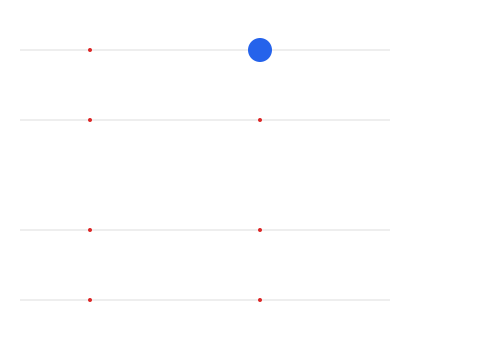
<path d="M 90,50" style="fill:none;stroke:blue;stroke-width:24;stroke-linecap:round;" />
<path d="M 260,50 L 260,50" style="fill:none;stroke:blue;stroke-width:24;stroke-linecap:round;" />
<path d="M 90,230" style="fill:none;stroke:black;stroke-width:24;stroke-linecap:round;" />
<path d="M 260,230 Z" style="fill:none;stroke:black;stroke-width:24;stroke-linecap:round;" />
For that reason, Subpath.normalizeZeroLengthLines keeps one zero-length line
if a subpath consists only of zero-length lines, preserving the difference
between a zero-length subpath and a move-only subpath. It does this even for
closed subpaths, where the choice is mainly about preserving internal
representation consistency.
Concerning the detailed mechanics of subpath closure, a literal read of the
SVG 2 specification
plausibly suggests that Z means "draw a final line from the current point to
the starting point, even if this final line has length 0, and then mark
topological closure". The observable behavior of user agents, however, suggests
that Z is commonly interpreted as meaning "draw a final line to the starting
point only if necessary to bridge a gap or when no segments have been added to
the subpath yet, and then mark topological closure". This library follows the
latter interpretation.
Under this interpretation, a final nonzero-jump line that geometrically closes a
topologically closed subpath can be elided in the representation of the subpath,
shortening M0,0 L10,10 0,0 Z to M0,0 L10,10 Z. A final zero-length jump
followed by Z cannot be dropped without losing information, so the serializer
never drops zero-length lines, including immediately prior to Z.
Transforming Paths
Transform applies SVG-style affine transforms to segments, subpaths, and
paths.
let movePathData input =
    Parse.path input
    |> Result.bind (fun path ->
        Transform.path path (Transform.translate 10.0<length> 20.0<length>))
    |> Result.map Serialize.path
Transforms use the SVG six-value affine matrix:
matrix(a b c d e f)
which corresponds to:
x' = a*x + c*y + e
y' = b*x + d*y + f
The ordinary segment, subpath, and path transform functions preserve
segment types and return DegenerateArcTransform when an affine transform
collapses an arc into line geometry. Use segmentGracefully,
segmentToSubpathGracefully, subpathGracefully, or pathGracefully when
collapsed arcs should instead become one or more line segments.
Matrix values can be constructed and inspected as tuples:
let inspectTransform () =
    Transform.rotate 30.0<degree>
    |> Transform.toTuple
Use Transform.chain first second when thinking in application order. Use
Transform.multiply left right when thinking in matrix multiplication order.
let scaleThenMove () =
    let scale = Transform.scale 2.0
    let move = Transform.translate 10.0<length> 20.0<length>

    Transform.chain scale move
Transforms can also be applied about a point, or about one of the nine anchor points on a segment, subpath, or path bounding box:
TopLeft      TopCenter      TopRight
CenterLeft   Center         CenterRight
BottomLeft   BottomCenter   BottomRight
let flipPathHorizontally path =
    Transform.pathAboutAnchor path (Transform.scaleXY -1.0 1.0) Center
Transform Attributes
SVG transform attributes can be parsed and serialized separately from paths.
let tidyTransformAttribute input =
    TransformParse.attribute input
    |> Result.map TransformSerialize.toString
The transform parser accepts normal SVG transform syntax, including compound attributes such as:
translate(10) scale(2) skewX(3)
Its errors use the same ParseError(reason, remaining) convention as path-data
parsing.
Transform serialization prefers readable SVG forms when the matrix can be recognized clearly:
translate(10 20)
translate(10 20) scale(2)
rotate(30)
translate(10 20) rotate(30) scale(2 3)
If no clearer representation is available, it falls back to:
matrix(a b c d e f)
Use TransformSerialize.forceMatrix when you want the raw matrix form even if a
shorter transform expression could be detected.
let rawTransformAttribute () =
    Transform.translate 10.0<length> 20.0<length>
    |> TransformSerialize.toStringWith (TransformSerialize.defaultOptions () |> TransformSerialize.forceMatrix)
Inspecting Paths
Inspect prints path data structures for debugging and tests. It is not the SVG
d serializer. Use Inspect.segment, Inspect.subpath, and Inspect.path for
readable structural output:
let inspectLine () =
    Line(Point.create 0.0<length> 0.0<length>, Point.create 12.0<length> 10.0<length>)
    |> Inspect.segment
Example output:
Line(start=0,0 end=12,10)
Use the Code functions when you want copy-pasteable F#:
let inspectCode path = Inspect.pathCode path
Inspection options mirror the serializer's decimal controls: rounding, fixed
decimal places, and left padding are available through the With functions.
Curve Clipping
Clip clips drawn geometry to a filled clipping region. This is not a filled
Boolean operation: the input path is treated as curves, and the clipping path is
treated as a filled region.
Clip.subpath input clipRegion Nonzero
Clip.path input clipRegion Nonzero
The returned subpaths contain only pieces of the original input geometry. Boundary pieces from the clipping region are not inserted. If an open subpath enters, exits, and re-enters the clipping region, the result contains multiple open subpaths. If a closed circle is clipped by a rectangle, the result is the visible arc fragments as open subpaths, not a closed rectangle-and-arc outline.
Closed inputs stay closed only when the whole subpath survives without being cut by the clipping boundary. Pieces whose sample point is inside or on the boundary of the clipping region are retained. Segment types are preserved where possible: lines remain lines, Beziers remain Beziers, and arcs remain arcs after splitting.
Offsets, Bands, and Stroke Outlines
Offset constructs offsets from the original curve types. Lines and circular
arcs are offset exactly. Quadratic and cubic Beziers and non-circular arcs are
represented by fitted cubic Beziers, checked against the source's true normal
displacement, and subdivided when the fit exceeds the requested tolerance.
Positive offsets point along the visual left normal in SVG screen coordinates; negative offsets point along the visual right normal. For example, a positive offset of a horizontal line directed from left to right appears above that line.
Offset.segment segment 12.0<length>
// Result<Subpath, Offset.Error>

Offset.subpath subpath 12.0<length>
Offset.path path 12.0<length>
// Result<Path, Offset.Error>
A segment offset returns a Subpath because one source curve may require
several fitted pieces. Subpath and path offsets return a Path: trimming may
split one offset walk into multiple subpaths or remove it entirely.
The With variants accept Offset.Options. The join can be Bevel,
Miter miterLimit, or Round. Options.Fitting controls fitted-curve accuracy
and maximum subdivision depth. Options.DistanceOptions controls the projection
and root-finding tolerances used during trimming; it is not a trimming-policy
switch.
Use Offset.subpathUntrimmed, Offset.pathUntrimmed, or their With variants
to obtain the connected offset walks before topological trimming. These are
useful for inspection or for callers implementing a different trimming policy,
but they may retain self-intersections, reversal folds, and regions lying on the
wrong side of a closed source contour.
Single-Offset Trimming
SingleOffsetTrimming controls two consecutive stages:
let options =
    { Offset.defaultOptions with
        SingleOffsetTrimming =
            { Offside = true
               FinalTrimming = InBandTrimming } }
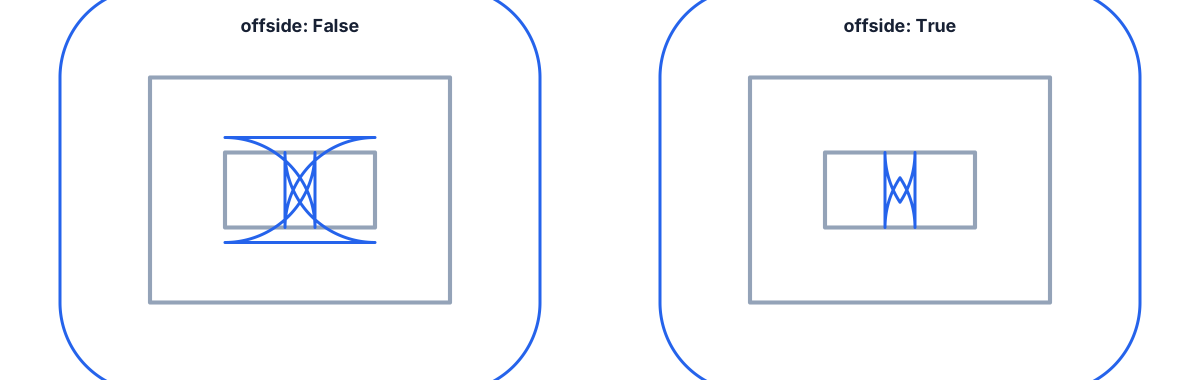
Offside applies only to closed source subpaths. The source and its offset
define a signed intervening region. Face-contamination through the arrangement
graph removes offset portions lying on the wrong side of that region. Open
source subpaths have no closed source face, so this stage has no effect on them.
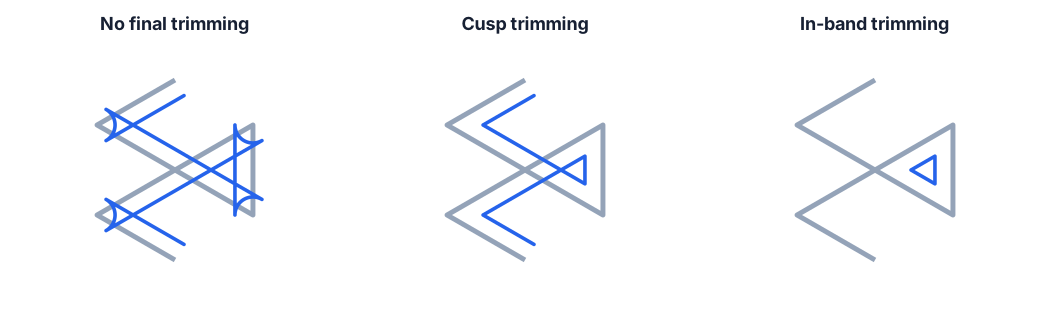
The final stage is selected independently:
SingleOffsetFinalTrimming |
Behavior |
|---|---|
NoTrimming |
Return the walks surviving the optional offside stage. |
CuspTrimming |
Remove side-local submerged folds whose run contains reversed offset geometry. |
InBandTrimming |
Apply the complete source-to-offset winding classification and parity-capacity reconstruction. This includes the effect of cusp trimming. |
The following open source has no offside stage, so the panels isolate the three final-trimming choices:
For closed contours, Offside is an additional and independent operation. In
this example the source contains oppositely oriented concentric rectangles; the
final trimming mode is NoTrimming in both panels:
The defaults are Offside = true and FinalTrimming = InBandTrimming.
Adjacent reversed/non-reversed loops created locally during offset assembly are
conservatively collapsed before these public trimming stages; that construction
cleanup is intentionally not a public switch.
Two-Sided Bands
Offset.subpathBand and Offset.pathBand construct and jointly trim two signed
offsets:
Offset.subpathBand subpath 18.0<length> 34.0<length>
Offset.pathBand path 18.0<length> 34.0<length>
inner and outer are caller-assigned roles, not a numeric-order restriction.
Either ordering is accepted. Exchanging the values reverses the orientation of
the resulting band. Bands do not add endpoint caps; use Offset.subpathStroke
or Stroke.subpath when an open source needs Butt, Square, or RoundCap
endpoints.
Band trimming has three independent Boolean controls:
let options =
    { Offset.defaultOptions with
        BandTrimming =
            { InnerCusps = true
               OuterCusps = true
               InBand = true } }
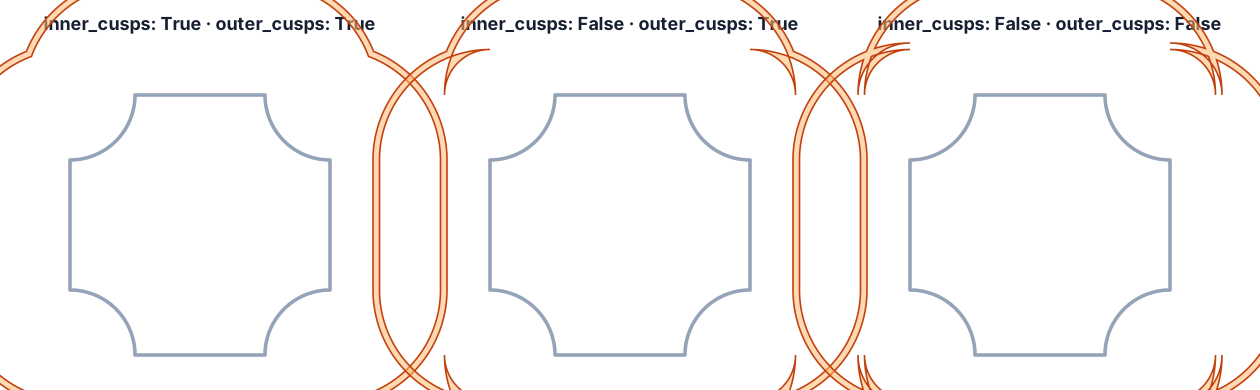
InnerCuspsapplies side-local cusp trimming to the caller-designated inner offset.OuterCuspsapplies the same operation to the caller-designated outer offset.InBandperforms the final joint winding classification and parity-capacity reconstruction after the two sides are assembled.
The cusp switches act before joint band trimming. The four-concave-corner
example below holds InBand = true while changing the two side-local switches:
The figure-eight below holds both cusp switches at true and changes only the
final joint pass:
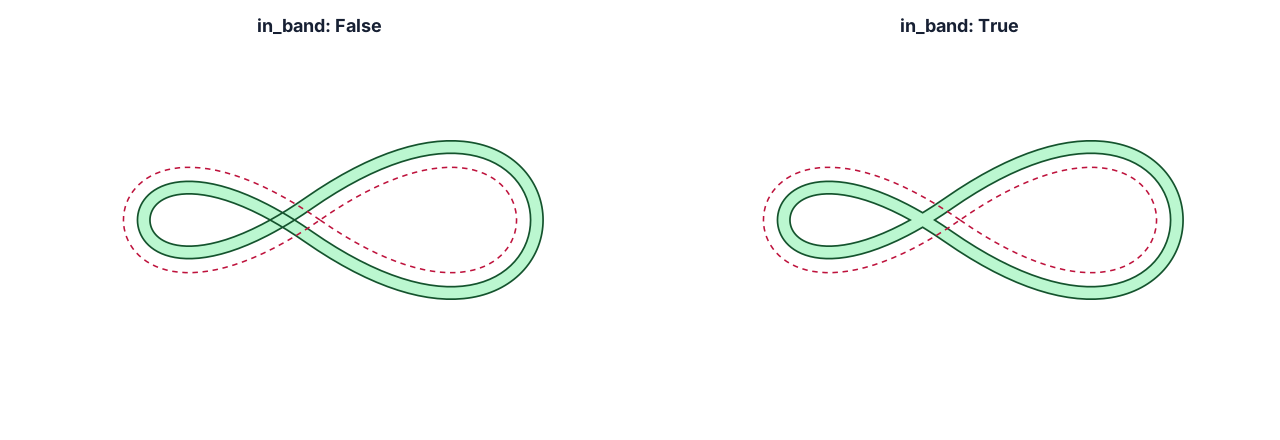
All three band switches default to true. Turning a stage off is useful for
inspection and for specialized callers that want to preserve intermediate
geometry, but the result can retain reversal folds, self-intersections, or
disconnected loops that the default pipeline removes.
Offset.subpathBandUntrimmed, Offset.pathBandUntrimmed, and their With
variants return the two synchronized offset sides without side-local or joint
trimming. They preserve inner-then-outer ordering and add no caps or bridges.
Stroke Outlines and Dashes
Stroke is a small public wrapper over the offset stroke-outline machinery. It
uses StrokeOptions, StrokeCap, and dash options rather than exposing every
offset-specific detail at the top level.
Stroke.segment (Line(a, b)) 2.0<length>
Stroke.subpath subpath 2.0<length>
Stroke.path path 2.0<length>

let roundStroke =
    { Stroke.defaultOptions with
        Width = 2.0<length>
        Cap = StrokeRound
        Offset = { Offset.defaultOptions with Join = Round } }

Stroke.subpathWith subpath roundStroke
Dash extraction uses SVG dash semantics: odd-length dash arrays are duplicated, zero patterns produce no dashes, negative dash lengths are rejected, and the dash offset is normalized around the total pattern length.
Arrangement Graphs
Arrangement constructs a planar arrangement from one or more source paths.
Construction preserves the caller's segment geometry while progressively
splitting segments at intersections, endpoint contacts, and overlap boundaries.
The resulting atomic edges do not intersect except at endpoint clusters.
Coincident edges are stored once with forward and reverse multiplicities.
For two overlapping squares, the input boundaries cross at two points. Those crossings become vertices, and the four original sides that pass through them are split into atomic edges. The left panel uses one color per source subpath; the right panel shows the resulting vertices, directed edges, winding levels, and directional multiplicities.
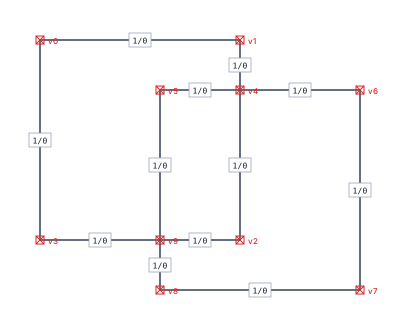
Arrangement.build [ left; right ] 0.000001<length> 0.00001<length>
ArrangementGraphBuild contains the graph and SegmentImages. Each segment
image records, in original path, subpath, and segment order, the graph-edge
identifiers produced from one source segment and whether each traversal reverses
the stored edge direction. An image can be empty when all pieces of an input
segment are shorter than MinimumChord.
The graph, vertex, and edge representations are transparent for inspection. Vertices retain their clustered source endpoints and use the center of the smallest circle enclosing those endpoints as their representative point. Edges retain their segment geometry, endpoint vertex identifiers, directional multiplicities, and bounds. Cyclic edge order around a vertex is derived from geometry and stored as ordered groups.
Arrangement construction compares segment geometry rather than requiring structurally equal segment values. In the following case, two equal circles run in opposite directions. Each consists of two 180-degree arcs, but the second circle's subdivision is shifted by 45 degrees. The graph splits the common circle at all four source endpoints and represents each geometric edge once, with one occurrence in each direction.
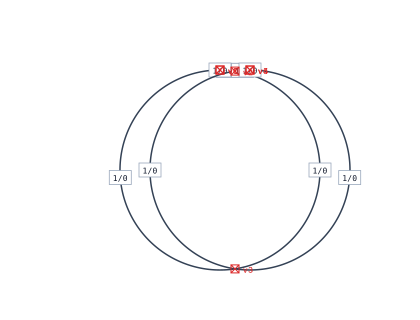
Arrangement.build is the supported constructor. Direct construction remains
possible for inspection, serialization, and tests, but callers then assume
responsibility for the documented graph invariants. Arrangement.validate
checks local representation and closed-boundary invariants that do not require
pairwise intersection tests.
ArrangementDrawing provides reusable drawing primitives for the transparent
graph representation. ArrangementDrawing.drawing shows vertices, edges, and
directional multiplicities. ArrangementDrawing.annotatedDrawing additionally
shows winding levels on both sides of every edge relative to a compatible source
path; it trusts that the supplied source corresponds to the graph.
Path CSG
Csg performs operations on the filled point-sets represented by SVG paths. It
builds an arrangement graph, measures the winding field on either side of its
edges, applies the requested fill rule, and reconstructs the necessary boundary
cycles.
Csg.union left right Nonzero
Csg.intersection left right Nonzero
Csg.difference left right Nonzero
Csg.symmetricDifference left right Nonzero
Each function returns Result<CsgResult, CsgError>. For example, both products
of a union remain available without rebuilding the arrangement:
let output = Csg.union left right Nonzero

// output.Path is the reconstructed result.
// output.Build is the exact ArrangementGraphBuild used to compute it.
CsgResult.Path is the reconstructed output path. CsgResult.Build exposes the
arrangement graph and source-segment images for inspection or drawing. This
matters because endpoint clustering and segment refinement make the
arrangement's geometry the source of truth for the returned path.
Boolean operations can produce no components, one component, multiple
components, holes, or islands inside holes. Multiple subpaths in each operand
are evaluated globally. Open subpaths follow SVG fill semantics and are
implicitly closed for filling. The fill rule is part of the operation: repeated
loops, self-intersections, and nested subpaths can produce different results
under Nonzero and EvenOdd.
The following worked example uses two paths containing two rectangles each. Every panel retains the same coordinate system: the first row shows the source paths, their arrangement graph, union, and intersection; the second shows both orders of difference, symmetric difference, and rounded nested contours. The arrangement is constructed once from geometry, while each binary result classifies its edge sectors under the selected fill rule.
Under Nonzero, any nonzero winding level is filled. The arrangement panel's
black numbers are the winding levels immediately to the left and right of each
directed edge; its red numbers are forward and reverse source multiplicities.
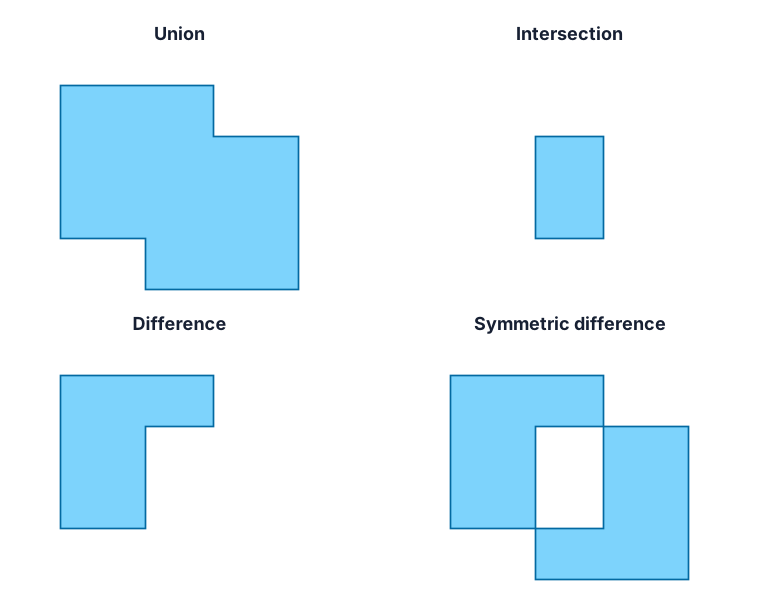
The same inputs and arrangement produce different Boolean boundaries under
EvenOdd, where winding parity determines whether a sector is filled. The final
nestedContours panel is unchanged because that unary operation preserves the
complete signed winding field and does not take a fill rule.
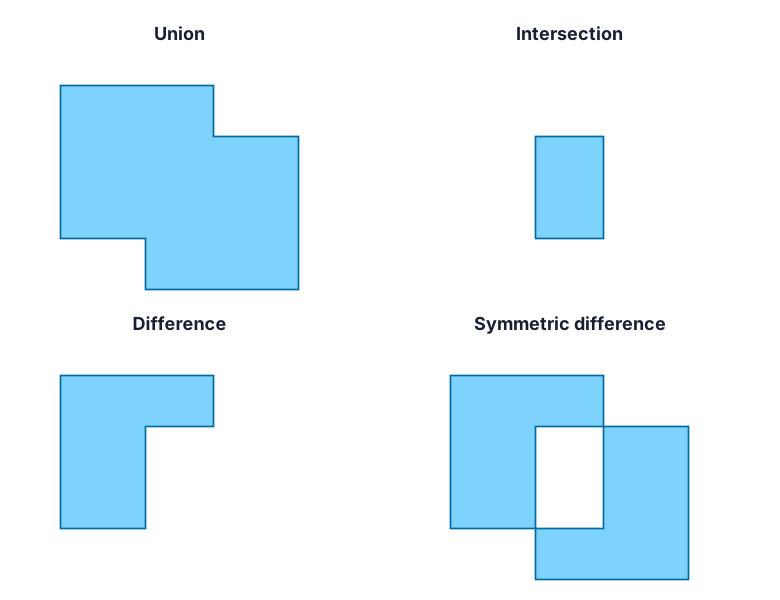
For points away from a boundary:
| Operation | The point is inside the result when |
|---|---|
union(left, right) |
it is inside left or right |
intersection(left, right) |
it is inside both operands |
difference(left, right) |
it is inside left but not right |
symmetricDifference(left, right) |
it is inside exactly one operand |
Use the With variants with CsgOptions to choose the endpoint tolerance and
minimum atomic-edge chord. Returned segments retain their source type where
possible: lines remain lines, Beziers remain Beziers, and arcs remain arcs after
splitting.
The unary Csg.nestedContours operation takes no fill rule. It reconstructs
nested or disjoint unit-level contours that preserve a path's complete signed
integer winding field, rather than reducing that field to filled/unfilled
values.
README Figures
README figures are generated through the public F# API by a non-packable console project:
scripts/generate-readme-figures
scripts/generate-readme-figures --check
The source SVGs live under docs/readme on main. For package README rendering,
the same generated SVGs are copied to the repository's markdown-assets branch
under figures/, so NuGet can fetch them as public raw GitHub assets. NuGet
renders externally hosted images from an allow-list that includes
raw.githubusercontent.com; it does not render images by reading relative paths
inside the .nupkg.
Development
scripts/test-fast          # ordinary tests, excluding the slow convex-hull suite
scripts/test-slow          # the slow convex-hull suite only
scripts/test-all           # full suite (fast then slow)
scripts/test-release       # canonical pre-release verification (full suite)
scripts/generate-readme-figures
scripts/generate-readme-figures --check
Without the scripts, the test project can be run directly:
dotnet test tests/SvgPath.Tests/SvgPath.Tests.fsproj --filter "Category!=Slow"
The generated README SVGs are not part of the SvgPath NuGet package. The
package includes the Markdown README itself, the compiled library, XML docs,
license metadata, repository metadata, and the FSharp.Core dependency.
| Product | Versions Compatible and additional computed target framework versions. |
|---|---|
| .NET | net9.0 is compatible. net9.0-android was computed. net9.0-browser was computed. net9.0-ios was computed. net9.0-maccatalyst was computed. net9.0-macos was computed. net9.0-tvos was computed. net9.0-windows was computed. net10.0 was computed. net10.0-android was computed. net10.0-browser was computed. net10.0-ios was computed. net10.0-maccatalyst was computed. net10.0-macos was computed. net10.0-tvos was computed. net10.0-windows was computed. |
-
net9.0
- FSharp.Core (>= 9.0.201)
NuGet packages
This package is not used by any NuGet packages.
GitHub repositories
This package is not used by any popular GitHub repositories.