Toralux.Open.IdentityServer.Admin.EntityFramework.Shared
0.2.2
dotnet add package Toralux.Open.IdentityServer.Admin.EntityFramework.Shared --version 0.2.2
NuGet\Install-Package Toralux.Open.IdentityServer.Admin.EntityFramework.Shared -Version 0.2.2
<PackageReference Include="Toralux.Open.IdentityServer.Admin.EntityFramework.Shared" Version="0.2.2" />
<PackageVersion Include="Toralux.Open.IdentityServer.Admin.EntityFramework.Shared" Version="0.2.2" />
<PackageReference Include="Toralux.Open.IdentityServer.Admin.EntityFramework.Shared" />
paket add Toralux.Open.IdentityServer.Admin.EntityFramework.Shared --version 0.2.2
#r "nuget: Toralux.Open.IdentityServer.Admin.EntityFramework.Shared, 0.2.2"
#:package Toralux.Open.IdentityServer.Admin.EntityFramework.Shared@0.2.2
#addin nuget:?package=Toralux.Open.IdentityServer.Admin.EntityFramework.Shared&version=0.2.2
#tool nuget:?package=Toralux.Open.IdentityServer.Admin.EntityFramework.Shared&version=0.2.2
Toralux Open.IdentityServer Admin
Modern administration UI for Open IdentityServer and ASP.NET Core Identity
Manage IdentityServer clients and resources, ASP.NET Core Identity users and roles, configuration health, auditing, and security from one modern interface.




Installation · Local Development · Docker · Roadmap · Upstream Discord
Toralux fork — synced to upstream 3.1.0
Toralux Open IdentityServer Admin is a fork of
skoruba/Duende.IdentityServer.Admin
— forked at v3.0.0 (commit 45da4dc4), synced to upstream 3.1.0
(commit 22c84428) — retargeted from Duende IdentityServer to
Open IdentityServer. Packages ship as Toralux.Open.IdentityServer.Admin.*;
upstream lineage and the divergences this fork intentionally keeps are
documented in CHANGELOG.md and NOTICE.
Not affiliated with or endorsed by Rock Solid Knowledge / IdentityServer.com. "Duende IdentityServer" is a trademark of Duende Software; "IdentityServer" is a trademark of Rock Solid Knowledge Ltd. This project is an independent administration UI for the open-source Open IdentityServer.
What's in this UI
A completely redesigned administration experience built with React, TypeScript, Tailwind CSS, shadcn/ui, and .NET 10.
See the roadmap and changelog for release history and upcoming features.
Highlights
| Area | Highlights | |
|---|---|---|
| 🧭 | New Admin UI | React, TypeScript, Tailwind CSS, and shadcn/ui |
| ⚙️ | Modern backend | .NET 10 and Open IdentityServer 7.4.7 |
| 📊 | Monitoring | Dashboards, configuration rules, and issue tracking |
| 🧙 | Client management | Improved workflows and guided client creation wizard |
| 🔐 | Authentication | Passkey support in STS Identity |
| 🧩 | Mapping | Mapperly-based mapping pipeline and customization points |
| 🛡️ | Security | Hardened audit logging and stronger validation |
| 🧪 | Quality | Expanded Playwright UI, Admin API, STS, repository, and audit test coverage |
Contents
- Administration UI Preview
- Prerequisites
- Installation via
dotnet newTemplate - Quick Start – Local Development
- Running via Docker
- EF Core & Data Access
- Authentication & Authorization
- Azure Key Vault Integration
- Logging
- Audit Logging
- External Authentication Providers
- Email Service
- Health Checks
- Localization
- API & Swagger
- STS Configuration
- Identity Mapping Customization
- Solution Overview
- Roadmap & Changelog
- License
- Acknowledgements
- Contact & Support
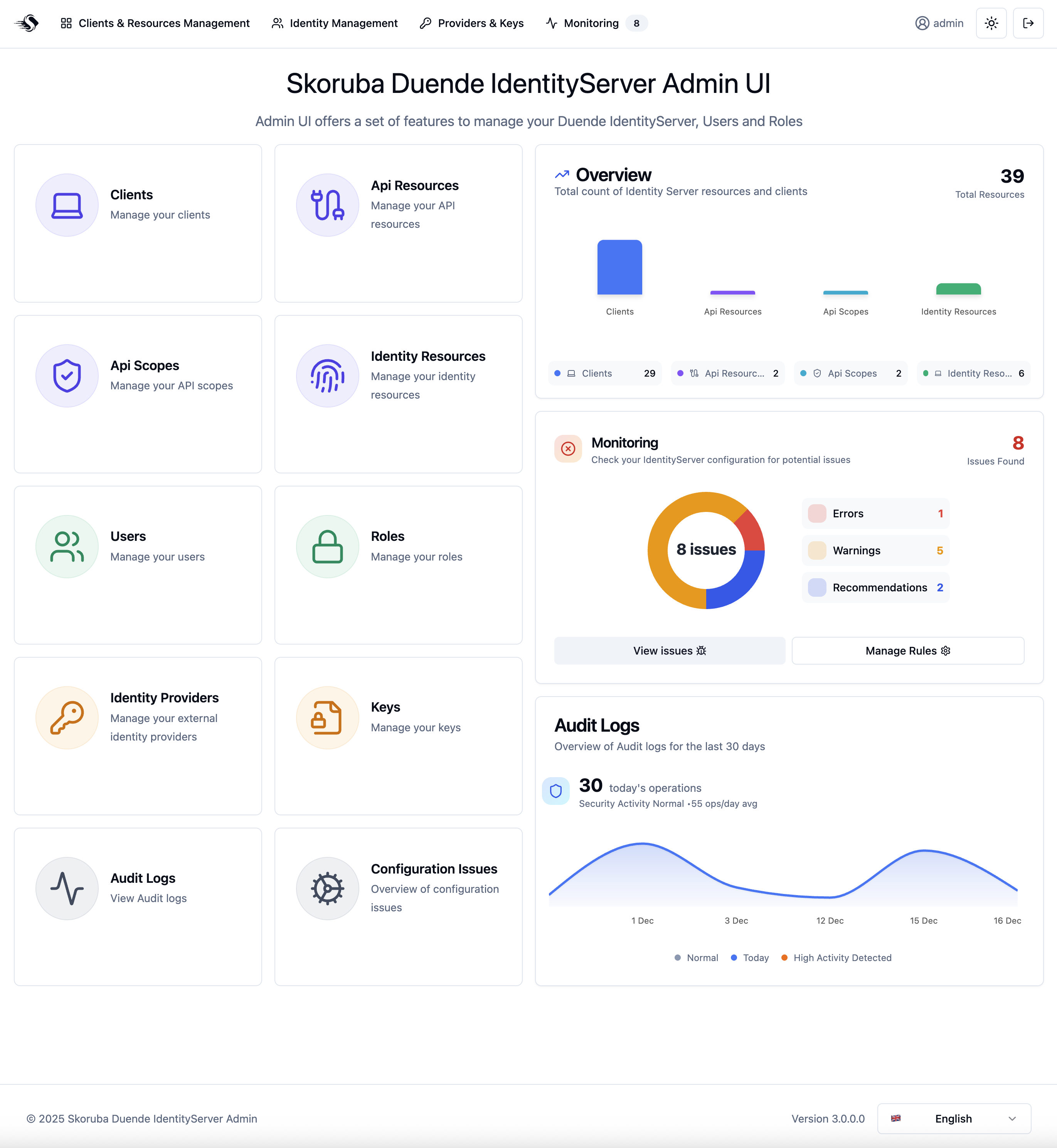
Administration UI Preview
Explore the redesigned administration experience, built with Tailwind CSS and shadcn/ui components.
🌙 Dashboard (Dark)
🧙♂️ Client Creation – Wizard Flow
💼 Client Management
📡 Monitoring
Define and track configuration rules for clients, API resources, and identity resources:
- Flag deprecated OAuth 2.1 flows
- Enforce required scopes
- Validate naming conventions
- Warn about expired client secrets
🧱 Configuration Rules
🧩 Configuration Issues
Solution Structure
✅ Prerequisites
- .NET 10 SDK
- Node.js 22.12+ and npm (required for the React client)
- SQL Server (default LocalDB) or PostgreSQL
- Open IdentityServer 7.4.7
Note: Using older .NET versions may cause 502.5 errors on IIS or application startup failures.
📦 Installation via dotnet new Template
🔒 Database note:
This template includes default EF migrations. Review them and back up your database before applying.
ℹ️ Migration note from IdentityServer4.Admin:
TheUserSecretsIdfor Admin, Admin API, and STS projects remains the same as in the olderSkoruba.IdentityServer4.Adminsolution to ease config migration. If you still have secrets from the old project on your machine, they will be reused (e.g.,ApplySeedcould point at your old DB). Change or clear user secrets if you need isolation.
1. Install the template
dotnet new install Toralux.Open.IdentityServer.Admin.Templates::0.1.0
2. Create a new project
dotnet new toralux.open-isadmin \
  --name MyProject \
  --title MyProject \
  --adminemail "admin@example.com" \
  --adminpassword "Passw0rd-123" \
  --adminrole MyRole \
  --adminclientid MyClientId \
  --adminclientsecret MyClientSecret \
  --dockersupport true \
  --requirepushedauthorization true
Template Options
| Option | Description |
|---|---|
--name |
Project name |
--title |
Admin UI title and footer text |
--adminemail |
Initial admin email |
--adminpassword |
Initial admin password |
--adminrole |
Role name used for admin authorization |
--adminclientid |
Client ID for the Admin UI OIDC client |
--adminclientsecret |
Client secret for the Admin UI OIDC client |
--dockersupport |
Include Docker support (true / false) |
--requirepushedauthorization |
Require PAR for admin client (true / false, default false). Note: Pushed Authorization Requests require Duende IdentityServer Business Edition upstream and are not used by Open IdentityServer. More info |
🚀 Quick Start – Local Development
Note: This section is for developers who want to clone and contribute to the repository. If you want to use the template, see the section above.
The solution contains three runnable services:
| Service | Project | Purpose |
|---|---|---|
| STS | Toralux.Open.IdentityServer.STS.Identity |
IdentityServer + authentication |
| Admin API | Toralux.Open.IdentityServer.Admin.Api |
REST API backend |
| Admin UI | Toralux.Open.IdentityServer.Admin |
SPA host |
1. Clone the repository
git clone https://github.com/toralux/Open.IdentityServer.Admin
cd Open.IdentityServer.Admin
2. Install React dependencies (first run only)
cd src/Toralux.Open.IdentityServer.Admin.UI.Client
npm install
cd ../..
3. Run the services
Open three terminals and run:
# Terminal 1: STS (IdentityServer)
cd src/Toralux.Open.IdentityServer.STS.Identity
dotnet run

# Terminal 2: Admin API
cd src/Toralux.Open.IdentityServer.Admin.Api
dotnet run

# Terminal 3: Admin UI Host
cd src/Toralux.Open.IdentityServer.Admin
dotnet run
4. Default local URLs
| Service | URL |
|---|---|
| STS | https://localhost:44310 |
| Admin API | https://localhost:44302 |
| Admin UI | Check console output (usually https://localhost:7127) |
By default, database migrations and seed data are enabled in Admin API (
ApplyDatabaseMigrations,ApplySeed).
🐳 Running via Docker (Optional)
Tip: For the fastest onboarding, use the
dotnet runapproach above. Docker requires custom domain and certificates.
DNS Configuration
Update your hosts file to resolve toralux.local:
Windows: C:\Windows\System32\drivers\etc\hosts
Linux / macOS: /etc/hosts
127.0.0.1 toralux.local sts.toralux.local admin.toralux.local admin-api.toralux.local
Certificates Setup
Use mkcert to generate self-signed local certificates.
Windows
cd shared/nginx/certs
mkcert --install
copy $env:LOCALAPPDATA\mkcert\rootCA-key.pem ./cacerts.pem
copy $env:LOCALAPPDATA\mkcert\rootCA.pem ./cacerts.crt

# Generate toralux.local certificates
mkcert -cert-file toralux.local.crt -key-file toralux.local.key toralux.local *.toralux.local
mkcert -pkcs12 toralux.local.pfx toralux.local *.toralux.local
macOS / Linux
cd shared/nginx/certs
mkcert -install

# Copy root certificates (adjust paths for your system)
# macOS: ~/Library/Application\ Support/mkcert/
# Linux: ~/.local/share/mkcert/
cp "$(mkcert -CAROOT)/rootCA-key.pem" ./cacerts.pem
cp "$(mkcert -CAROOT)/rootCA.pem" ./cacerts.crt

# Generate toralux.local certificates
mkcert -cert-file toralux.local.crt -key-file toralux.local.key toralux.local *.toralux.local
mkcert -pkcs12 toralux.local.pfx toralux.local *.toralux.local
Run Docker Compose
docker-compose build
docker-compose up -d
Docker setup is based on bravecobra's repository – thanks! 😊
Docker Images
Docker images are available on Docker Hub.
To publish images, check build/publish-docker-images.ps1 and update the profile name.
🗄️ EF Core & Data Access
DbContexts
The solution uses the following DbContext classes:
AdminIdentityDbContext– ASP.NET Core Identity dataAdminLogDbContext– Logging dataIdentityServerConfigurationDbContext– IdentityServer configuration storeIdentityServerPersistedGrantDbContext– IdentityServer operational storeAuditLoggingDbContext– Audit loggingIdentityServerDataProtectionDbContext– Data protection keysAdminConfigurationDbContext– Admin configuration and monitoring (added in v3.0.0)
Database Providers
- SQL Server (default)
- PostgreSQL
Switch providers in appsettings.json:
"DatabaseProviderConfiguration": {
  "ProviderType": "SqlServer"
}
Connection String Examples
Seven connection strings are used. Beyond the six obvious ones
(ConfigurationDbConnection, PersistedGrantDbConnection, IdentityDbConnection,
AdminLogDbConnection, AdminAuditLogDbConnection, DataProtectionDbConnection),
hosts also read AdminConfigurationDbConnection (Admin UI configuration storage).
When overriding per environment (env vars like
ConnectionStrings__AdminConfigurationDbConnection, Key Vault, etc.),
override all seven — missing the seventh causes hard-to-diagnose startup failures.
SQL Server (LocalDB):
Data Source=(LocalDb)\\MSSQLLocalDB;database=DuendeIdentityServerAdmin;trusted_connection=yes;
PostgreSQL:
Server=localhost;Port=5432;Database=DuendeIdentityServerAdmin;User Id=sa;Password=#;
Running Entity Framework Migrations
Note: Initial migrations are included in the repository.
Use the PowerShell script in build/add-migrations.ps1:
.\add-migrations.ps1 -migration DbInit -migrationProviderName SqlServer
Arguments:
--migration– Migration name--migrationProviderName– Provider type (choices:All,SqlServer,PostgreSQL)
Seed Data
Migrating from Skoruba/Duende Admin? Open.IdentityServer seed secrets hash as
BASE64 (Duende.IdentityModel ToSha256), not the IS4-style lowercase hex
SHA-256. Client secrets seeded or imported with hex hashes will not authenticate —
re-hash (BASE64) or re-seed them when moving data from a Skoruba/Duende database.
Seed data is configured in:
identityserverdata.json– IdentityServer clients and resourcesidentitydata.json– ASP.NET Core Identity users and roles
Enable seeding via:
Option 1: Command line
dotnet run /seed
Option 2: Configuration (appsettings.json)
"SeedConfiguration": {
  "ApplySeed": true
},
"DatabaseMigrationsConfiguration": {
  "ApplyDatabaseMigrations": true
}
🔐 Authentication & Authorization
- Admin policy:
AuthorizationConsts.AdministrationPolicy - Required role configured in
AdministrationRole(appsettings.json) - Admin UI authenticates via OIDC against STS
- Admin UI calls Admin API using client credentials
Configuration in appsettings.json:
"AdministrationRole": "ToraluxIdentityAdminAdministrator"
🔑 Azure Key Vault Integration
Azure Key Vault supports:
- Configuration secrets
- Data Protection keys
- IdentityServer signing certificates
Configuration
"AzureKeyVaultConfiguration": {
  "AzureKeyVaultEndpoint": "https://your-vault.vault.azure.net/",
  "ReadConfigurationFromKeyVault": true,
  "ClientId": "",
  "ClientSecret": "",
  "UseClientCredentials": true
}
For Azure App Service: Only specify AzureKeyVaultEndpoint.
Outside Azure: Use client credentials (register app in Azure Portal).
Data Protection
"DataProtectionConfiguration": {
  "ProtectKeysWithAzureKeyVault": true
},
"AzureKeyVaultConfiguration": {
  "DataProtectionKeyIdentifier": "https://your-vault.vault.azure.net/keys/dataprotection"
}
IdentityServer Signing Certificate
"AzureKeyVaultConfiguration": {
  "IdentityServerCertificateName": "IdentityServerSigningCert"
}
📝 Logging
Uses Serilog with the following sinks (configured in serilog.json):
- Console
- File
- MSSqlServer
- Seq
Example configuration:
{
  "Serilog": {
    "MinimumLevel": {
      "Default": "Error",
      "Override": {
        "Skoruba": "Information"
      }
    },
    "WriteTo": [
      {
        "Name": "Console"
      },
      {
        "Name": "File",
        "Args": {
          "path": "log.txt",
          "rollingInterval": "Day"
        }
      },
      {
        "Name": "MSSqlServer",
        "Args": {
          "connectionString": "...",
          "tableName": "Log"
        }
      }
    ]
  }
}
📊 Audit Logging
Integrated via skoruba/AuditLogging.
Configuration in appsettings.json:
"AuditLoggingConfiguration": {
  "Source": "IdentityServer.Admin.Web",
  "SubjectIdentifierClaim": "sub",
  "SubjectNameClaim": "name",
  "IncludeFormVariables": false
}
Audit logs are stored in the AuditLog table.
Usage example:
await AuditEventLogger.LogEventAsync(new ClientDeletedEvent(client));
🔌 External Authentication Providers
Configure external providers in STS (appsettings.json):
"ExternalProvidersConfiguration": {
  "UseGitHubProvider": false,
  "GitHubClientId": "",
  "GitHubClientSecret": "",
  "UseAzureAdProvider": false,
  "AzureAdClientId": "",
  "AzureAdTenantId": "",
  "AzureInstance": "https://login.microsoftonline.com/",
  "AzureAdSecret": "",
  "AzureAdCallbackPath": "/signin-oidc",
  "AzureDomain": ""
}
Supported providers:
- GitHub
- Azure AD
- Any provider via aspnet-contrib/AspNet.Security.OAuth.Providers
Azure AD setup guide:
Quickstart: Sign in users in ASP.NET Core web apps
📧 Email Service
SendGrid
"SendgridConfiguration": {
  "ApiKey": "",
  "SourceEmail": "",
  "SourceName": ""
}
SMTP
"SmtpConfiguration": {
  "From": "",
  "Host": "",
  "Login": "",
  "Password": ""
}
🏥 Health Checks
All services expose a /health endpoint for monitoring:
- Admin UI:
https://localhost:7127/health - Admin API:
https://localhost:44302/health - STS:
https://localhost:44310/health
Checks include:
- Database connectivity
- IdentityServer availability
🌍 Localization
Translations are stored in /i18n.
Currently supported:
- English
Contributing translations:
Feel free to submit a PR with your translation! 😊
🧪 API & Swagger
Swagger UI is available at:
https://localhost:44302/swagger
Configuration (appsettings.json):
"AdminApiConfiguration": {
  "IdentityServerBaseUrl": "https://localhost:44310",
  "OidcSwaggerUIClientId": "toralux_identity_admin_api_swaggerui",
  "OidcApiName": "toralux_identity_admin_api"
}
⚙️ STS Configuration
Login Method
Choose between Username or Email login:
"LoginConfiguration": {
  "ResolutionPolicy": "Username"
}
User Registration
Enable or disable user registration:
"RegisterConfiguration": {
  "Enabled": true
}
🧩 Identity Mapping Customization
Identity DTO/entity mapping in Toralux.Open.IdentityServer.Admin.BusinessLogic.Identity is handled by IdentityDataMapper.
By default:
- Standard ASP.NET Core Identity fields are mapped explicitly.
- Additional custom fields are mapped automatically when DTO and entity use the same property name and compatible type.
- Internal Identity fields (
PasswordHash,SecurityStamp,ConcurrencyStamp,NormalizedUserName,NormalizedEmail) are protected during DTO → entity updates.
1. Same-name custom properties
If your custom UserDto / RoleDto and IdentityUser / IdentityRole share the same custom property name, no extra configuration is needed.
2. Different property names (customizers)
When names differ, implement customizers and register them in DI:
services
    .AddAdminAspNetIdentityServices<...>()
    .AddIdentityUserMappingCustomizer<ApplicationUserDto, ApplicationUser, ApplicationUserMappingCustomizer>()
    .AddIdentityRoleMappingCustomizer<ApplicationRoleDto, ApplicationRole, ApplicationRoleMappingCustomizer>();
Customizers implement:
IIdentityUserMappingCustomizer<TUserDto, TUser>IIdentityRoleMappingCustomizer<TRoleDto, TRole>
If your custom user DTO exposes additional audit-sensitive fields, also implement
IIdentityUserAuditSanitizer<TUserDto> on the user mapping customizer. The built-in
audit sanitizer always redacts PasswordHash, SecurityStamp, and
ConcurrencyStamp by property name.
3. Full mapper override
If you need full control, replace the default IIdentityDataMapper<...> registration in DI with your own implementation after calling AddAdminAspNetIdentityServices.
Custom mapper implementations do not need to implement audit sanitization for
backward compatibility, but they can implement
IIdentityAuditDataMapper<TUserDto, TUsersDto> when they need custom audit
redaction. Without it, audit logging falls back to the built-in redaction for
PasswordHash, SecurityStamp, and ConcurrencyStamp.
📚 Solution Overview
The solution contains unit and integration tests for all major components.
STS
Toralux.Open.IdentityServer.STS.Identity – IdentityServer with ASP.NET Core Identity
Admin API
Toralux.Open.IdentityServer.Admin.Api – REST API with Swagger
Admin UI
Toralux.Open.IdentityServer.Admin– .NET hostToralux.Open.IdentityServer.Admin.UI– UI servicesToralux.Open.IdentityServer.Admin.UI.Spa– Precompiled React assetsToralux.Open.IdentityServer.Admin.UI.Client– React source code
Business Logic
Toralux.Open.IdentityServer.Admin.BusinessLogic– IdentityServer DTOs, services, repositoriesToralux.Open.IdentityServer.Admin.BusinessLogic.Identity– Identity DTOs, services, repositoriesToralux.Open.IdentityServer.Admin.BusinessLogic.Shared– Shared logic
Entity Framework
Toralux.Open.IdentityServer.Admin.EntityFramework– Core EF entitiesToralux.Open.IdentityServer.Admin.EntityFramework.Configuration– Entity configurationsToralux.Open.IdentityServer.Admin.EntityFramework.Extensions– EF extensionsToralux.Open.IdentityServer.Admin.EntityFramework.Identity– Identity repositoriesToralux.Open.IdentityServer.Admin.EntityFramework.Shared– DbContextsToralux.Open.IdentityServer.Admin.EntityFramework.SqlServer– SQL Server migrationsToralux.Open.IdentityServer.Admin.EntityFramework.PostgreSQL– PostgreSQL migrations
Shared
Toralux.Open.IdentityServer.Shared– Shared DTOsToralux.Open.IdentityServer.Shared.Configuration– Shared configuration
Tests
Toralux.Open.IdentityServer.Admin.UnitTests– Unit testsToralux.Open.IdentityServer.Admin.Api.IntegrationTests– API integration testsToralux.Open.IdentityServer.STS.IntegrationTests– STS integration testsToralux.Open.IdentityServer.Admin.UI.Client.IntegrationTests– Playwright UI integration tests (OIDC login flow + Admin UI assertions)
UI Integration Tests (Playwright)
The UI E2E test project is located in:
tests/Toralux.Open.IdentityServer.Admin.UI.Client.IntegrationTests
To run it:
cd tests/Toralux.Open.IdentityServer.Admin.UI.Client.IntegrationTests
npm install
npx playwright install chromium
npm test
Default expected runtime services:
- STS:
https://localhost:44310 - Admin API:
https://localhost:44302 - Admin UI host:
- Kestrel-hosted app:
https://localhost:7127 - Vite dev server / default
E2E_ADMIN_URLfor Playwright:https://localhost:50445
- Kestrel-hosted app:
Important: The seeded OIDC client redirect URIs and CORS origins in
src/Toralux.Open.IdentityServer.Admin.Api/identityserverdata.jsonusehttps://localhost:50445by default. If you run the Admin UI onhttps://localhost:7127instead, update the client configuration (or the PlaywrightE2E_ADMIN_URL) so redirects and CORS validation continue to work.
The tests load credentials and expected client data from seed files:
src/Toralux.Open.IdentityServer.Admin.Api/identitydata.jsonsrc/Toralux.Open.IdentityServer.Admin.Api/identityserverdata.json
🚦 Roadmap & Changelog
For detailed release history and upcoming features, see CHANGELOG.md.
Fork roadmap:
- Playwright E2E spec-sync (specs drifted from the SPA during the retarget)
- Single-glyph package icon variant for better 32px legibility
- Track upstream skoruba releases — absorbed via the documented replay workflow in CONTRIBUTING.md
- Track Open.IdentityServer releases (server-side sessions and PAR are on their roadmap)
For the upstream project's own roadmap (3.x–6.x plans: DTO refactoring, claims management UI, Minimal API rewrite), see their README.
Releasing
Publishing is fully tag-driven via the publish workflow:
- Prerelease (beta): push a tag like
v0.2.0-beta.1— packages publish as prerelease versions (0.2.0-beta.1), visible on NuGet only with--prerelease. - Stable: push
v0.2.0— same pipeline, standard visibility. - The tag is the single source of truth for the version — no manual version bumps.
- Convention: beta tags for upstream-sync releases and anything not yet proven in the wild; stable tags after a beta has cooked (or for trivially safe fixes).
Auth is keyless via nuget.org trusted publishing: the workflow exchanges a GitHub OIDC token for a 1-hour API key — no NUGET_API_KEY secret to store or rotate. Requires a one-time policy on nuget.org (username → Trusted Publishing → this repo + publish.yml).
📜 License
This repository is licensed under Apache License 2.0.
Open.IdentityServer — the framework this admin UI targets — is likewise licensed under Apache 2.0. There is no commercial license, no RPL, and no production licensing requirement for either project.
This project includes code with deep lineage, originally derived from DuendeSoftware/IdentityServer.Quickstart.UI (Apache 2.0) via the upstream admin project.
🙏 Acknowledgements
This project is a community fork and would not exist without:
- Jan Škoruba — author of skoruba/Duende.IdentityServer.Admin (v3.0.0), the direct upstream of this fork: its architecture, the React 18 + .NET 10 admin UI, and the vast majority of the code
- Rock Solid Knowledge — maintainers of Open.IdentityServer, the free Apache-2.0 continuation of the IdentityServer4 framework this fork targets
- Dominick Baier and Brock Allen — creators of IdentityServer4 and Duende IdentityServer, the foundation beneath all of it
- Tomáš Hübelbauer — initial code review (upstream)
- All upstream contributors 👍
📧 Contact & Support
Maintainer: Tor Anders Johansen (@toralux)
Feedback is welcome — please open an issue on this repository.
Supporting the upstream
The original admin project is maintained by Jan Škoruba. If this fork saved you time, consider supporting him directly:
- GitHub Sponsors: https://github.com/sponsors/skoruba
- PayPal: https://www.paypal.me/skoruba
- Patreon: https://www.patreon.com/skoruba
| Product | Versions Compatible and additional computed target framework versions. |
|---|---|
| .NET | net10.0 is compatible. net10.0-android was computed. net10.0-browser was computed. net10.0-ios was computed. net10.0-maccatalyst was computed. net10.0-macos was computed. net10.0-tvos was computed. net10.0-windows was computed. |
-
net10.0
- Duende.IdentityModel (>= 8.1.0)
- Microsoft.AspNetCore.DataProtection.EntityFrameworkCore (>= 10.0.12)
- Skoruba.AuditLogging.EntityFramework (>= 3.0.0)
- Toralux.Open.IdentityServer.Admin.EntityFramework.Admin.Storage (>= 0.2.2)
- Toralux.Open.IdentityServer.Admin.EntityFramework.Configuration (>= 0.2.2)
NuGet packages (2)
Showing the top 2 NuGet packages that depend on Toralux.Open.IdentityServer.Admin.EntityFramework.Shared:
| Package | Downloads |
|---|---|
|
Toralux.Open.IdentityServer.Admin.EntityFramework.Admin
Entity Framework layer for admin features |
|
|
Toralux.Open.IdentityServer.Admin.BusinessLogic.Identity
Business Logic layer for the administration of the Asp.Net Core Identity and Open IdentityServer |
GitHub repositories
This package is not used by any popular GitHub repositories.