AutoNormalize.Abstractions
1.0.0
dotnet add package AutoNormalize.Abstractions --version 1.0.0
NuGet\Install-Package AutoNormalize.Abstractions -Version 1.0.0
<PackageReference Include="AutoNormalize.Abstractions" Version="1.0.0" />
<PackageVersion Include="AutoNormalize.Abstractions" Version="1.0.0" />
<PackageReference Include="AutoNormalize.Abstractions" />
paket add AutoNormalize.Abstractions --version 1.0.0
#r "nuget: AutoNormalize.Abstractions, 1.0.0"
#:package AutoNormalize.Abstractions@1.0.0
#addin nuget:?package=AutoNormalize.Abstractions&version=1.0.0
#tool nuget:?package=AutoNormalize.Abstractions&version=1.0.0
AutoNormalize

Consistent, configurable, safe-by-default input normalization for modern .NET applications.



1. Problem Statement
Across ASP.NET Core applications, developers repeatedly write boilerplate logic to canonicalize incoming text data:
- Trimming leading and trailing whitespace from strings.
- Converting empty or whitespace-only strings to
null. - Canonicalizing Unicode character sequences into standard Unicode Normalization Form C.
- Enforcing standardized casing rules across DTOs and database models.
When performed manually, normalization is scattered across controllers, validators, or repository layers. This leads to subtle defects:
- Missing
.Trim()calls causing duplicate database records (e.g."user@example.com "vs"user@example.com"). - Inadvertent mutilation of sensitive fields (such as passwords, tokens, API keys, or Base64 payloads) when naive global string converters are used.
- Accidental mutation crashes on immutable C# positional records.
- Unnecessary managed heap allocations on strings that were already clean.
2. Why DotNet.AutoNormalize Exists
DotNet.AutoNormalize provides representation canonicalization at application ingress and persistence boundaries. It integrates directly with:
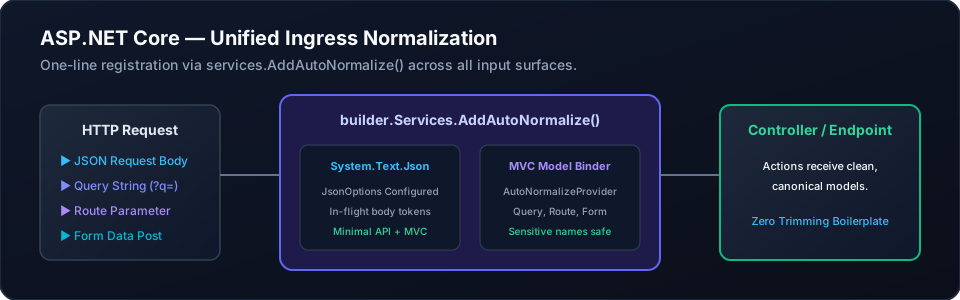
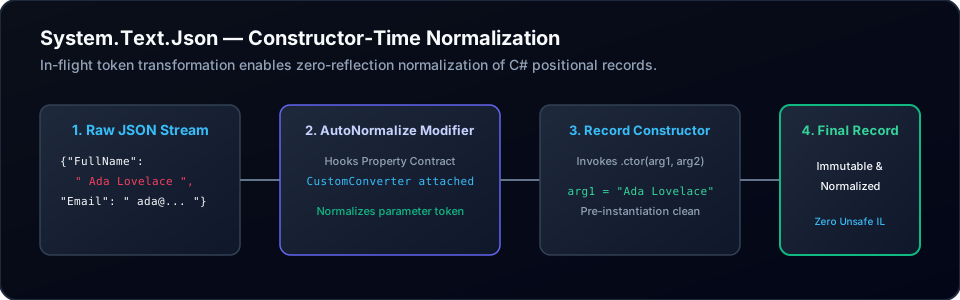
System.Text.Json: Canonicalizes string tokens in-flight during deserialization, binding cleanly into immutable C# positional records before constructor invocation.- ASP.NET Core Minimal APIs & MVC: Normalizes JSON request bodies, query strings, route parameters, and form fields via unified dependency injection.
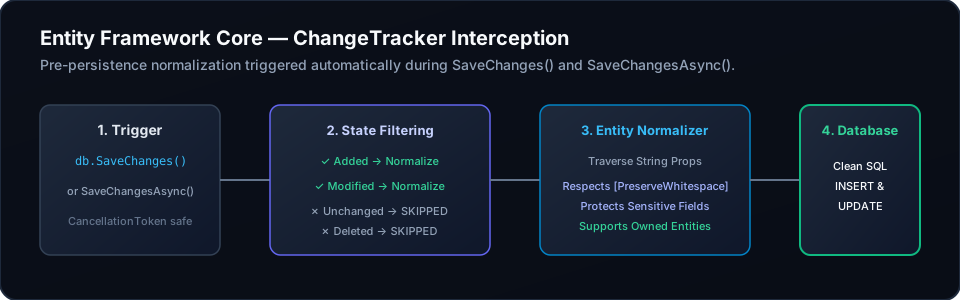
- Entity Framework Core: Hooks
SaveChanges()via anISaveChangesInterceptor, canonicalizingAddedandModifiedentity states prior to database write while skipping unchanged entities.
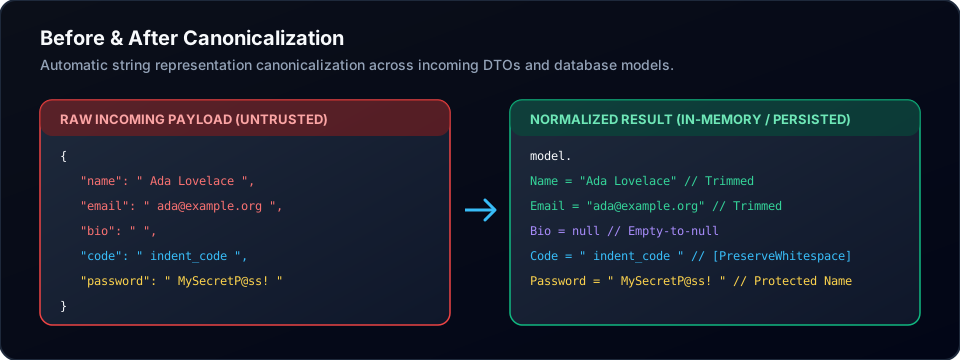
       RAW INPUT                             CANONICAL OUTPUT
┌──────────────────────────┐          ┌──────────────────────────┐
│ Name:     "   Ada   "    │  ──────► │ Name:     "Ada"          │
│ Bio:      "     "        │          │ Bio:      null           │
│ Password: "  secret  "   │          │ Password: "  secret  "   │ (Shielded)
└──────────────────────────┘          └──────────────────────────┘
3. Key Features
- Zero-Allocation Fast Path: Clean strings that do not require trimming or Unicode re-encoding bypass allocation, completing in 4.83 nanoseconds with 0 bytes allocated.
- Constructor-Time Record Normalization: Position records (
public record User(string Name, string Email)) normalize during JSON deserialization without unsafe IL or reflection mutations. - Defense-in-Depth Sensitive Guard: Built-in heuristic shielding for sensitive property names (
Password,Token,ApiKey,Secret,Signature,Hash,Salt). - Explicit Opt-Out Attributes: Declarative control via
[PreserveWhitespace],[DoNotNormalize], and[NormalizeWith(typeof(T))]. - Cycle-Safe Object Graphs: Traverses complex DTO hierarchies with circular reference tracking and configurable recursion limits.
- Dictionary Safety: Dictionaries normalize string values only; dictionary keys are never mutated to avoid hash bucket corruption or collisions.
4. Supported Target Frameworks
| Target Framework | Implementation Tier | Minimum SDK |
|---|---|---|
.NET 9.0 (STS) |
Native multi-target | 9.0.100+ |
.NET 8.0 (LTS) |
Native multi-target | 8.0.100+ |
.NET Standard 2.0 |
DotNet.AutoNormalize.Abstractions |
Compatible with .NET Framework 4.6.2+ & .NET Core |
.NET 10.0 |
Forward-compatible via NuGet asset resolution | Compatible |
5. Package Ecosystem & Installation
Install the specific package matching your architectural layer. See the Installation Guide for full package details.
# Core standalone engine
dotnet add package AutoNormalize.Core

# ASP.NET Core (Minimal APIs, MVC & System.Text.Json)
dotnet add package AutoNormalize.AspNetCore

# Entity Framework Core persistence interceptor
dotnet add package AutoNormalize.EntityFrameworkCore
6. Basic Usage (Standalone Engine)
using DotNet.AutoNormalize.Core;
using DotNet.AutoNormalize.Core.Engine;

var options = new AutoNormalizeOptions
{
    TrimStrings = true,
    EmptyStringsToNull = true,
    UnicodeNormalization = System.Text.NormalizationForm.FormC
};

IAutoNormalizer normalizer = new AutoNormalizer(options);

var user = new UserProfile
{
    DisplayName = "   Nikola Tesla   ",
    Bio = "      "
};

normalizer.Normalize(user);

// user.DisplayName == "Nikola Tesla"
// user.Bio == null

7. ASP.NET Core Integration
In your Program.cs, call AddAutoNormalize() on builder.Services:
var builder = WebApplication.CreateBuilder(args);

// Configures Minimal APIs, MVC Model Binding, and System.Text.Json
builder.Services.AddAutoNormalize(options =>
{
    options.TrimStrings = true;
    options.EmptyStringsToNull = true;
    options.UnicodeNormalization = NormalizationForm.FormC;
});

var app = builder.Build();

// Positional records normalized at birth during JSON deserialization
app.MapPost("/api/users", (RegisterUserCommand command) =>
{
    return Results.Ok(command);
});

app.Run();

public record RegisterUserCommand(string FullName, string Email);
8. System.Text.Json Integration
When configuring standalone JsonSerializerOptions:
using System.Text.Json;
using DotNet.AutoNormalize.Json.Extensions;

var options = new JsonSerializerOptions().AddAutoNormalize(opt =>
{
    opt.TrimStrings = true;
    opt.EmptyStringsToNull = true;
});

string json = """{"Name": "   Grace Hopper   ", "Email": "   grace@navy.mil   "}""";
var customer = JsonSerializer.Deserialize<CustomerRecord>(json, options);

// customer.Name == "Grace Hopper"
// customer.Email == "grace@navy.mil"
9. Entity Framework Core Integration
Add the interceptor to your DbContext:
using Microsoft.EntityFrameworkCore;

builder.Services.AddDbContext<AppDbContext>(options =>
{
    options.UseSqlServer(connectionString)
           .AddAutoNormalize(opt =>
           {
               opt.TrimStrings = true;
               opt.EmptyStringsToNull = true;
           });
});
10. Attributes and Opt-Outs
Fine-tune normalization behavior on individual properties or classes:
using DotNet.AutoNormalize.Abstractions;

public class EmployeeRecord
{
    public string Name { get; set; } = string.Empty; // Normalized

    [PreserveWhitespace]
    public string FormattedCode { get; set; } = string.Empty; // Whitespace preserved

    [DoNotNormalize]
    public string RawHash { get; set; } = string.Empty; // Excluded completely

    public string Password { get; set; } = string.Empty; // Protected by sensitive name heuristic
}
11. Custom Normalizers
Implement IStringNormalizer to enforce domain-specific rules:
public class UppercasePostalCodeNormalizer : IStringNormalizer
{
    public string? Normalize(string? value, NormalizationContext context)
    {
        return value?.Trim().ToUpperInvariant();
    }
}

// Register globally in options:
options.AddNormalizer(new UppercasePostalCodeNormalizer());

// Or attach via attribute:
public class Address
{
    [NormalizeWith(typeof(UppercasePostalCodeNormalizer))]
    public string? PostalCode { get; set; }
}
12. Security Considerations
Normalization Boundary Rules
- Normalization IS NOT Validation: Normalization canonicalizes representation. It never asserts business rules, regex formats, or ranges. Use FluentValidation or DataAnnotations for validation.
- Normalization IS NOT Sanitization: Normalization does not strip HTML tags or escape script tags. Use dedicated sanitizers for HTML sanitization.
- Normalization IS NOT SQL Injection Defense: Always use parameterized queries for SQL injection protection.
Sensitive Field Protection
By default, properties matching the following names are shielded from trimming and modification:
Password, Passcode, Token, AuthToken, AccessToken, RefreshToken, Secret, ClientSecret, SecretKey, ApiKey, PrivateKey, Signature, Hash, Salt, Passphrase, Certificate.
13. Audited Benchmarks
Tested via BenchmarkDotNet v0.14.0 on .NET 9.0 (RyuJIT AVX2, Windows 11):
| Workload | Method | Mean Duration | Managed Allocation |
|---|---|---|---|
| Clean String | CleanString_AutoNormalize |
4.83 ns | 0 B (Zero Allocation) |
| Dirty String | DirtyString_AutoNormalize |
17.35 ns | 112 B |
| Whitespace to Null | WhitespaceOnly_AutoNormalize |
12.49 ns | 0 B |
| Decomposed Unicode | DecomposedUnicode_AutoNormalize |
136.37 ns | 32 B |
| Typical DTO (6 props) | TypicalDto_AutoNormalize |
283.55 ns | 912 B |
| JSON Deserialization | Deserialize_AutoNormalize |
601.90 ns | 952 B |
| EF Core SaveChanges | SaveChanges_WithAutoNormalize |
22.23 µs | 30.95 KB |
All microbenchmarks use non-constant runtime inputs (string.Concat) to prevent RyuJIT constant-folding. See the Benchmark Report & Audit.
14. Known Limitations
- In-Memory Positional Records: Calling
normalizer.Normalize(record)on an already-instantiated positional record cannot mutate properties post-construction. Full record normalization occurs duringSystem.Text.Jsondeserialization. - Dictionary Keys: Dictionaries normalize values only. Keys are never mutated to prevent hashcode invalidation or key collisions.
- Read-Only Collections: In-place normalization cannot mutate
IReadOnlyList<T>elements and safely skips them.
15. Documentation Index
- Installation Guide
- Architecture & Design Proposal
- Security Model & Boundaries
- Benchmark Report & Audit
- .NET 10 Evaluation
- Release Engineering & Pipeline
16. Contributing & Community
Contributions are welcome! Please review CONTRIBUTING.md and SECURITY.md before opening a pull request or submitting a report.
17. License
Distributed under the MIT License. Copyright © DotNet.AutoNormalize Contributors.
| Product | Versions Compatible and additional computed target framework versions. |
|---|---|
| .NET | net5.0 was computed. net5.0-windows was computed. net6.0 was computed. net6.0-android was computed. net6.0-ios was computed. net6.0-maccatalyst was computed. net6.0-macos was computed. net6.0-tvos was computed. net6.0-windows was computed. net7.0 was computed. net7.0-android was computed. net7.0-ios was computed. net7.0-maccatalyst was computed. net7.0-macos was computed. net7.0-tvos was computed. net7.0-windows was computed. net8.0 is compatible. net8.0-android was computed. net8.0-browser was computed. net8.0-ios was computed. net8.0-maccatalyst was computed. net8.0-macos was computed. net8.0-tvos was computed. net8.0-windows was computed. net9.0 is compatible. net9.0-android was computed. net9.0-browser was computed. net9.0-ios was computed. net9.0-maccatalyst was computed. net9.0-macos was computed. net9.0-tvos was computed. net9.0-windows was computed. net10.0 was computed. net10.0-android was computed. net10.0-browser was computed. net10.0-ios was computed. net10.0-maccatalyst was computed. net10.0-macos was computed. net10.0-tvos was computed. net10.0-windows was computed. |
| .NET Core | netcoreapp2.0 was computed. netcoreapp2.1 was computed. netcoreapp2.2 was computed. netcoreapp3.0 was computed. netcoreapp3.1 was computed. |
| .NET Standard | netstandard2.0 is compatible. netstandard2.1 was computed. |
| .NET Framework | net461 was computed. net462 was computed. net463 was computed. net47 was computed. net471 was computed. net472 was computed. net48 was computed. net481 was computed. |
| MonoAndroid | monoandroid was computed. |
| MonoMac | monomac was computed. |
| MonoTouch | monotouch was computed. |
| Tizen | tizen40 was computed. tizen60 was computed. |
| Xamarin.iOS | xamarinios was computed. |
| Xamarin.Mac | xamarinmac was computed. |
| Xamarin.TVOS | xamarintvos was computed. |
| Xamarin.WatchOS | xamarinwatchos was computed. |
-
.NETStandard 2.0
- No dependencies.
-
net8.0
- No dependencies.
-
net9.0
- No dependencies.
NuGet packages (4)
Showing the top 4 NuGet packages that depend on AutoNormalize.Abstractions:
| Package | Downloads |
|---|---|
|
AutoNormalize.EntityFrameworkCore
Entity Framework Core SaveChanges interceptor and entity input normalization for DotNet.AutoNormalize. |
|
|
AutoNormalize.Core
High-performance input normalization engine, built-in rules, metadata caching, and cycle-safe graph traversal for DotNet.AutoNormalize. |
|
|
AutoNormalize.Json
System.Text.Json type contract modifiers and metadata-aware deserialization hooks for DotNet.AutoNormalize. |
|
|
AutoNormalize.AspNetCore
Unified ASP.NET Core integration for DotNet.AutoNormalize: Minimal APIs, MVC Model Binding, and System.Text.Json configuration. |
GitHub repositories
This package is not used by any popular GitHub repositories.
| Version | Downloads | Last Updated |
|---|---|---|
| 1.0.0 | 50 | 11/21/2026 |
| 1.0.0-preview.2 | 51 | 11/21/2026 |
| 1.0.0-preview.1 | 52 | 11/21/2026 |