H3.NET.Native
0.2.0
See the version list below for details.
dotnet add package H3.NET.Native --version 0.2.0
NuGet\Install-Package H3.NET.Native -Version 0.2.0
<PackageReference Include="H3.NET.Native" Version="0.2.0" />
<PackageVersion Include="H3.NET.Native" Version="0.2.0" />
<PackageReference Include="H3.NET.Native" />
paket add H3.NET.Native --version 0.2.0
#r "nuget: H3.NET.Native, 0.2.0"
#:package H3.NET.Native@0.2.0
#addin nuget:?package=H3.NET.Native&version=0.2.0
#tool nuget:?package=H3.NET.Native&version=0.2.0
H3.NET.Native




A thin, idiomatic P/Invoke binding over Uber H3 v4.5.0 for .NET 8 and .NET 10 (net8.0 / net10.0). H3.NET.Native exposes the H3 hexagonal hierarchical geospatial indexing system through a clean, managed .NET API. The native libh3 is built from a pinned upstream source revision and bundled directly in the NuGet package, so consumers need no C compiler, CMake, or other native toolchain to use it.
Status
First preview release on the 0.x line. The full Uber H3 v4.5.0 public surface (roughly seventy functions across inspection, hierarchy, grid traversal, directed edges, vertices, measures/units, and regions) is implemented and validated. As a 0.x preview the API is largely stable but may still receive minor refinements before 1.0.
Installation
dotnet add package H3.NET.Native
The bundled native assets are delivered through NuGet's runtimes/{rid}/native/ convention. This means H3.NET.Native must be consumed as a PackageReference (from nuget.org or another feed) so the native libraries propagate to your build and publish output. A bare ProjectReference to the source project does not carry the bundled native libraries, and your application will fail to load libh3 at runtime.
Supported platforms
| Aspect | Support |
|---|---|
| Target frameworks | net10.0, net8.0 |
| Runtime identifiers | linux-x64, linux-musl-x64, osx-arm64 |
There is currently no Windows support and no Native AOT requirement or support; both are out of scope for this initial release and may be considered later.
Quickstart
The following snippet illustrates the public API. All latitude and longitude values are in degrees (radians are internal only), matching h3-py and h3-go. On the 0.x line the API may still see minor refinements before 1.0.
using H3.NET.Native;

var cell = H3Index.FromLatLng(new LatLng(37.7752, -122.4188), resolution: 9);
Console.WriteLine(cell);                 // H3 index

var center = cell.ToLatLng();            // back to LatLng (degrees)

foreach (var neighbor in cell.GridDisk(1))
    Console.WriteLine(neighbor);
Versioning
The library follows Semantic Versioning. Versions are derived from annotated git tags prefixed with v (for example v0.1.0) via MinVer. The library version is independent of the bundled Uber H3 version but tracks it: the binding currently bundles and targets Uber H3 v4.5.0.
Correctness and benchmarks
Correctness is validated against the reference implementation, not against other managed ports: the differential test corpus is generated from the official Uber H3 C library (via h3-py ≥ 4, pinned to the bundled v4.5.0), with h3-go available as a tiebreaker and a pure-C valgrind harness guarding native memory usage. Because the binding calls that C code directly rather than reimplementing it, its outputs are the reference outputs; the corpus (tens of thousands of assertions per run, zero tolerated failures) confirms the marshalling layer preserves them across every supported platform. Each release also ships a CycloneDX SBOM and a signed build-provenance attestation, and is published to nuget.org via OIDC trusted publishing (no long-lived API keys).
Performance is measured with BenchmarkDotNet. The benchmark project compares three implementations across the same workloads, point indexing (latLngToCell), gridDisk, and polygonToCells:
- Raw libh3 C: direct P/Invoke into the bundled native
libh3with no idiomatic layer; the floor that isolates this binding's own marshalling overhead. It is the per-category baseline forlatLngToCellandgridDisk. - H3.NET.Native: this binding.
- pocketken.H3: the fully managed (NetTopologySuite-based) port, the managed library many teams run today.
polygonToCells has no raw baseline (its C entry takes a GeoPolygon* whose marshalling would just duplicate the binding), so the binding is the baseline there and pocketken is measured against it.
Run the full suite with:
dotnet run --project tests/H3.NET.Native.Benchmarks -c Release -- --filter '*'
Representative results (Apple M3 Pro, .NET 10, BenchmarkDotNet 0.15.8; absolute timings vary by hardware, ratios are the stable signal):
| Method | Category | Mean | Ratio | Allocated |
|---|---|---|---|---|
| raw libh3 latLngToCell | LatLngToCell | 195 ns | 1.00 | – |
| H3.NET.Native FromLatLng | LatLngToCell | 196 ns | 1.01 | – |
| pocketken.H3 FromLatLng | LatLngToCell | 243 ns | 1.25 | 376 B |
| raw libh3 gridDisk | GridDisk | 1,025 ns | 1.00 | – |
| H3.NET.Native GridDisk | GridDisk | 1,115 ns | 1.09 | 1,504 B |
| pocketken.H3 GridDiskDistances | GridDisk | 1,709 ns | 1.67 | 6,576 B |
| H3.NET.Native ToCells | PolygonToCells* | 98.8 µs | 1.00 | 608 B |
| pocketken.H3 Polyfill.Fill | PolygonToCells* | 35.2 µs | 0.36 | 28,232 B |
Indexing and traversal sit essentially on the raw-C floor (latLngToCell 1.01x, gridDisk 1.09x) with far less managed allocation than pocketken.H3, and none at all on the indexing path.
* The polygonToCells row is a small polygon (a res-9, ~55-cell triangle), the one regime where the native binding loses: stable libh3 sizes its working buffer from the polygon's bounding box, not its cell count, so a small fill pays a fixed setup cost. That cost amortizes as the fill grows: the native binding overtakes pocketken.H3 past ~650 output cells and leads by ~1.4–1.6x at scale, while allocating ~19–46x less throughout the sweep:
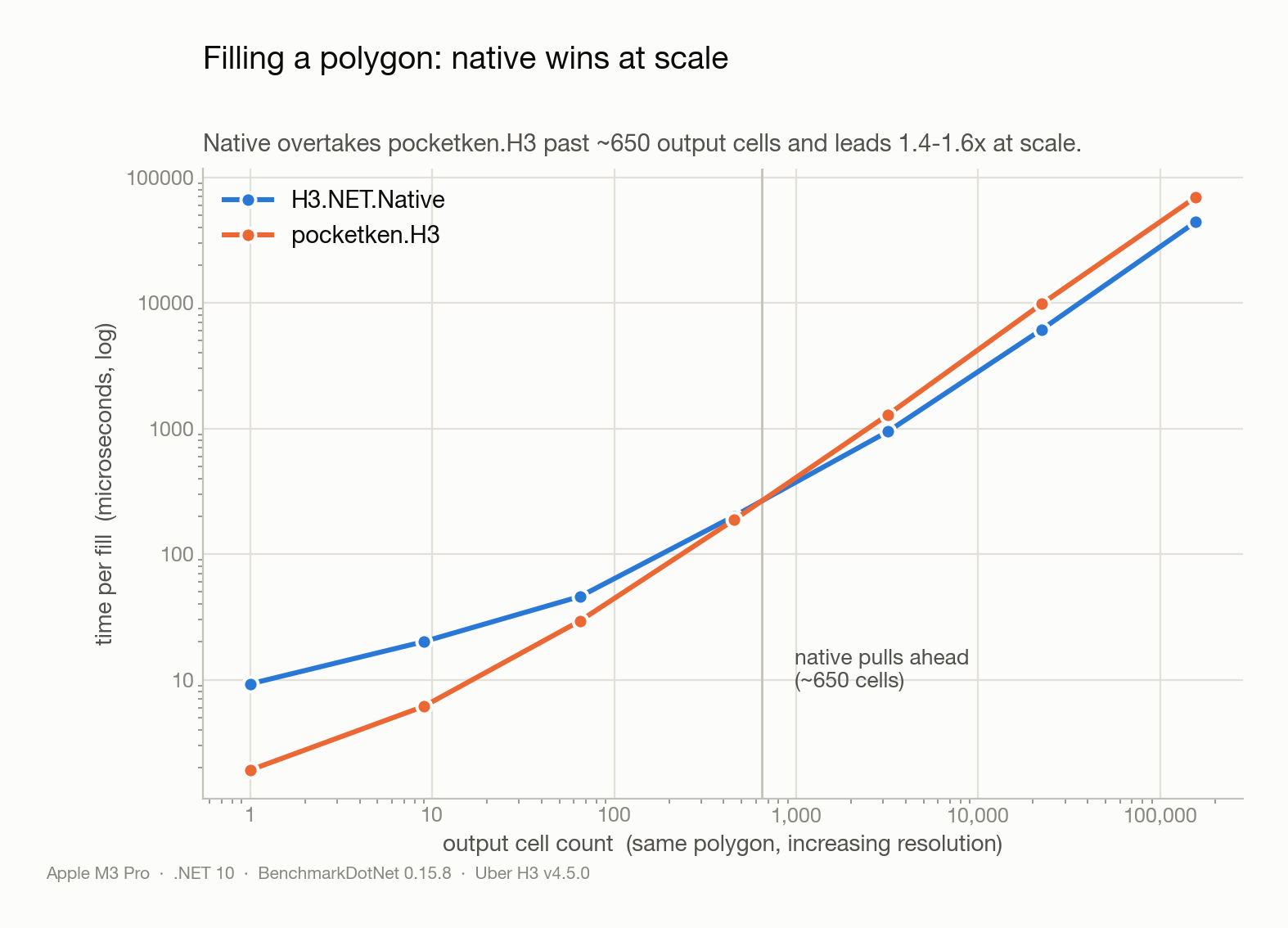
Full methodology, the resolution sweep, per-operation allocation charts, and the correctness/provenance detail: Benchmarks.
Benchmarks are informational, never gate CI (a tiny dry-run smoke runs there to keep them building and runnable), and their shapes may change while the binding is in preview.
Links
- API documentation: https://FOOincognita.github.io/H3.NET.Native/
- Benchmarks
- Uber H3: https://h3geo.org
- Contributing
- Security policy
- Code of conduct
- Changelog
License
Licensed under the Apache License, Version 2.0. Copyright 2026 FOOincognita.
Uber H3 is a separate project, also licensed under Apache-2.0, copyright Uber Technologies, Inc. See https://github.com/uber/h3.
| Product | Versions Compatible and additional computed target framework versions. |
|---|---|
| .NET | net8.0 is compatible. net8.0-android was computed. net8.0-browser was computed. net8.0-ios was computed. net8.0-maccatalyst was computed. net8.0-macos was computed. net8.0-tvos was computed. net8.0-windows was computed. net9.0 was computed. net9.0-android was computed. net9.0-browser was computed. net9.0-ios was computed. net9.0-maccatalyst was computed. net9.0-macos was computed. net9.0-tvos was computed. net9.0-windows was computed. net10.0 is compatible. net10.0-android was computed. net10.0-browser was computed. net10.0-ios was computed. net10.0-maccatalyst was computed. net10.0-macos was computed. net10.0-tvos was computed. net10.0-windows was computed. |
-
net10.0
- No dependencies.
-
net8.0
- No dependencies.
NuGet packages
This package is not used by any NuGet packages.
GitHub repositories
This package is not used by any popular GitHub repositories.