UPnP.Rx
6.0.0
dotnet add package UPnP.Rx --version 6.0.0
NuGet\Install-Package UPnP.Rx -Version 6.0.0
<PackageReference Include="UPnP.Rx" Version="6.0.0" />
<PackageVersion Include="UPnP.Rx" Version="6.0.0" />
<PackageReference Include="UPnP.Rx" />
paket add UPnP.Rx --version 6.0.0
#r "nuget: UPnP.Rx, 6.0.0"
#:package UPnP.Rx@6.0.0
#addin nuget:?package=UPnP.Rx&version=6.0.0
#tool nuget:?package=UPnP.Rx&version=6.0.0
UPnP.Rx






A modern, functional, Rx-based UPnP control point for .NET 10: discover devices, browse their services, call their actions - as observables and immutable records. Includes an IGD port-mapping client with auto-renewing leases.
Discover a device, browse its services, call its actions, watch its state, change its state.
Please star this project if you find it useful. Thank you.
Overview
UPnP.Rx covers the full control-point chain of the UPnP Device Architecture 2.0:
- Discovery (UDA clause 1) - SSDP via SSDP.UPnP.PCL, exposed as observable streams of discovered devices.
- Description (clause 2) - device description documents and SCPDs fetched lazily, parsed into immutable records, cached by
LOCATION+CONFIGID. - Control (clause 3) - SOAP 1.1 action calls with typed results and typed UPnP faults.
- Port mapping - the flagship: find the internet gateway and map ports in one call, with automatic lease renewal.
- Eventing (clause 4, GENA) - subscribe to a service's evented state as an observable:
service.Events()handles SUBSCRIBE/renewal/UNSUBSCRIBE, replays last-known state to late subscribers, and recovers from failures and SEQ gaps automatically. A subscription also watches its device's presence, so a byebye or an unannounced reboot abandons it withSubscriptionCancelledand a reason instead of leaving it silently dead until a renewal fails (UDA 2.0 clause 4.1.1). AV services'LastChangepayloads decode viaUPnP.Rx.Eventing.Av(events.SelectAvChanges()). - Roster -
client.Roster()(inUPnP.Rx.Presence) streams device presence as changes: arrivals, restarts (DeviceRebooted, including UPnP 1.0 devices, which signal one withNLSrather thanBOOTID), description changes under a device that stayed up,CACHE-CONTROL-driven expiry for devices that vanish silently, and byebye departures - with the current roster replayed to late subscribers. Bounded state, built for long-lived apps. Alongside it:Announcements()streams every parsed SSDP envelope undeduplicated (the activity-log feed), andSearchAsync()sends one M-SEARCH burst to solicit fresh responses without resetting anything. - Version claims -
UpnpVersionClaimsreports what a device says about the UDA version it implements in each of the four places UDA 2.0 makes normative (theSERVERheader, the device description, each SCPD, and control responses). The spec names no authority between them, so the claims are kept with their provenance rather than reconciled away, and a device that contradicts itself is visible as exactly that.
Installing
dotnet add package UPnP.Rx
Try it in two minutes
No code needed - clone and run the browser against your own network:
git clone https://github.com/1iveowl/UPnP.rx.git
cd UPnP.rx
dotnet run --project samples/Sample.Browser
FRITZ!Box 7590  [http://192.168.178.1:49000/igddesc.xml]
urn:schemas-upnp-org:device:InternetGatewayDevice:2  (AVM FRITZ!Box 7590)
├─ · urn:schemas-upnp-org:service:WANCommonInterfaceConfig:1
└─ urn:schemas-upnp-org:device:WANDevice:2  (AVM)
   └─ ...
(colored in the terminal; glyphs chosen to render on every platform, including the legacy Windows console)
dotnet run --project samples/Sample.PortMapper finds your router and lists its
port-mapping table; add --map to hold an auto-renewing mapping. Run on the
host, not in a container - and on Windows, pause the built-in "SSDP Discovery"
service first, since it occupies UDP 1900 and keeps clients from seeing
responses (elevated prompt):
net stop SSDPSRV     &REM pause - lets UPnP.Rx receive SSDP
net start SSDPSRV    &REM resume when done
More gotchas under Troubleshooting.
Ever wondered what UPnP devices are on your network?
The dashboard sample answers it live: every device on your LAN, unfolded down to its services and actions. Watch a Sonos change state in real time, drag its volume from the browser, follow the SSDP chatter per device - or invoke any action its SCPD declares, with a form generated from the spec itself.
Leave it running and it becomes a record rather than a snapshot: devices that go
stay listed, grayed, saying whether they announced their departure or simply went
quiet, and when. Restarts are called out, each device shows what UDA version it
claims and flags itself when those claims disagree, and a deep search asks
ssdp:all for the hardware that ignores an ordinary root-device search.
dotnet run --project samples/Sample.Dashboard # on the host, then open http://localhost:5287
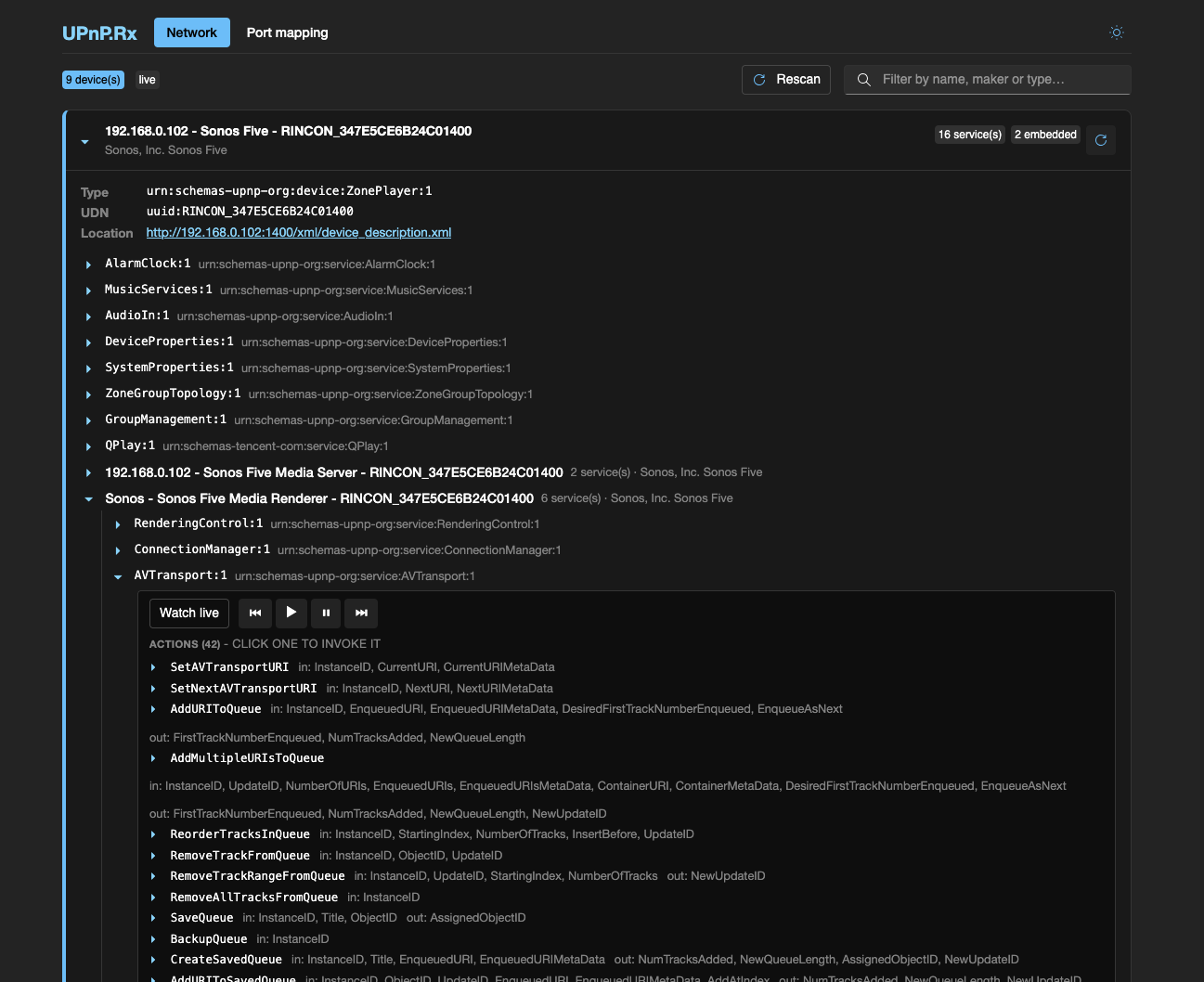
Blazor WebAssembly + FluentUI + ReactiveUI, light and dark - and everything in it is built on the library's public API.
Quick start - port mapping
using UPnP.Rx.PortMapping;

// One line: discover the gateway, map the port, auto-renew the lease.
await using var lease = await PortMapper.AddPortMappingAsync(
    externalPort: 8080, internalPort: 8080, Protocol.Tcp,
    description: "my app", lease: TimeSpan.FromHours(1));

Console.WriteLine($"Mapped external port {lease.Mapping.ExternalPort}");

// Renewal outcomes are an observable - a failed renewal retries, it never throws.
using var events = lease.Events.Subscribe(e => Console.WriteLine($"[lease] {e.Kind}"));
Disposing the lease with await using removes the mapping from the router. Sync Dispose() is the abrupt path: renewal stops and the finite lease simply expires on the router - you never leak a mapping forever.
More control:
await using var gateway = await PortMapper.DiscoverGatewayAsync();

Console.WriteLine(await gateway!.GetExternalIPAddressAsync());
Console.WriteLine((await gateway.GetStatusInfoAsync()).IsConnected);        // WAN up?

var taken = await gateway.GetSpecificPortMappingEntryAsync(8080, Protocol.Tcp);
Console.WriteLine(taken is null ? "8080 is free" : $"8080 -> {taken.InternalClient}");

await foreach (var m in gateway.GetPortMappingsAsync())
    Console.WriteLine($"{m.Protocol} {m.ExternalPort} -> {m.InternalClient}:{m.InternalPort}");
Rx-first? The scalar discovery is FirstAsync sugar over an observable - subscribe to the stream itself (multi-homed networks can have several gateways):
using var upnp = new UpnpClient(myAddresses);
using var gateways = PortMapper.DiscoverGateways(upnp).Subscribe(g =>
    Console.WriteLine(g.Device.Description.FriendlyName));
Quick start - the general client
using UPnP.Rx;

using var upnp = new UpnpClient(ipAddress);            // your local interface address(es)

using var subscription = upnp
    .DiscoverDescribedDevices()                        // SSDP + description fetch, cached
    .Where(d => d.HasService("WANIPConnection"))
    .SelectMany(async gateway =>
    {
        var wan = gateway.Service("WANIPConnection");
        return await wan.InvokeAsync("GetExternalIPAddress");
    })
    .Subscribe(result => Console.WriteLine(result["NewExternalIPAddress"]));
(DiscoverDevices() gives the raw discovery stream - SSDP envelopes with lazy
GetDescriptionAsync() - when you want control over the description step.)
DiscoverDevices(searchTarget, mx)sends an M-SEARCH on subscription and mergesssdp:aliveannouncements, deduplicated per subscription. The default target isupnp:rootdevice; configure it viaUpnpClientOptions.DefaultSearchTargetor per call (SearchTargets.All,SearchTargets.DeviceType("MediaRenderer"), …).DeviceLost()streamsssdp:byebyenotices.Service(...)matches by full service type URN, service id, or bare type name ("WANIPConnection"matches any version), across the whole embedded-device tree.InvokeAsyncthrowsUpnpActionExceptioncarrying the device'sUpnpErroron SOAP faults.
Behavior notes
- Strict in what we send, lenient in what we accept. Envelopes and headers follow the UDA 2.0 letter (including the quoted
charset="utf-8"); parsers tolerate wrong namespaces, wrong casing, whitespace inside identifiers, unescaped ampersands, and UPnP 1.0-eraURLBase(which UDA 2.0 requires control points to honor). A document only fails to parse when it identifies nothing. - Pipelines never die from one bad message. Degraded announcements are surfaced (
DiscoveredDevice.HasParsingError), unusable ones are dropped with a log note;OnErroris reserved for the source itself dying. - One clock. Every timeout and renewal runs on
UpnpClientOptions.TimeProvider(defaultTimeProvider.System) - injectFakeTimeProviderin tests and drive renewals deterministically. - Disposal.
DisposeAsyncis the graceful path: port-mapping leases delete their mappings, and a client with live event subscriptions sends UNSUBSCRIBE before releasing its resources; disposing anEvents()subscription likewise says goodbye from the engine's own teardown. SyncDisposereleases resources without network goodbyes - finite lease and subscription timeouts make that safe (the device expires them on its own). - Spec review. Clause 2/3 and clause 4 behavior was audited against the UDA 2.0 text; the findings live in plan/uda2-compliance-review.md and plan/uda2-clause4-compliance-review.md.
Where UPnP.Rx fits
The .NET ecosystem has several UPnP libraries, each with real strengths. Mono.Nat and Open.NAT made router port mapping accessible to a generation of .NET apps - and Mono.Nat also speaks NAT-PMP, which UPnP.Rx deliberately leaves to it. Rssdp is a focused, actively maintained SSDP implementation with device-side publishing. Waher.Networking.UPnP brings UPnP into a much broader IoT framework. If one of those matches your needs and target frameworks, it's a fine choice.
UPnP.Rx's place is the full control-point chain in one standalone package - discover → describe → control - for modern .NET:
- an Rx + immutable-records API (device presence and lease renewals as observables),
async/IAsyncEnumerableergonomics, one testable clock (TimeProvider) throughout,- spec-audited UDA 2.0 behavior with deliberately lenient parsing of real-world devices,
- port mapping with auto-renewing leases as the flagship, and
- near-zero dependencies on
net10.0.
At a glance:
| Library | Focus | UPnP.Rx in comparison |
|---|---|---|
| Mono.Nat | Port mapping (UPnP IGD + NAT-PMP) | UPnP only, but adds description/control beyond IGD, an Rx + async API, and auto-renewing leases |
| Open.NAT | Port mapping (UPnP IGD) | The full discover → describe → control chain, under active development |
| Rssdp | SSDP discovery + device-side publishing | Picks up where discovery ends: from the LOCATION URL to description and control |
| Waher.Networking.UPnP | UPnP within the Waher IoT framework | Standalone package, near-zero dependencies, net10.0-idiomatic |
Known boundary: UPnP.Rx speaks UPnP only - for NAT-PMP/PCP, Mono.Nat has you covered. Planned next: a live device roster with expiry (4.1).
Troubleshooting
No gateway / no devices found?
UPnP is usually disabled on gateways by default - and that only affects the port-mapping features; discovery and control of other devices (TVs, speakers, hubs) work regardless. On UniFi (UDM/UXG/Express/USG - they run
miniupnpd): Settings → Internet → your WAN → UPnP (older controllers: Settings → Services → UPnP), primary WAN only. Other routers/firewalls hide the toggle under NAT, port forwarding or "media sharing" settings. Security note: the IGD control endpoint is LAN-side only by design - nothing on the WAN can reach it - but it has no authentication, so any LAN device can open WAN ports for itself. Enable it consciously; the mapping table (dashboard orSample.PortMapper) shows exactly what has been opened, and UPnP.Rx's own mappings use finite auto-renewed leases that expire on their own.Containers can't multicast: Docker, WSL and devcontainers won't see SSDP. Run on the host.
On Windows, the built-in "SSDP Discovery" service (
SSDPSRV) occupies UDP 1900 and keeps other clients from seeing responses. Pause it while discovering (elevated prompt), and start it again afterwards:net stop SSDPSRV &REM pause - lets UPnP.Rx receive SSDP net start SSDPSRV &REM resume when doneVPNs commonly capture the default route or block multicast - try disconnected.
AP isolation / IGMP snooping on some networks filters SSDP - try wired.
Sample.Browseranswers "is anything visible from this machine?" in one command;Sample.PortMapperprints the interfaces it searched from.Pass an
ILoggerviaUpnpClientOptions.Loggerto see dropped announcements and skipped descriptions.
Eventing (Events()) trouble?
- The callback listener needs an inbound port. Subscribing starts a small
HTTP listener for the device's NOTIFYs - expect a firewall prompt on first
use and allow it. By default the port is ephemeral; set
UpnpClientOptions.EventCallbackPortto a fixed port if you need a firewall rule. SubscriptionRefusedwith HTTP 404/405/410/501: some devices advertise aneventSubURLfor services that are not actually evented - either the endpoint refuses the method (405/501, e.g. Sonos'sQPlay:1) or the URL is a placeholder that plain doesn't exist (404/410, e.g. the/ssdp/notfoundstub on Sonos'sSpeakerGroup:1pseudo-device). Such a refusal contradicts the device's own description and is permanent, so instead of retrying forever the stream reports the reason as aSubscriptionRefusedevent and then terminates withOnError. Transient failures (timeouts, 5xx during a reboot, SEQ gaps) keep the auto-recovery behavior.
Advanced
Bring your own SSDP control point (for interception, custom sockets, or tests) and/or HttpClient:
var controlPoint = new ControlPoint(myPreparedInterfaces);   // SSDP.UPnP.PCL
using var upnp = new UpnpClient(controlPoint, myHttpClient, options, addresses);
Tests fake the network at two seams: IControlPoint (drive parsed SSDP messages from a Subject) and HttpMessageHandler (serve descriptions and SOAP). Multicast is never required. For your own unit tests, the control surfaces have interfaces - IUpnpService, IInternetGateway, IPortMappingLease - so application code can be tested against fakes without any network replay.
SCPD-driven argument marshalling - validate and order in-arguments before invoking:
var scpd = await wan.GetScpdAsync();
var args = scpd.ValidateAndOrderArguments("AddPortMapping", myArguments);
// args.IsSuccess ? await wan.InvokeAsync("AddPortMapping", args.Value) : report args.Error
Build-time checks
UPnP.Rx ships analyzers inside the package - no extra reference, nothing to install. They report mistakes this library can see at build time instead of letting a router, or a silent default, answer for them.
The design rule is that a rule is the last resort. Most of what an analyzer could have
checked here is instead unrepresentable: ports are ushort, Protocol is an enum, MX is
MxSeconds, so the compiler refuses the bad value without anyone writing a diagnostic. What
remains are range and resource mistakes the type system cannot express.
Each rule reports literals and compile-time constants only. A computed value is left alone deliberately - the budget is zero false positives, and a run-time guard covers the rest. A rule you learn to suppress takes the quiet ones with it.
Turning one off - .editorconfig, <NoWarn> and #pragma warning disable all work:
dotnet_diagnostic.UPNPRX001.severity = none
ExcludeAssets="analyzers" does not work; it has been measured three times, in three
repositories, and never suppressed anything.
<a id="upnprx001"></a>
UPNPRX001 - a port-mapping lease outside the range IGD allows
What it catches. A lease argument to AddPortMappingAsync, AddAnyPortMappingAsync or
PortMapper.AddPortMappingAsync, or a PortMappingEntry.LeaseDuration, that is negative or
above 604 800 seconds (7 days).
Why it matters. IGD carries the lease as a ui4 of seconds, ranged 0-604800 by the
standardized service template, where zero means indefinite. That makes the negative case
genuinely dangerous rather than merely wrong: .NET's floating-point to integer conversion
saturates, so (uint)(-5.0) is 0 - and asking for a lease five seconds in the past used to
ask the router for a permanent port forward, with no exception and no log line.
// Reported: silently became a permanent mapping before 6.0.0.
await using var lease = await gateway.AddPortMappingAsync(
    8080, 8080, Protocol.Tcp, "my app", TimeSpan.FromSeconds(-5));
How to fix it. Pass a lease inside the range, or say what you meant:
LeaseDurations.Maximum for the longest IGD allows, LeaseDurations.Indefinite for a mapping
that never expires. Two code fixes offer exactly those - and "indefinite" is offered only
for a negative lease, because someone who wrote 30 days meant "a long time", not "forever".
<a id="upnprx002"></a>
UPNPRX002 - a UpnpClientOptions value outside its documented range
What it catches. A non-positive DescriptionTimeout, ActionTimeout or
RosterExpiryFallback, or an EventSubscriptionTimeout under one second - in an object
initializer or a with expression.
Why it matters. A non-positive timeout cancels immediately, so every description fetch or
SOAP call fails before it starts. A sub-second EventSubscriptionTimeout composes
TIMEOUT: Second-0, which is malformed GENA (UDA 2.0 clause 4.1.2); a negative one composes
Second--5.
// Reported: every SOAP call would fail before it started.
var options = new UpnpClientOptions { ActionTimeout = TimeSpan.Zero };
How to fix it. Use a positive duration. Note what is not reported: a short but positive
timeout. ActionTimeout = TimeSpan.FromMilliseconds(100) may be exactly right on a fast LAN,
and this rule does not second-guess it.
No code fix - there is no defensible value to substitute for your intent.
<a id="upnprx003"></a>
UPNPRX003 - the port mapping's lease is discarded
What it catches. Awaiting a port-mapping call as a bare statement, or assigning it to _,
so the returned lease goes nowhere.
Why it matters. The lease owns three things: the mapping on the router, a renewal loop
that runs for the life of the process, and - for the PortMapper one-liner - the discovery
client and its sockets. Dropping it leaks all three and leaves an open port with nothing left
to close it. CA2000 does not cover this: its analysis tracks object creations, not a
method's return value.
// Reported: the mapping is never removed.
await gateway.AddPortMappingAsync(8080, 8080, Protocol.Tcp, "my app", TimeSpan.FromHours(1));
How to fix it. Hold the lease, and dispose it asynchronously - the code fix does this:
await using var lease = await gateway.AddPortMappingAsync(
    8080, 8080, Protocol.Tcp, "my app", TimeSpan.FromHours(1));
await using, not using: the async path deletes the mapping from the gateway, while the
sync path only stops renewing and lets it lapse. Both are legitimate - Dispose is the
documented abrupt path - which is why a sync using is not reported.
<a id="upnprxgen001"></a>
UPNPRXGEN001 - the SCPD document a generated wrapper names was not supplied
Reported by the source generator below when [ScpdService("X.scpd.xml")] names a document
that is not among the compiler's AdditionalFiles. Without it you would get no generated
members and a pile of "no such method" errors at every call site instead of the actual cause.
Trimming and native AOT
The library declares IsTrimmable and IsAotCompatible, and CI holds it to the claim rather
than taking its word: every build publishes a sample as a native AOT binary and runs it.
ILC staying quiet only proves the managed side is clean; it does not prove the result starts.
That is affordable because nothing here is discovered at run time - no reflection, no
serializers, no DI scanning. XML is LINQ to XML throughout (XDocument/XElement), regexes
are [GeneratedRegex], log messages are [LoggerMessage]. Publishing your own app is the
ordinary command:
dotnet publish -c Release -r linux-x64 --self-contained -p:PublishAot=true
One thing worth knowing, because its failure looks like something else entirely: publish for
the architecture you are on. Asking for -r linux-x64 on an arm64 machine is a cross-compile,
and the native linker rejects flags meant for another target with an error that reads exactly
like a missing toolchain. On Linux you also want clang and zlib1g-dev installed, which is
what Microsoft documents as the prerequisite.
Typed service wrappers from an SCPD (source generator)
Every action name, argument name and out-argument name in UPnP is a string that a device validates by returning a SOAP fault. An SCPD document already describes all of them, so the package generates the typed wrapper instead:
[ScpdService("WANIPConnection1.scpd.xml")]
public sealed partial class WanIpConnection;
with the document handed to the compiler:
<ItemGroup>
  <AdditionalFiles Include="Scpd/WANIPConnection1.scpd.xml" />
</ItemGroup>
What it emits, over the same IUpnpService.InvokeAsync everything else uses: a
constructor taking the service, one …Async method per action with typed parameters, a nested
record per action that has out-arguments, and the document's own allowedValueRange and
allowedValueList checked before anything reaches the network.
var wan = new WanIpConnection(service);
var status = await wan.GetStatusInfoAsync();          // typed result record
await wan.AddPortMappingAsync("", 8080, "TCP", 8080, "192.168.1.42", true, "my app", 3600);
What it does not promise. The wrapper describes the document, not the device. A
checked-in SCPD is the standardized service template, and real devices deviate from it - which
is why this library's parsers are lenient. A generated method compiling proves the template
declares that action; it proves nothing about the box on your network, which can still answer
with a UpnpActionException.
Seeing the output. Set <EmitCompilerGeneratedFiles>true</EmitCompilerGeneratedFiles> and
look under obj/. Keep the path inside obj/ - anywhere else in the project directory gets
globbed back in as compile input and every generated file is compiled twice.
Generated members are public API with no deprecation path. Renaming an action in the document renames a method for everyone who called it. UPnP.Rx holds its own generated surface to the public-API ledger for exactly that reason.
Samples
samples/Sample.PortMapper- discover the gateway, print the external IP and mapping table;--mapholds an auto-renewing mapping.samples/Sample.Browser- discover everything on the network and dump device trees and services.samples/Sample.Eventing- subscribe to any evented service and watchUpnpEvents live (the manual test protocol lives in the 4.0 plan).samples/Sample.Dashboard- a Blazor + FluentUI dashboard: live device cards that appear and vanish as devices join and leave the network - Rx end to end. See below.
All need a real network (multicast does not work in containers).
Running the dashboard
One command runs everything - the server hosts the WebAssembly client, so there is nothing separate to start:
dotnet run --project samples/Sample.Dashboard
Then open http://localhost:5287 (or the HTTPS URL from the console output).
How it fits together: the server process is the only thing touching the
network - it owns the UpnpClient, does the SSDP listening (which the browser
sandbox cannot), and streams DeviceUp/DeviceGone over a SignalR hub that
replays the current roster to every newly connected browser. The client runs
as WebAssembly in your browser: SignalR feeds a DynamicData cache, bound
through a ReactiveUI view model into FluentUI cards. Open the page from any
machine that can reach the server - phones included.
The usual multicast rules apply to the server process: run it on a real
host (not a container), and on Windows pause the "SSDP Discovery" service
first (net stop SSDPSRV, elevated - see Troubleshooting).
The dashboard itself repeats these hints when nothing shows up after a few
seconds of scanning.
Two pages: Network (live device browser with service drill-down) and Port mapping (gateway status, the mapping table, add/delete with auto-renewing leases and a live renewal-event feed). A word of caution: the port-mapping page lets any browser that can reach the server modify the router, and the sample has no authentication - treat it as a LAN tool.
About this project - the role of AI
The work leading to UPnP.Rx goes back more than a decade - through HttpMachine.PCL, SimpleHttpListener.Rx and SSDP.UPnP.PCL, each hand-built and refined over years of real-world use.
UPnP.Rx is the first library in the family built with AI assistance from the very first commit.
I still write code, and I review what the AI produces. For a library of this size, resting on this much prior work, AI made the building of it much easier - but it could not have created it by itself. I set the direction, settled the design decisions, and reviewing the generated code sometimes meant demanding fundamental changes; even those, though, were far faster to refactor with AI in the loop.
What did not change is the bar: the project plan, the real-life testing across various platforms, the settled policies (time model, disposal model, Rx rules), the UDA 2.0 compliance review and an adversarial pre-release code review are all in this repo - the same attention to detail and focus as the siblings over the past 10 years, applied faster.
Everything that steered the work ships with the repo, on purpose: the agent instructions (CLAUDE.md / AGENTS.md) and the full plan, decision record and reviews under plan/. For transparency and for anyone who wants to contribute.
If there is one lesson from building this way, it is that getting specs right is the key - the quality of what AI produces tracks the quality of the plan and the rules set up front. This code wasn't "vibe-coded" it was managed and directed, with the AI as a tool.
Upgrading from 5.x
Every break is the same idea: a value the type could not express honestly now has a type that can. Each fix is one line, and the compiler finds all of them.
mx is MxSeconds, not TimeSpan. MX is whole seconds on the wire and UDA 2.0 floors
it at 1, so TimeSpan could express values the protocol cannot carry - TimeSpan.FromMilliseconds(500)
used to truncate to MX: 0 and go out silently.
// 5.x
client.DiscoverDevices(mx: TimeSpan.FromSeconds(3));
var options = new UpnpClientOptions { DefaultMx = TimeSpan.FromSeconds(3) };

// 6.0
client.DiscoverDevices(mx: new MxSeconds(3));
var options = new UpnpClientOptions { DefaultMx = new MxSeconds(3) };
The type enforces the floor; the ceiling UDA merely recommends is reported by SSDP001 on
your own literal, at your own call site. Same for SearchAsync and DiscoverDescribedDevices.
EventCallbackPort is a ushort. 0 still means "bind an ephemeral port".
var options = new UpnpClientOptions { EventCallbackPort = 49152 }; // int literal still fine
A port mapping's lease and internal port are nullable. A gateway that reports nothing used
to read as TimeSpan.Zero, which is IGD's encoding for never expires - so silence looked
like a promise of permanence.
// 5.x - "0" meant both "indefinite" and "the gateway told us nothing"
TimeSpan lease = mapping.LeaseDuration;

// 6.0 - three states
mapping.LeaseDuration switch
{
    null => "the gateway did not say",
    { Ticks: 0 } => "never expires",
    { } finite => $"expires in {finite}"
};
Out-of-range values now throw instead of being sent. A negative lease used to saturate to
0 on the wire and ask the router for a permanent port forward. AddPortMappingAsync and
the UpnpClientOptions durations now reject what they cannot honestly carry, and the
UPNPRX001/UPNPRX002 analyzers report the literal ones before you run anything. If you were
passing a computed duration that could go negative, clamp it - see
Build-time checks.
GenaHeaders.ComposeTimeout refuses anything under a second, rather than composing
Second-0 or Second--5. Only relevant if you call it directly.
SSDP.UPnP.PCL moves to 10.0, which splits its message types into what you send and what
you receive (Notify/ReceivedNotify, MSearchResponse/ReceivedMSearchResponse) and makes
an M-SEARCH a MulticastMSearch. UPnP.Rx surfaces USN, ST and Server from that package,
which are unchanged - you only touch this if you use its API directly or fake IControlPoint
in your own tests.
Upgrading from 4.x
One breaking change, and it is the point of the release: a device's boot identity is
no longer a bare number, because a uint cannot say "the device sent nothing" - and
the UPnP 1.0 installed base sends nothing.
// 4.x - 0 meant both "the device said 0" and "the device said nothing"
if (device.BootId != previous.BootId) { /* rebooted? maybe. */ }

// 5.0 - three states, and one question with one answer
if (device.BootSignature.IndicatesRebootSince(previous.BootSignature)) { /* rebooted. */ }

device.BootSignature.BootId    // uint?   - BOOTID.UPNP.ORG, null when not sent
device.BootSignature.Nls       // string? - the UPnP 1.0 signature, when that is what it sends
device.BootSignature.IsKnown   // false   - reboots are undetectable for this device
Alongside it: Announcement.MaxAge is TimeSpan? (null when no usable lifetime was
announced, TimeSpan.Zero when the device genuinely said zero), and the presence types
moved to UPnP.Rx.Presence - RosterChange, Announcement and friends need that
using. Everything else is additive.
Version history
| Version | Notes |
|---|---|
| 6.0.0 | Breaking. Build time instead of run time. The package now ships analyzers and a source generator - no extra reference. Three rules: UPNPRX001 (a port-mapping lease outside IGD's 0-604800 s; a negative lease used to saturate to zero and silently ask the router for a permanent forward), UPNPRX002 (a UpnpClientOptions duration outside its documented range), UPNPRX003 (the lease from a port-mapping call discarded, so nothing ever removes the mapping - CA2000 does not catch it). Most candidate rules were deleted instead of written, by making the state unrepresentable: mx becomes MxSeconds (the UDA floor is now a type invariant and the ceiling is reported by SSDP.UPnP.PCL's own SSDP001 at your call site), EventCallbackPort becomes ushort. A new SCPD source generator turns a checked-in service description plus [ScpdService] into typed action methods with the document's own range checks. PortMappingEntry.LeaseDuration and its ports become nullable, so a gateway that reports nothing stops reading as "this mapping never expires". Rides SSDP.UPnP.PCL 10.0 (send/receive message split, MulticastMSearch, MxSeconds) and SimpleHttpListener.Rx 7.6 - and fixes a bug that upgrade exposed: a USN whose entity part cannot be parsed is now delivered rather than killing the discovery stream. |
| 5.0.0 | Breaking. Absence is now representable - an optional field a device did not send is no longer reported as a value it did not send. DiscoveredDevice.BootId (uint) becomes BootSignature, carrying BOOTID.UPNP.ORG, the UPnP 1.0 NLS signature, or neither, so a UPnP 1.0 device that reboots is finally detected and one that announces no boot identity is never mistaken for a value of 0; Announcement.MaxAge becomes TimeSpan?. Event subscriptions now follow their device's presence: a byebye or an unannounced BOOTID change abandons the subscription with SubscriptionCancelled and a reason, rather than leaving it silently dead until a renewal fails minutes later (UDA 2.0 clause 4.1.1). ssdp:update is honoured, so a multi-homed device changing address is no longer mistaken for a restart. New UpnpVersionClaims records what a device claims about its UDA version in each of the four places the spec makes normative, keeping the provenance rather than reconciling silently. Presence types move to UPnP.Rx.Presence; IUpnpService gains VersionClaims; new LocalNetwork.IPv4Addresses(); all logging source-generated. Dashboard: version badges with a disagreement flag, restart markers, departed devices retained and grayed, a deep ssdp:all search. Rides SSDP.UPnP.PCL 9.1 (nullable BOOTID and advertisement lifetime, NLS, corrected SERVER version parsing, IAsyncDisposable) and SimpleHttpListener.Rx 7.4. |
| 4.2.0 | Structural release: IUpnpClient (mock/decorate the client), public-API ledger (PublicApiAnalyzers - surface changes now fail the build), the description cache extracted and directly unit-tested, engine/HTTP-exchange/test-helper dedups (EngineSource, TimedExchange, TestKit), decision ledger (plan/DECISIONS.md), CI trimmed-publish smoke and symbol packages on GitHub releases. No behavioral changes. |
| 4.1.0 | Device roster (Roster(): presence changes with replay, max-age expiry, reboot detection and lazy description self-healing), Announcements() + SearchAsync() (activity feed and solicitation), typed AV LastChange decoding (UPnP.Rx.Eventing.Av), TryService, trim/AOT-clean, memory audit with soak tests; dashboard: generic SCPD-driven action invocation with confirm-step, volume/mute/transport quick controls that follow the device live, and a per-device SSDP activity log. |
| 4.0.0 | GENA eventing: service.Events() as a shared observable with automatic renewal, SEQ-gap recovery and last-known-state replay; permanent SUBSCRIBE refusals surfaced as SubscriptionRefused (devices advertise eventSubURLs they don't honor - Sonos QPlay/SpeakerGroup); clause 4 compliance review; dashboard live-event watching and rescan; Sample.Eventing. Rides SSDP.UPnP.PCL 8.0 (lazy Rx lifecycle) and SimpleHttpListener.Rx 7.3 (packet-info local endpoints, reliable restarts). |
| 3.0.0 | First release of UPnP.Rx: discovery → description → control, IGD port mapping with auto-renewing leases, SCPD-driven argument validation, and three samples including a Blazor + FluentUI live dashboard. Versioned to reflect its lineage - it builds on years of learnings from SSDP.UPnP.PCL, SimpleHttpListener.Rx and HttpMachine.PCL rather than starting from scratch. |
Why .NET 10?
UPnP.Rx is net10.0-only, like its siblings SSDP.UPnP.PCL and SimpleHttpListener.Rx: modern C# records for the immutable model, TimeProvider throughout for testable time, and no legacy TFM baggage. If you need older targets, the underlying protocol layers remain available separately.
License
MIT - see LICENSE.
A thank-you
Christian Geuer-Pollmann didn't just read this library - he rebuilt the entire control point in Elixir on OTP, tests and samples included, and then wrote up what the two designs teach each other: The same UPnP control point in .NET Rx and Elixir OTP. It walks through how a graph of streams, gates and disposables becomes a topology of supervised processes - same protocol rules, different concurrency model - and is generous about both. If you have ever wondered what this codebase would look like on the BEAM, there is no better read. Thank you, Christian!
| Product | Versions Compatible and additional computed target framework versions. |
|---|---|
| .NET | net10.0 is compatible. net10.0-android was computed. net10.0-browser was computed. net10.0-ios was computed. net10.0-maccatalyst was computed. net10.0-macos was computed. net10.0-tvos was computed. net10.0-windows was computed. |
-
net10.0
- Microsoft.Extensions.Logging.Abstractions (>= 10.0.10)
- SimpleHttpListener.Rx (>= 7.6.0)
- SSDP.UPnP.PCL (>= 10.0.0)
- System.Reactive (>= 7.0.0)
NuGet packages
This package is not used by any NuGet packages.
GitHub repositories
This package is not used by any popular GitHub repositories.